This course is about using AI to find, check and remember information. Finding means asking good questions and getting to useful sources quickly. Checking means confirming that what the assistant says is actually supported by something you can open and read. Remembering means turning what you have learned into notes, flashcards and practice that last beyond the night before an exam or a meeting. You do not need any technical background. You need a chat assistant, a willingness to click on links, and about an hour and three quarters spread across a few sittings.
By the end you will produce one real piece of work: a one-page sourced brief on a topic you choose, plus a verification log that records every important claim, where you checked it and how confident you are. Along the way you will also build a reusable prompt kit for research questions, citation audits, PDF summaries, fact-checks, flashcards and revision plans. Every lesson ends with something you can run straight away on your own material.
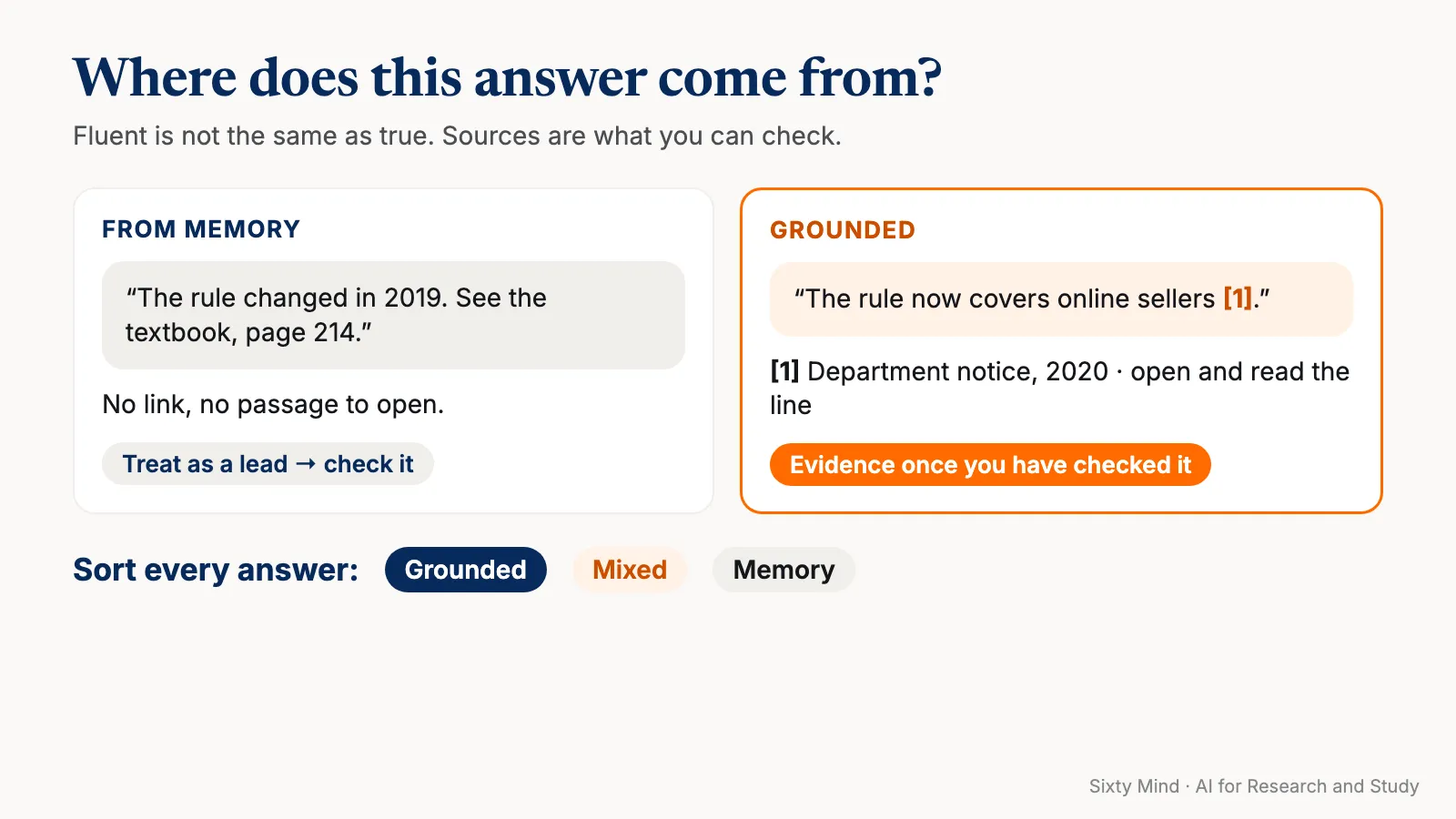
A chat assistant writes by predicting which words are likely to come next, based on patterns learned from a huge amount of text. That is why its answers sound fluent and well organised. But fluent is not the same as true. When the assistant has seen a fact many times, the prediction is usually right. When the fact is rare, very specific or recent, the model may fill the gap with something that merely sounds right: a plausible date, a believable statistic or a citation stitched together from real-looking parts.
These made-up details are called hallucinations. They are more likely when you ask for exact numbers, page references, quotes, legal or medical specifics, or anything about small organisations and local events. A second problem is outdated answers. A model learns from data collected up to a certain point, so rules, prices, rankings and news can change after that. Assistants with web search reduce this risk, but they can still pick a weak page, misread it or mix an old source with a new one.
From now on, sort every AI answer into three buckets. Grounded answers point to a source you can open, and the source says what the answer says. Memory answers come from the model alone; treat them as useful leads, not facts. Mixed answers have some cited parts and some uncited parts, which is the most common case and the easiest to be fooled by. Your job is not to distrust AI. It is to know which bucket you are in before you repeat something in an essay, an exam answer or a report to your manager.
One safety habit belongs here too. Before you paste anything into an AI tool, ask whether you would be comfortable if it were stored on someone else's server. Never paste passwords, ID numbers, bank details, private health information, other people's personal data, or confidential work documents unless your organisation has approved that tool for that data. For study, your own notes and published material are usually fine. For work, check your company policy first.