
An AI agent can look impressive in a demonstration and still disappoint the moment real work arrives. A carefully chosen example may contain clean information, a helpful user, and no awkward exceptions. Production supplies all three in reverse. Messages are incomplete, documents disagree, connected services time out, permissions change, and people expect the system to explain what it has done.
That gap does not mean agents are useless. It means a demonstration answers the wrong question. The important question is not whether an agent can complete one successful run. It is whether a team can recognise a bad run quickly, contain its effects, understand the cause, and improve the process without guessing.
What counts as a production failure?
A failure is more than a completely wrong answer. An agent fails when it produces an unsafe action, hides uncertainty, uses the wrong source, breaks a promised format, exceeds its authority, or leaves a person unable to reconstruct what happened. A run that eventually reaches the right result may still be a failure if it takes so long to repair that the process costs more than manual work.
Consider a support agent that prepares replies from a company knowledge base. It may invent a policy, select an old document, omit an important condition, or send a draft before a reviewer has seen it. Each problem has a different cause and requires a different check. Calling all of them “hallucinations” encourages a team to change the prompt when the real fault lies in the source data, tool permission, or approval design.
A useful incident record begins with the outcome, not a theory. Save the user request, the information retrieved, the instructions presented to the model, the tools it called, the result returned, and the point at which a person intervened. Without that trail, teams tend to argue from memory.
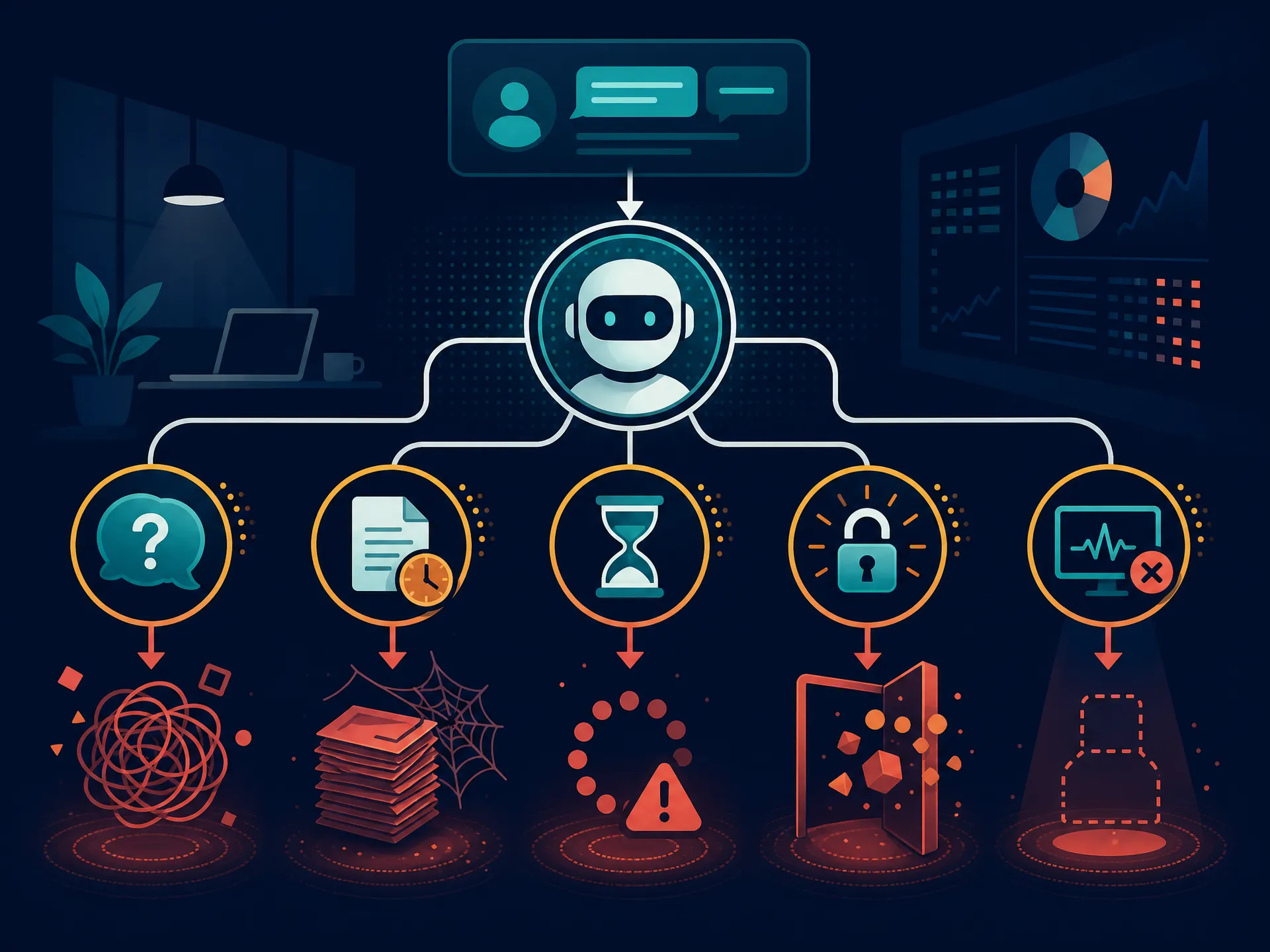
Many production problems come from the workflow around the model rather than from the model alone.
Failure pattern 1: The agent receives an unclear job
Many production problems begin before a model is selected. A request such as “look after new leads” contains several decisions about classification, priority, timing, ownership, and communication. The system may appear inconsistent because the business never defined what a successful run should produce.
Turn the assignment into an observable contract. Define the trigger, the information the agent may use, the result it must produce, the actions it must refuse, and the point at which a person takes over. “Read a new enquiry, identify its topic, and prepare a draft for review” is easier to test than “manage enquiries”.
The early check
Ask three people to describe the agent’s job without showing them the instructions. Compare their answers. If they disagree about the starting event, final output, or human responsibility, pause the build. The problem is not yet a model problem; it is a specification problem.
Failure pattern 2: The source material cannot support the answer
An agent can only produce a dependable answer when the information behind it is current, relevant, and easy to retrieve. A large document collection may look valuable, but it can contain superseded policies, duplicate files, conflicting dates, and unrelated material. More context does not automatically improve accuracy.
Keep a register for approved documents. Record each document’s title, owner, review date, and purpose. Remove old versions before testing retrieval. Ask the agent to identify the source it used, not merely to provide a confident answer. If no approved source supports the response, the correct result may be a question for a person.
Begin with questions that have known answers. Use one question answered by a single fact, one requiring two documents, one based on an outdated fact, and one the collection cannot answer. A strong system should answer the first two, avoid the outdated version, and acknowledge the missing information.
The early check
Re-run the same test set whenever the source collection changes. Record whether the answer was correct, whether the cited source was appropriate, and whether the system admitted uncertainty. A prompt adjustment cannot repair a missing or contradictory policy.
Failure pattern 3: The tools work separately but fail together
A tool chain may work in isolated tests and still fail when the steps are connected. A field may be renamed, a service may return a partial response, or a retry may create the same task twice. The model’s reasoning is only one part of a multi-step system.
Test each tool with valid, incomplete, delayed, and rejected inputs. Then test the handoff between tools. Give every important action an identifier so a reviewer can tell whether a second attempt repeated the first action or created a new one. Design retries carefully; repeating a search is different from repeating a payment or sending a second customer message.
The early check
Disconnect one service during a test run. The agent should report the failure, preserve the original request, and offer a safe handover. It should not invent a successful result to keep the conversation moving. Run the same test with a slow response and a malformed field.
Failure pattern 4: Permissions are wider than the task
A small workflow can become dangerous when it receives broad access “for convenience”. An agent that only prepares internal drafts rarely needs permission to delete records, approve spending, change account settings, or contact customers without review. Excess access increases the consequences of an ordinary mistake and gives an attacker more to exploit.
Use separate credentials where possible. Give the agent the smallest useful set of actions and restrict the data it can read. Place approval before irreversible operations. Log who authorised the connection, which tool was called, and what information the tool returned.
OWASP’s agentic-AI guidance tells teams to anticipate misuse and add safeguards before an autonomous system goes live. [1] NIST’s framework gives teams four jobs: govern the system, map its risks, measure its behaviour, and manage problems throughout its life. [2]
The early check
List every action the agent can take and mark each as read, prepare, change, send, or delete. At launch, grant only the permissions required for the defined job. Try an unapproved action and confirm that the system refuses it, records the attempt, and sends the case to a person.
Failure pattern 5: The test set is too easy
A clean test set can hide the conditions that break an agent in daily use. Teams often test a complete form, a polite message, and a document with the expected wording. Real inputs include abbreviations, attachments, contradictory statements, missing fields, unusual names, and requests that should not be processed at all.
Build tests around boundaries rather than average cases. Include incomplete requests, duplicate submissions, empty attachments, unexpected languages, ambiguous dates, and instructions hidden inside uploaded documents. Ask what the agent should do when two approved sources disagree. The best answer may be to stop and request a review.
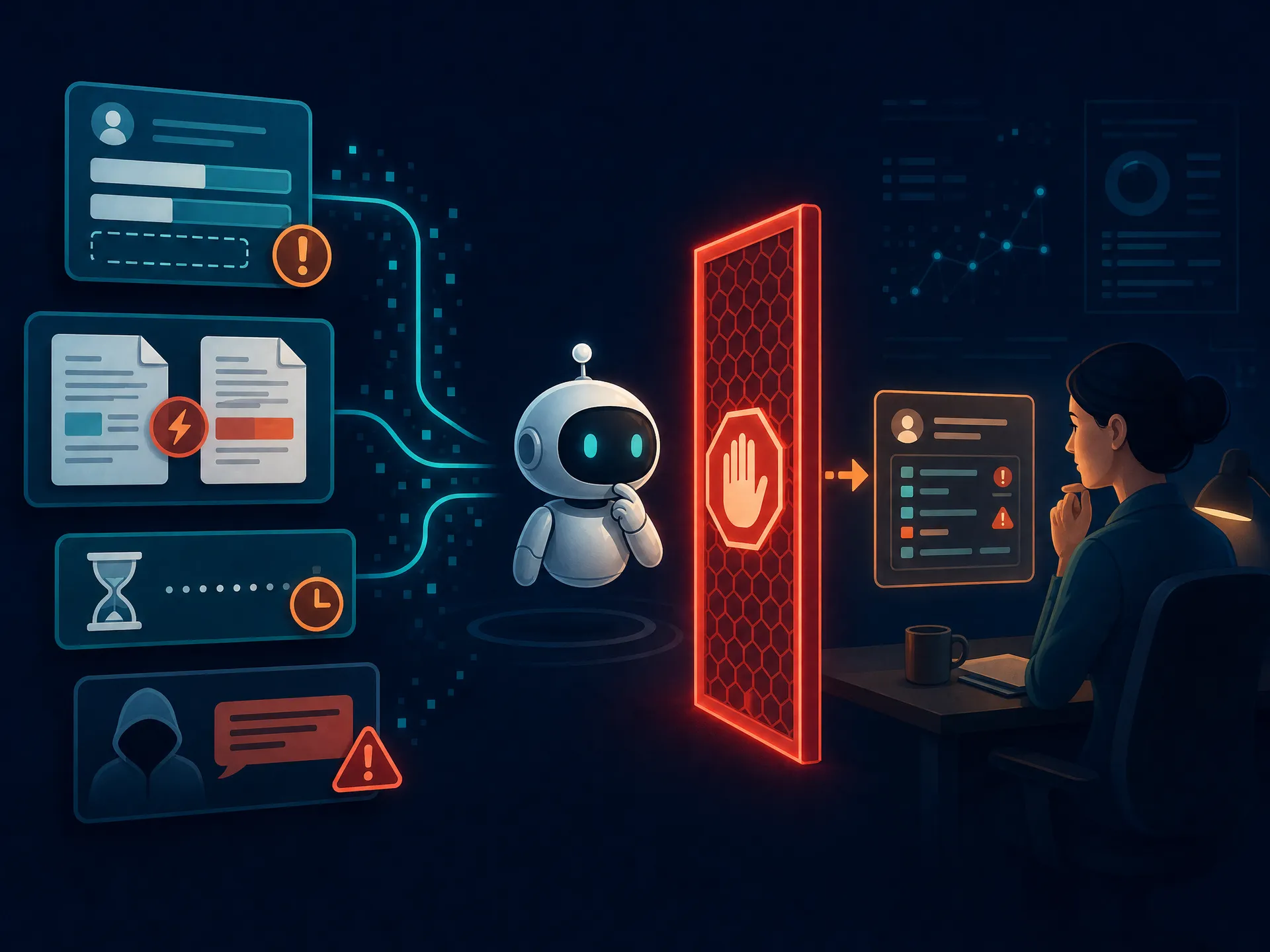
Boundary testing shows whether the agent can stop safely when ordinary assumptions no longer hold.
NIST’s Generative AI Profile identifies pre-deployment testing and incident disclosure as important considerations for managing generative-AI risks. [3] That principle is practical for small teams: test before release, and keep enough evidence to explain a problem afterwards.
The early check
Create a small failure library. Each case should state the input, the expected safe behaviour, the actual result, and the lesson for the next version. Re-run the library after changing the model, prompt, source set, permission, or connected service.
Failure pattern 6: Live behaviour goes unobserved
An agent can pass its launch tests and deteriorate later. A policy changes, a supplier changes its response format, a model update changes the tone, or users begin sending requests the original designer never considered. Without monitoring, the team learns about the failure from an angry customer or a missing internal record.
Monitor the parts that reveal harm early. Useful measures include completion rate, handover rate, source-citation rate, correction frequency, tool errors, response time, duplicate actions, and the number of runs stopped by a safeguard. A single success percentage is too blunt because it hides whether the system is failing safely or quietly producing questionable outputs.
Set thresholds before launch. For example, more handovers may start an investigation; a failed permission check may stop the workflow immediately. Assign an owner who receives alerts and has authority to stop the agent. Monitoring without a response plan creates a dashboard, not control. Review the alerts during normal working hours and after any major system change.
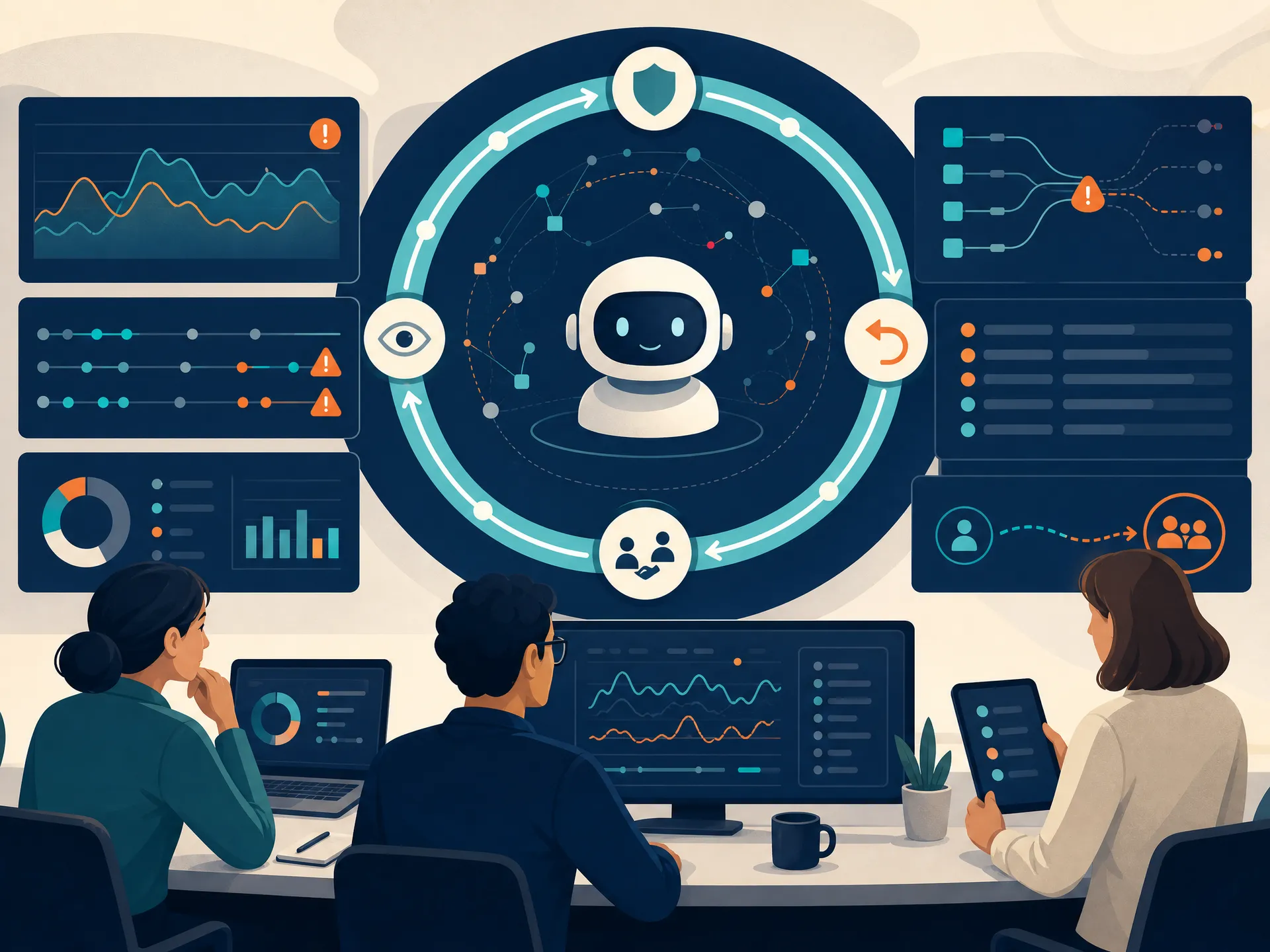
Monitoring becomes useful when an alert leads to an owner, an action, and a recorded decision.
Failure pattern 7: The team changes too many things at once
When a workflow fails, people often replace the model, rewrite the prompt, add documents, reconnect tools, and alter the approval rule in one afternoon. The next result may improve, but nobody knows why. The team has lost the ability to learn from the experiment.
Change one important variable at a time when the risk allows it. Keep a version number for the instructions, source collection, model, tool configuration, and evaluation set. Record what changed and compare the new result with the previous baseline. If a serious incident requires an immediate rollback, restore the last known safe version before investigating further.
This discipline also reduces false confidence. A small improvement on one test set does not prove that the system is reliable everywhere. Look for progress across the failure cases that matter to the business, not only the examples that make the demonstration look better.
A practical production-readiness gate
Before release, ask the owner to demonstrate five things. The agent must have one defined job and a clear stopping point. The approved sources must be current and traceable. The tools must reject actions outside the agent’s role. A person must be able to inspect the evidence and take over. The team must also have a test library, a monitoring plan, a rollback method, and a named incident owner.
| Check | Evidence to keep |
|---|---|
| Job definition | Starting event, expected result, forbidden actions |
| Source quality | Approved documents, owners, review dates, retrieval tests |
| Tool safety | Permission list, refusal tests, action logs |
| Boundary testing | Incomplete, conflicting, delayed, and malicious inputs |
| Live control | Alerts, thresholds, rollback steps, incident owner |
Do not release simply because the agent performs well on ordinary examples. The team should release only when it knows how the system behaves when something goes wrong. A safe failure is visible, limited, reversible, and assigned to a person who can act.
Write the first incident response before launch. It should say who pauses the agent, where the run evidence is stored, how affected people are contacted, and when the service may resume. Keep a short timeline for every serious event. Note the first warning, the action taken, the underlying cause, and the change that should prevent a repeat. This record turns an embarrassing surprise into a source of operational knowledge.
When should an agent be taken out of production?
Pause the system when it repeats an action, loses its source trail, exceeds its permissions, produces an unusual rise in corrections, or encounters a new type of request that the tests do not cover. Do not wait for a large incident before using the stop rule. A short pause can protect trust while the team examines the evidence.
The right response is not always a new model. Sometimes the answer is a cleaner source register, narrower permissions, a better handover, a missing test case, or a decision to keep the task manual. A reliable production system needs clear instructions, dependable data, safe tools, and human oversight alongside a capable model.
An agent becomes dependable through repeated, visible learning. The team defines the job, challenges its boundaries, watches real behaviour, and changes one part at a time. That work may seem less exciting than adding another capability, but it is what turns a clever demonstration into a system people can safely use.