
Sensitive notes create a difficult AI choice. A useful assistant could search a project notebook, summarise a long document, retrieve a fact from a private archive, or help someone find a forgotten decision. The same assistant could also receive personal details, confidential plans, financial information, health notes, or material that was never meant to leave a trusted device.
That is why “private AI assistant” is not a complete category. Privacy depends on how information enters the system, where it is processed, how long it remains available, who can access it, and what happens when the account closes. A local application may reduce some transfer risks, but it can still expose files through weak device security. A hosted service may offer better maintenance and collaboration, but its controls depend on the plan, settings, region, and provider.
The sensible question is not, “Which assistant is absolutely private?” Ask instead, “Which arrangement gives this particular information the protection, usefulness, and human oversight it needs?”
Start with the information, not the assistant
Before comparing products, catalogue the information you plan to use. Identify each document’s owner, the people allowed to read it, and the consequences of a leak or an incorrect answer. A personal reading list does not need the same controls as an employee record. A draft business idea does not carry the same risk as a passport scan or a medical letter.
A simple classification can make the decision clearer. Public material may be suitable for an early trial. Internal material may require an approved account and limited access. Personal or confidential material may need stronger safeguards, a clear purpose, and a documented reason for using AI at all. Highly sensitive material may be unsuitable for a general-purpose assistant.
Do not rely on labels such as “private”, “secure”, or “enterprise” without asking what each one covers. When a provider says “private”, ask whether it excludes prompts from model training. When it says “secure”, ask whether encryption protects data in transit, at rest, or both. When it says “enterprise”, ask whether the term refers to a contract, an administrative console, or simply a paid tier. Record the provider’s exact explanation and the date you checked it.
Understand the difference between local and hosted processing
A local assistant runs on a device or on infrastructure that you control. It may allow documents to remain on that device and can reduce the need to send content to a third-party service. Local processing can also support work without an internet connection, depending on the software and model. These benefits do not remove every risk. A stolen laptop, an unencrypted drive, a vulnerable extension, or an overlooked backup can still expose the material.
A hosted assistant processes information on systems operated by a provider. A hosted service may provide managed hardware, automatic updates, account recovery, collaboration features, and access from several devices. This arrangement also creates questions about transfer, retention, administrative access, subprocessors, jurisdiction, and service changes. A convenient interface does not answer those questions.
There is a third arrangement: a private deployment on rented or organisational infrastructure. This can provide more control than a consumer account while retaining some benefits of central management. It also creates responsibility for configuration, patching, monitoring, identity management, backups, and incident response. Control is valuable only when someone can exercise it competently.
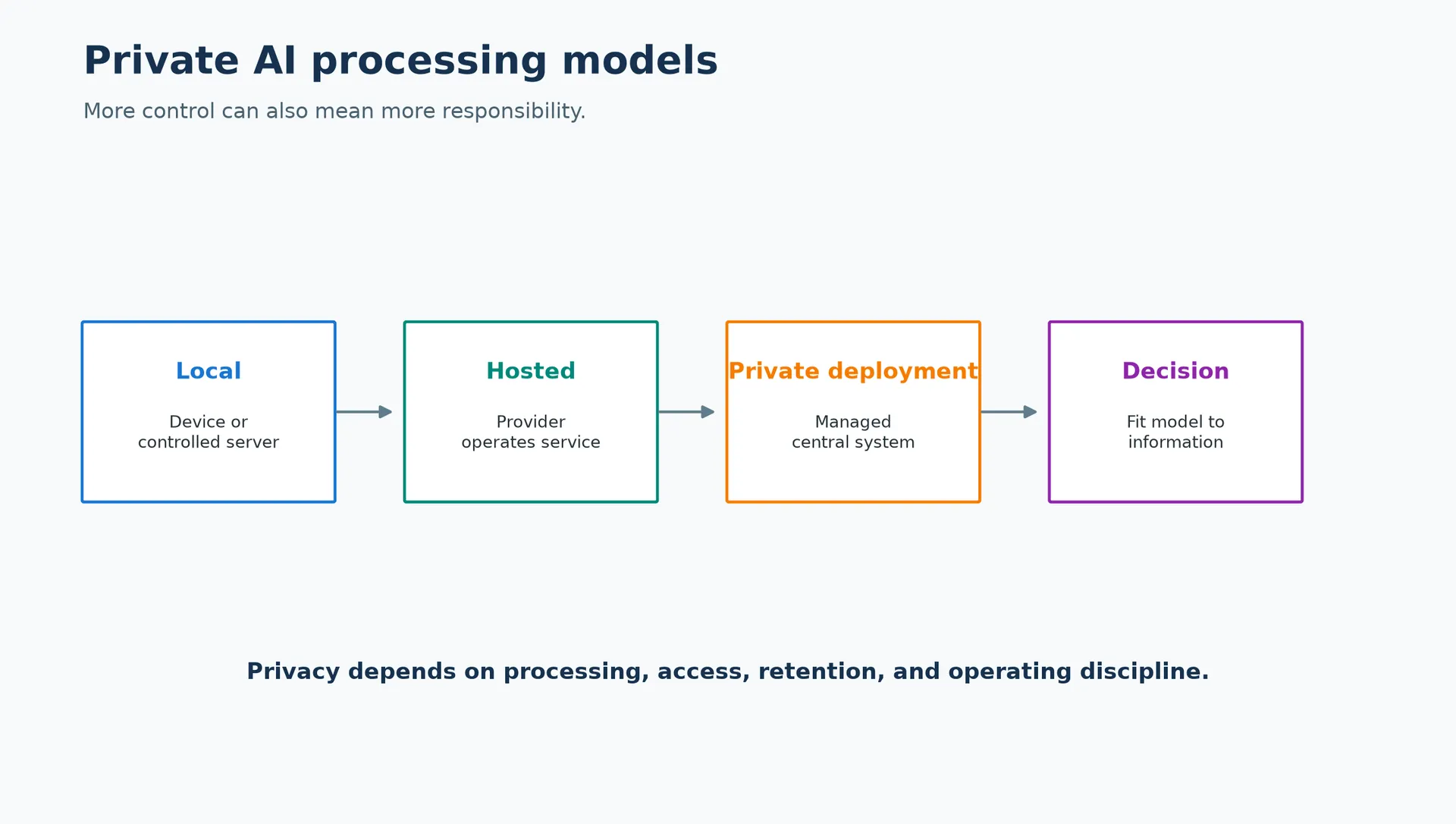
The processing model changes both the privacy risk and the work required to operate the assistant safely.
Check what happens to your documents
Read the provider’s current documentation before uploading real material. Look for answers to six questions. What information does the service receive? Is the information used to improve a model? How long are prompts, files, logs, and derived indexes retained? Who can administer or review the account? Where is the information processed or stored? Can you delete the source files, conversation history, indexes, and backups?
The same provider may apply different rules to different products. Check the consumer account, business plan, application programming interface, and self-hosted installation separately. Never carry a privacy promise from one plan into another. Save the policy page or contract record that supports your decision, together with the date you checked it.
Australian privacy guidance treats a commercial AI product as a privacy matter when an organisation’s use involves personal information.[3] The practical lesson applies more widely: privacy needs a place in the evaluation process, not a footnote added after the tool has been selected.
The ICO organises its AI and data-protection guidance around responsibility, openness, lawful use, accuracy, fairness, security, limited data use, and people’s rights.[2] The page is under review because of changes made by the Data (Use and Access) Act. Readers should therefore treat it as guidance that may change, not as a substitute for current legal advice.
Reduce the information before it enters the system
Data minimisation is often more practical than a promise of perfect privacy. Remove names, addresses, account numbers, signatures, unnecessary dates, and unrelated pages. Replace a person’s name with a role when the name does not affect the task. If you need a summary, provide only the relevant clause instead of the entire contract.
Test every redacted copy. A black rectangle may hide words on the page while leaving the text underneath intact. A document may also identify someone through a combination of job title, location, dates, and unusual events. First read the cleaned copy as an ordinary reader. Then inspect it for hidden text, comments, tracked changes, and attachments.
Fewer inputs give the assistant fewer opportunities to expose information. However, removing necessary detail can weaken the answer. Record what you removed and decide whether the remaining context is sufficient for the task.
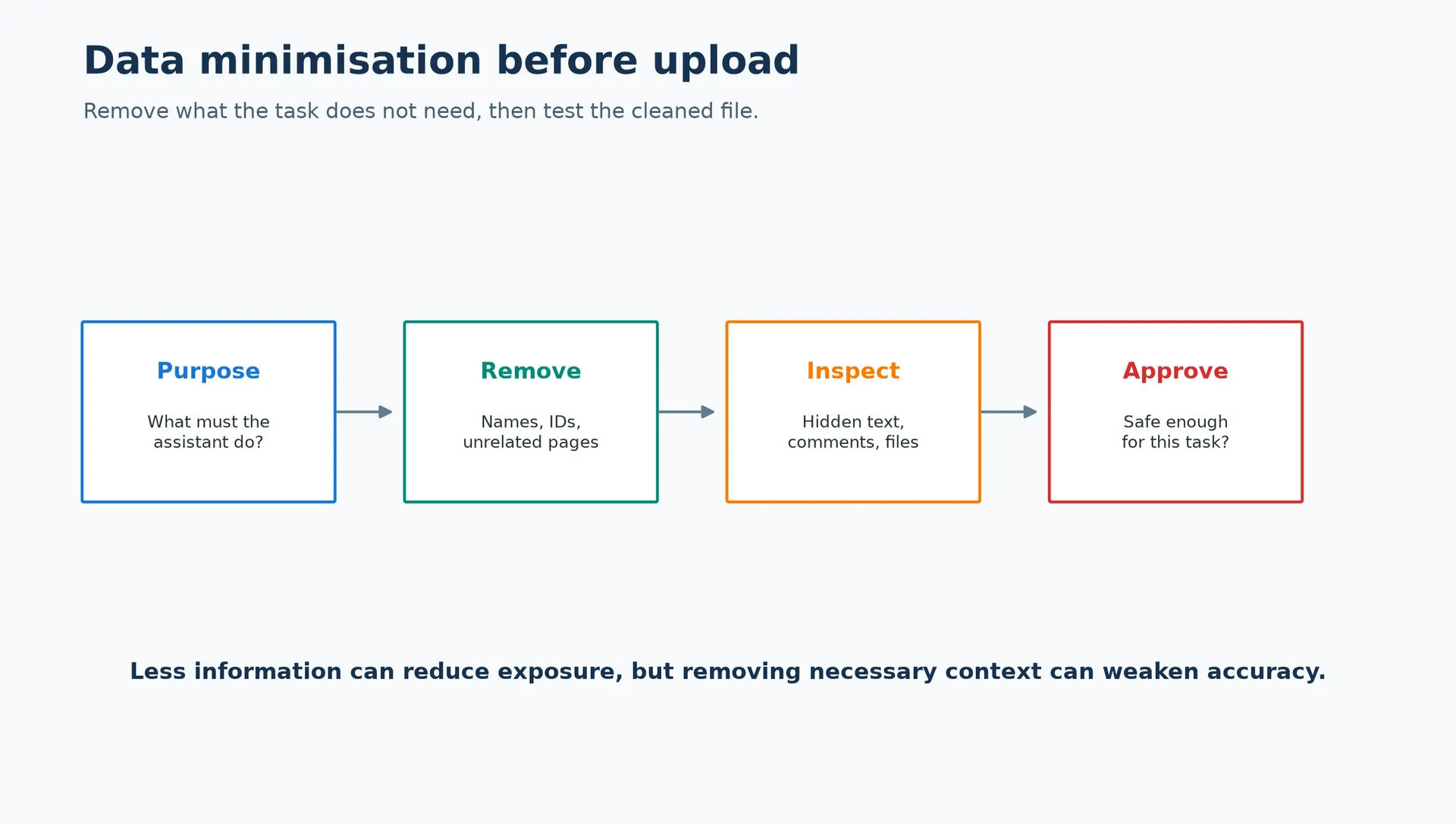
Remove unnecessary information before upload, then test the cleaned document rather than assuming that redaction worked.
Compare retrieval quality with privacy controls
A private assistant is not useful if it cannot retrieve the right passage. Test retrieval with questions whose answers you know. Ask for a direct fact, a detail spread across two pages, a date that appears in a table, and a question that has no answer in the collection. Require the assistant to identify the supporting document and page or section when the system can do so.
Watch for three different failures. The assistant may invent an answer when the document contains no support. It may find a related passage but attach the wrong conclusion to it. It may retrieve an old version while presenting the result as current. A fluent paragraph does not prove that retrieval was accurate.
Keep a human review step for high-impact material. A summary can omit a qualification. A search result can expose a document to someone who should not see it. An extraction can change a number, name, or date. NIST presents its AI Risk Management Framework as a voluntary method for building trust checks into an AI system’s design and operation.[1] For private document assistants, that supports a practical habit: test the system, record failure modes, assign responsibility, and review the arrangement when the information or use changes.
Evaluate access as carefully as storage
A secure server does not protect a document when the wrong person gains access to a signed-in account. Check account roles, shared workspaces, link access, search permissions, administrator visibility, device sessions, and multifactor authentication. Ask whether the assistant respects the source document’s permissions or creates a new collection with broader access.
Separate personal workspaces from shared workspaces. Do not place a private journal in a collection that a household, team, or organisation can search. Do not assume that a document remains private because the original folder was private. An imported copy, index, cached file, or exported conversation may have different permissions.
Set an owner for access reviews. The owner should know which collections exist, who can use them, and how to remove access when a person leaves or a project ends. A permission that nobody remembers is a permission that may remain open too long.
Ask how the assistant behaves when it is wrong
Privacy and accuracy are connected. A wrong answer can expose information by quoting the wrong document, merging two people’s records, or revealing a detail in response to a question that should have been refused. Test negative cases deliberately. Ask for a document that does not exist. Ask for information outside the collection. Ask whether the system can distinguish two people with similar names.
Good behaviour includes an honest “I do not know”, a clear source trail, a useful refusal, and a route to human review. Warning signs include invented answers, vague citations, unexpected access expansion, and refusals that explain nothing. Record these results beside the privacy findings because answer quality and information protection affect one another.
Set search boundaries and prove deletion
A document assistant should not search every collection by default. Create separate spaces for different purposes, such as personal notes, client material, household records, and archived projects. Give each space a clear owner and a narrow set of permitted users. Search becomes safer when the assistant has fewer places to look.
Deletion needs evidence, not just a button. Remove a sample document and check whether it disappears from search, conversation history, generated indexes, exports, and connected backups. A button labelled “delete” may affect fewer copies than users expect. Record which copies the provider says will be deleted, then set a date for the next deletion test.
If the service cannot explain its search boundary or deletion route, do not place sensitive material in it. Keep a separate copy in a controlled location until the trial has answered those questions. Convenience should never become the only copy of an important document.
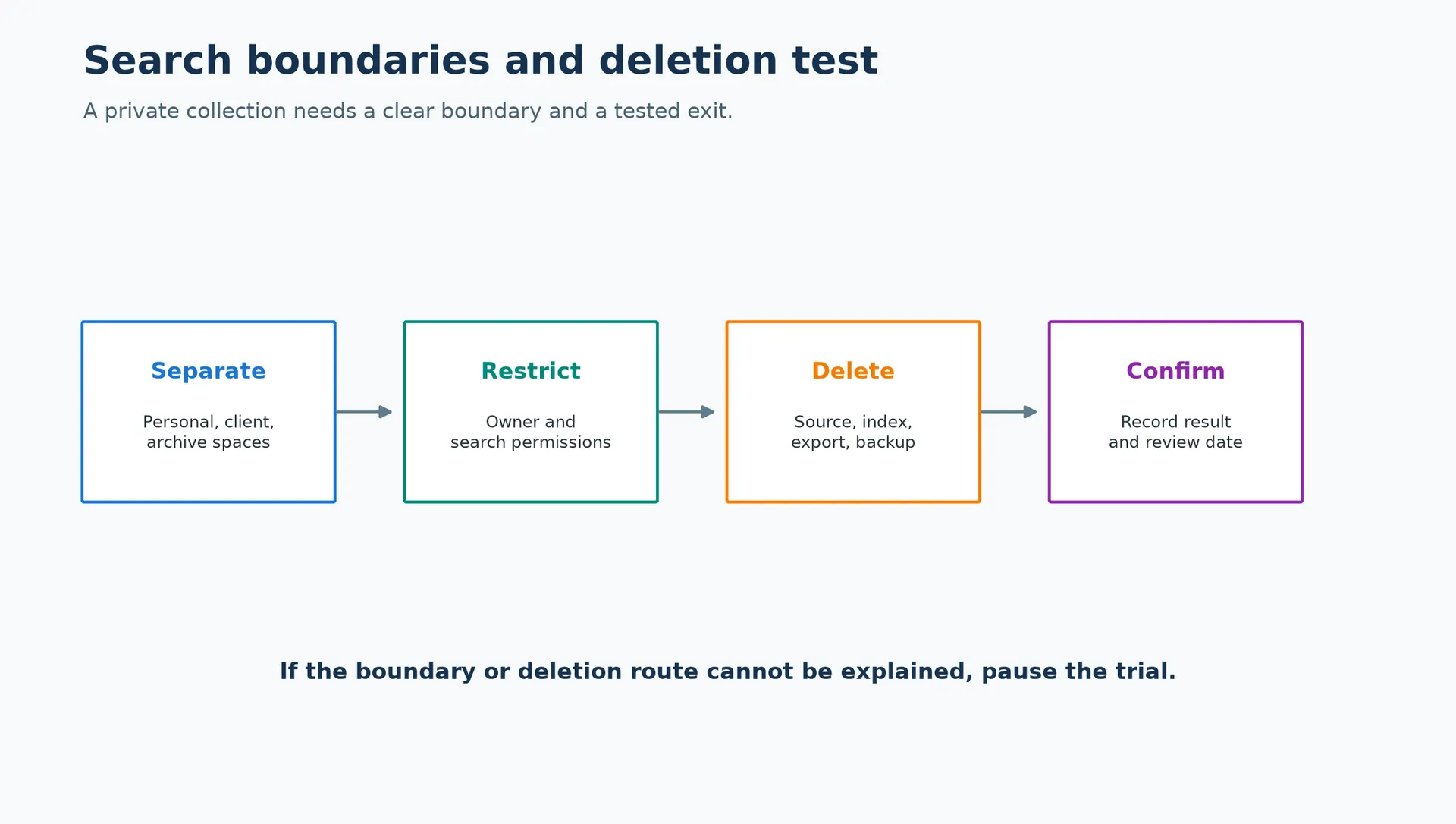
Separate collections and test deletion so a private assistant cannot become an unexplained memory store.
Compare the real cost of privacy
The visible subscription is only one part of the cost. Add time for redaction, account administration, access reviews, backups, testing, support, migration, and incident response. A local assistant may avoid a monthly service fee while requiring better hardware and more technical maintenance. A hosted assistant may reduce maintenance while creating continuing costs and dependence on a provider.
Use a decision table rather than a single privacy score. Score each option against the exact information and task. Mark unknowns as unknowns. Do not award a high privacy score merely because a provider uses a reassuring phrase on a marketing page.
| Dimension | Question to ask | Evidence to record |
|---|---|---|
| Data movement | Where does the document travel? | Processing location and transfer route |
| Retention | What remains after the task ends? | Policy, settings, deletion process |
| Access | Who can search or administer the collection? | Roles, permissions, session controls |
| Retrieval | Can the assistant show reliable support? | Test answers and source references |
| Recovery | Can the work continue if the service stops? | Export, backup, and manual process |
| Exit | Can you leave without losing control? | File formats, deletion confirmation, dependencies |
Run a small trial before trusting sensitive notes
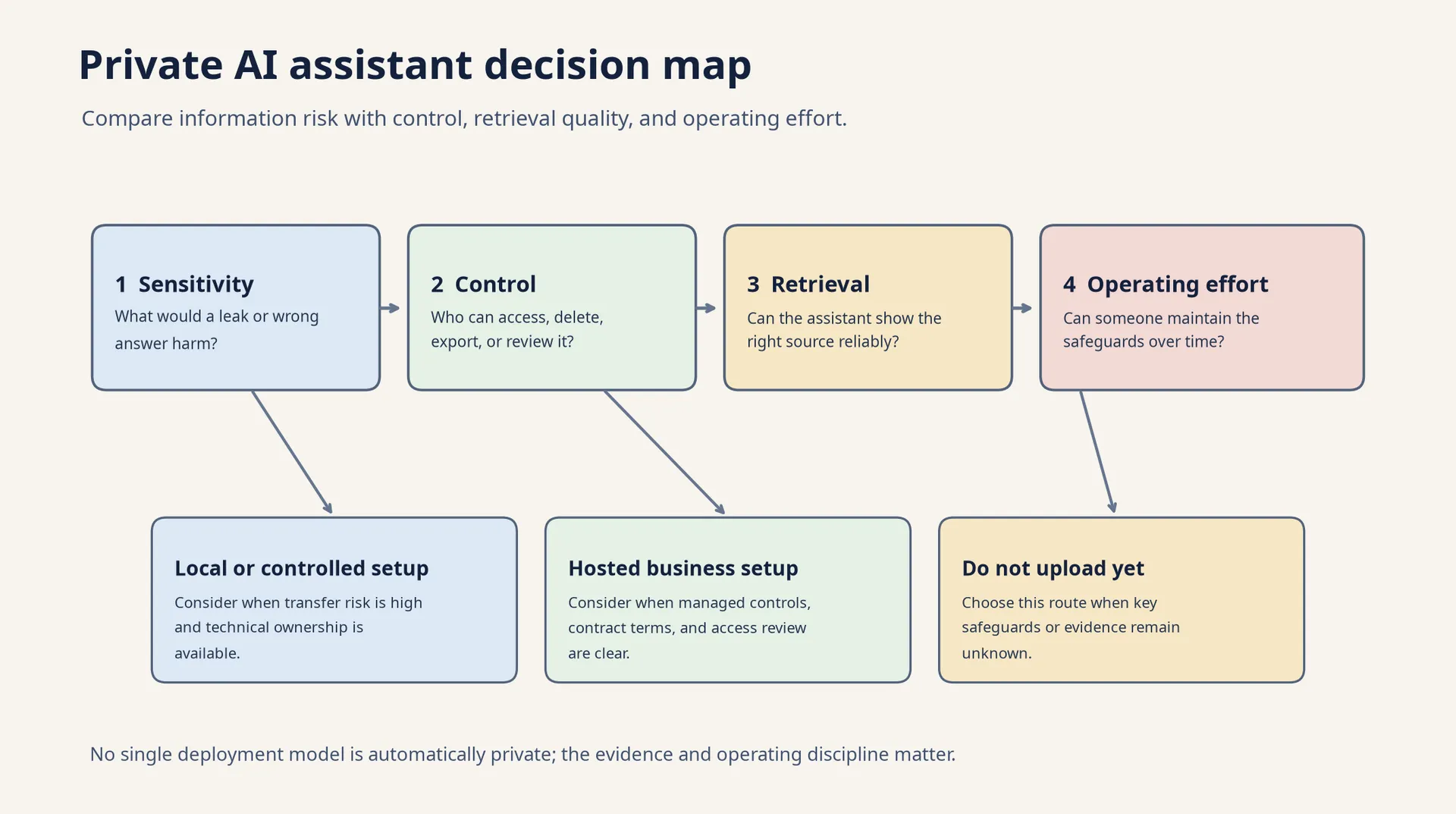
Use the decision map to compare the information risk with the control and maintenance burden before beginning a trial.
Choose one low-risk collection and one narrow task. Use anonymised or synthetic material first. Write down the expected answer, permitted source, unacceptable disclosure, reviewer, and stop condition. Test the same examples after changing a permission, updating a document, or switching the model. A single successful demonstration is not evidence of dependable privacy.
When the trial ends, ask four direct questions. Did the assistant save enough time to justify the review work? Did users understand its limits? Could everyone explain where the data went? Did anyone mistake a plausible answer for an authoritative record? If any answer is unclear, narrow the task or stop the trial.
Private AI is not a product label that removes judgement. It is a system of choices about information, processing, access, accuracy, retention, and responsibility. The strongest option may be a local tool, a hosted service with suitable controls, a managed private deployment, or no AI at all. The correct choice is the one that fits the information and remains understandable after the first impressive demonstration.