
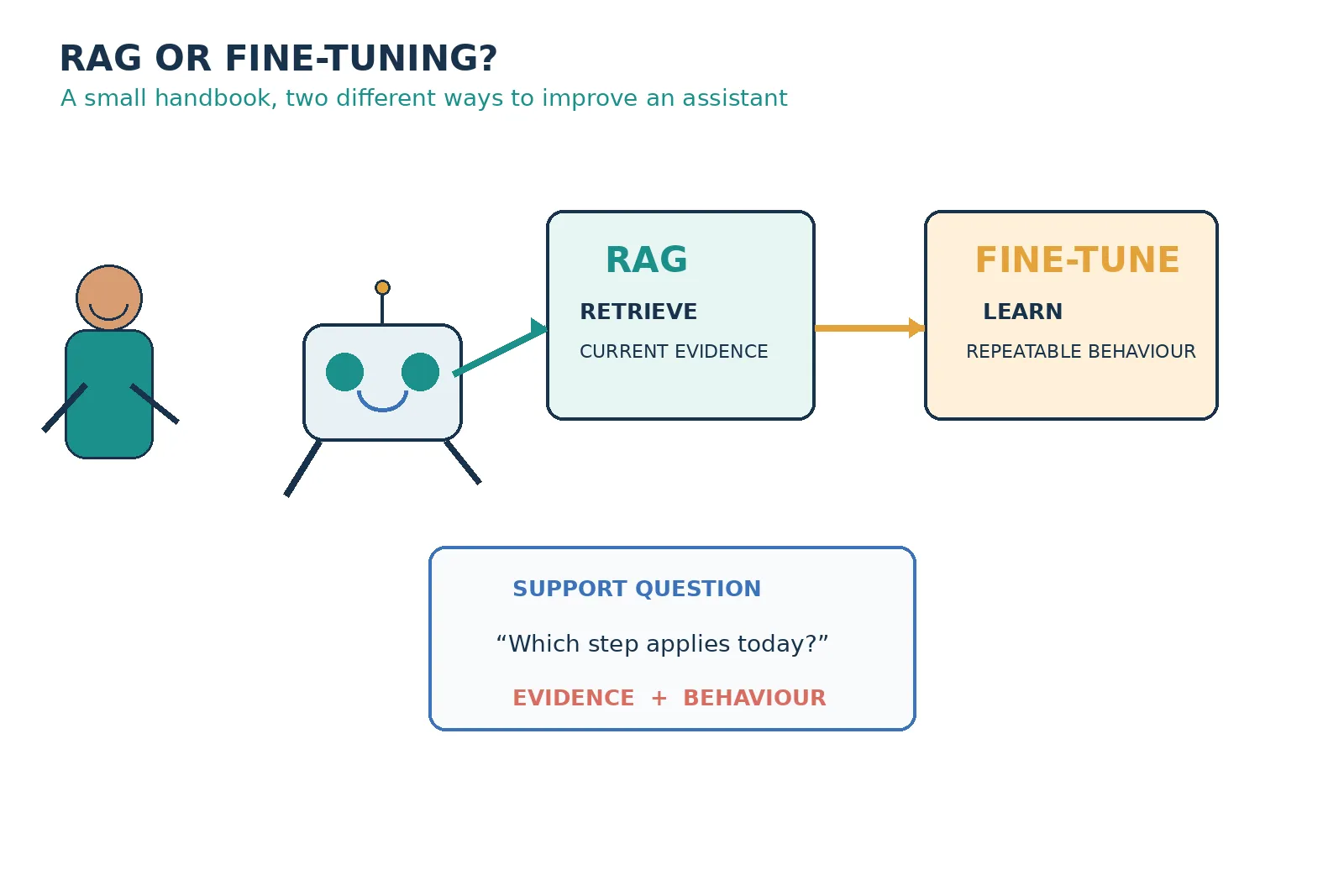
A small company with a useful internal handbook often faces an awkward AI decision. Should it connect a language model to the handbook each time somebody asks a question, or should it train the model on examples from the handbook? The first option is retrieval-augmented generation, usually called RAG. The second is fine-tuning.
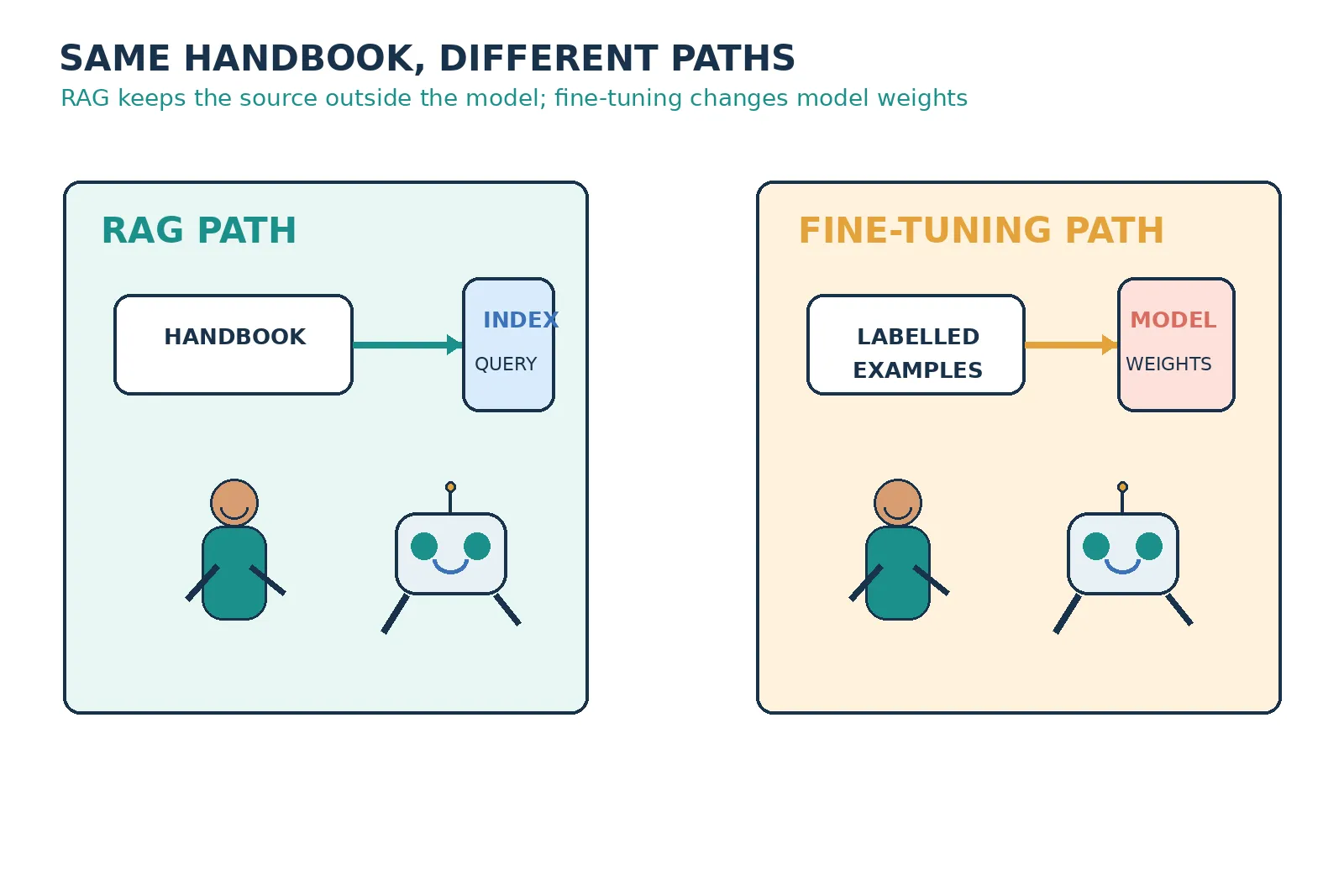
Both approaches can improve an AI application, but they change different parts of the system. RAG changes the information path: the application retrieves relevant material and places it into the model’s working context. Fine-tuning changes model weights through additional training on a focused dataset. IBM describes RAG as connecting a model to proprietary information, while fine-tuning adapts a model for a domain-specific task. [1]
This article uses a fictional equipment-servicing company with a 180-page support handbook. Its managers want an assistant that helps technicians answer questions about inspection steps, replacement parts, warranty conditions, and escalation routes. The example shows why a small knowledge base often benefits from RAG first, while also explaining when fine-tuning or a hybrid design may make sense.
The short answer for a small knowledge base
Choose RAG when the main problem is that the assistant needs access to changing, private, or citable information. Choose fine-tuning when the main problem is that the model must follow a stable task pattern, speak in a consistent format, classify requests, or reproduce a specialised style. Consider both only after each approach has been evaluated on its own.
A small knowledge base does not automatically make fine-tuning cheaper or easier. A limited document set may be ideal for a carefully designed retrieval pilot because the team can inspect every source, create a question set, and trace each response. Fine-tuning still requires a suitable collection of labelled examples, a training process, evaluation, and a method for handling knowledge that changes after training.
The right choice begins with the type of improvement the company wants. If the request is “Please tell me the current torque limit for this model,” that is primarily a knowledge-access problem. If the request is “Turn every technician note into the same five-field incident record,” that is primarily a behaviour and output-format problem.
What RAG does
A RAG application has a retrieval stage before response generation. The company prepares its handbook by splitting it into useful passages, creating searchable representations, and storing each passage with a source reference and relevant metadata. When a technician asks a question, the application retrieves passages that may answer it. The language model then receives the question and selected evidence and drafts a response.
IBM describes the broad RAG sequence as a query, information retrieval, integration of the retrieved information with the query, and response generation. [1] AWS likewise presents RAG as a way to connect a language model with an external knowledge base, so the application can draw on information outside the model’s original training data. [2]
The handbook therefore remains a source that the company can update. If a safety instruction changes, the team can revise the source, rebuild the relevant index entries, and test affected questions. The model does not need to memorise the new sentence through a new training run.
RAG is not a guarantee of accuracy. Retrieval may select the wrong passage, the passage may be outdated, or the language model may misread a condition. A dependable design keeps the source title, revision, section, and link attached to each retrieved passage.
What fine-tuning does
Fine-tuning exposes a base model to a focused dataset of examples and updates its weights so that it performs better on a selected task. IBM describes fine-tuning as a supervised-learning method in which labelled examples are used to hone performance for a use case. [1]
For the equipment company, a fine-tuning dataset might contain technician questions paired with concise answer formats, issue categories, escalation labels, or approved rewrites. The training examples teach the model how the company wants a task performed. They do not create a convenient, perfectly searchable copy of the handbook.
A fine-tuned model may learn terminology, preferred structure, tone, or classification boundaries. It may also produce more consistent outputs for repeated tasks. However, it can be difficult to determine whether a particular policy sentence has been learned reliably, and a model trained on yesterday’s examples will not automatically know tomorrow’s revision.
Fine-tuning also needs disciplined data preparation. Remove contradictory examples, settle labels, protect customer information, separate training and evaluation data, and define the behaviour that counts as success. A small dataset can be valuable, but it can also encourage overfitting if it repeats a narrow set of phrases.
Compare the two approaches by the change you need
The company writes down several requirements before choosing a tool. Technicians need current servicing rules, managers want traceable sources, and the helpdesk wants replies to follow a short format. These requirements do not all point to the same mechanism.
RAG is usually the stronger first candidate for current handbook content because the source can remain outside the model and be updated through an ingestion workflow. Fine-tuning may be more suitable for a stable classification task, such as assigning a ticket to “parts”, “safety”, “warranty”, or “field escalation”.
The distinction is not absolute. A RAG system can use a prompt to request a particular format, and a fine-tuned model can still be connected to retrieval. The important question is whether the proposed investment solves the observed failure.
| Requirement | RAG | Fine-tuning |
|---|---|---|
| Current private facts | Strong fit when retrieval and permissions are sound. | Weak as the sole knowledge method because training data becomes dated. |
| Citation and source traceability | Natural fit when passages retain references. | Requires additional design and may be difficult to trace. |
| Consistent tone or response structure | Can improve through prompts and output rules. | Strong candidate when many good examples exist. |
| Classification or repeated transformation | Possible, but may be more infrastructure than needed. | Often a useful fit for stable labelled tasks. |
| Frequent document changes | Update the source and retrieval index. | Requires new training or another external knowledge path. |
| Small pilot budget | Start with a narrow retrieval workflow. | Training, evaluation and hosting add complexity. |
| Sensitive information | Enforce access around the retrieved source. | Training data may broaden the exposure if poorly controlled. |
| Main failure risk | Wrong or missing evidence. | Inconsistent, overfitted, or outdated learned behaviour. |
Why RAG often suits a small handbook first
A small knowledge base gives the team a manageable retrieval boundary. The service company can review every article, remove obsolete instructions, add headings and metadata, and build a test set from real technician questions. It can then inspect whether the correct passage appears before asking the model to write an answer.
This approach is also easier to explain to an owner. The response can say, “This answer came from the inspection procedure, revision 4, section 3.” If the answer is wrong, the team can investigate the source, chunk, metadata, retrieval ranking, prompt, or generation step.
RAG keeps factual change close to content management. That does not make the workflow effortless. Extraction, chunking, permissions, index refreshes, and evaluation still need owners. Yet a small team can often operate those controls without building a full training programme.
Do not choose RAG merely because it is fashionable. If the actual task is converting free-text notes into a stable JSON record, retrieval may add little value. A prompt, a structured output schema, or a carefully evaluated fine-tuning experiment may be more appropriate.
When fine-tuning may be worth considering
Fine-tuning becomes more attractive when the team has a substantial set of high-quality examples and a stable task that the model performs repeatedly. Suppose the helpdesk has thousands of reviewed tickets, each labelled with a fault family, urgency, required department, and approved next action. A fine-tuned classifier may learn that workflow more consistently than a general model with a long instruction prompt.
It may also help when the desired output style is precise and repeated. The company could train on examples that turn technician notes into a compact service summary with fields for symptom, test performed, likely cause, parts used, and follow-up owner.
The team should still test whether prompt design, a smaller model, or a rules-based validator solves the problem first. Fine-tuning introduces a model version that must be evaluated, deployed, monitored, and replaced when its behaviour is no longer suitable. A lower token cost at runtime does not remove those responsibilities.
The hybrid pattern
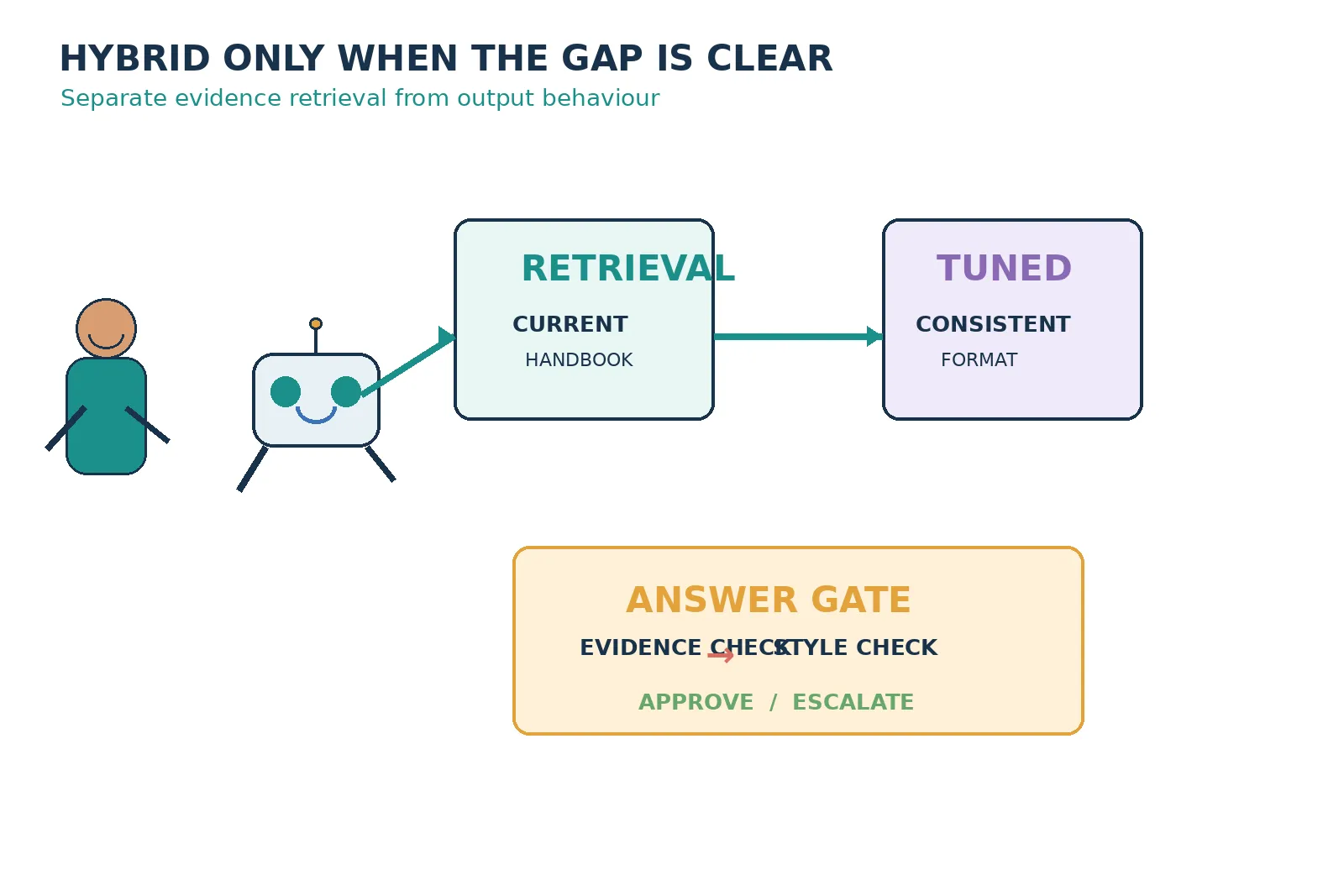
RAG and fine-tuning can work together when they solve separate problems. The company might fine-tune a model to classify a technician’s request and format the final response, while RAG supplies the current handbook passages. The retrieval layer provides changing evidence; the tuned model provides a consistent task behaviour.
A hybrid architecture can be useful, but it should not be the default answer to uncertainty. Each additional component creates another place for errors, version drift, logging, and access mistakes. Establish a baseline first. If a simple RAG prototype retrieves the right evidence but formats responses inconsistently, a formatting intervention is justified. If retrieval is poor, tuning the generator will not repair the missing evidence.
Evaluate knowledge and behaviour separately
The service company creates two evaluation tracks. The first tests retrieval: does the correct procedure appear, does the result respect the technician’s permissions, and is the current revision ranked above an obsolete one? The second tests generation: does the answer preserve conditions, use the requested format, cite the supplied passage, and admit when evidence is missing?
For a fine-tuning experiment, the evaluation set must contain examples that were not used during training. Include ordinary cases, confusing cases, rare labels, contradictory wording, and requests outside the model’s permitted scope. Compare the tuned model with the base model and a prompt-only baseline.
Record failures by cause. A wrong answer might result from an absent handbook passage, a poor retrieval query, an incorrect label, a prompt instruction, a model limitation, or an unsafe permission boundary. Without this classification, a team may tune the model to compensate for bad source preparation.
Costs, updates, and operational effort
RAG commonly shifts effort towards document preparation, embedding or indexing, retrieval requests, storage, and monitoring. Fine-tuning shifts effort towards dataset creation, training runs, model evaluation, deployment, and model lifecycle management. Actual costs vary by model, provider, traffic, context size, hardware, and update frequency, so a fixed price claim would be misleading.
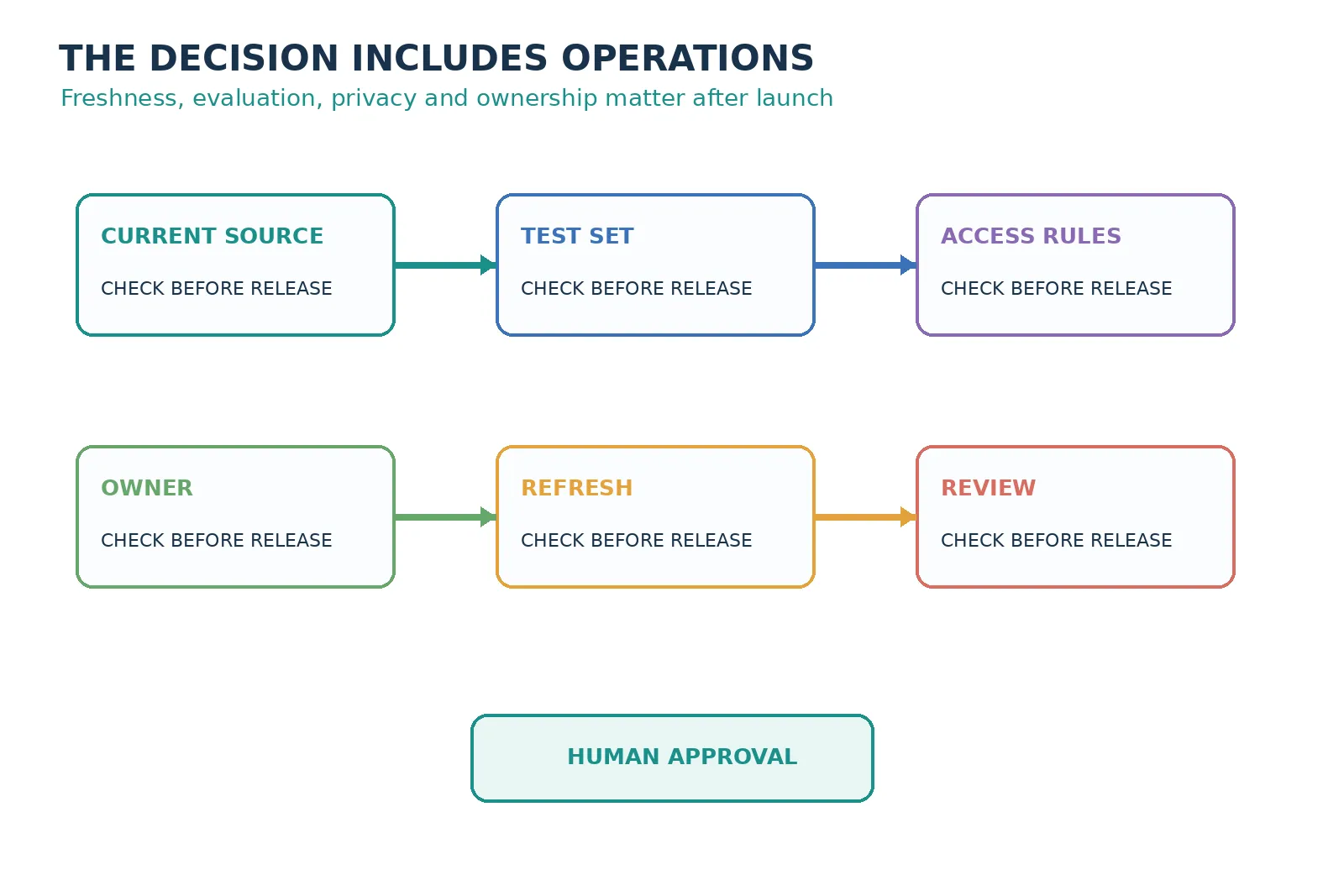
Estimate the whole workflow instead of a single API call. Count source review, ingestion, test maintenance, failed-answer investigation, access-control checks, retraining or re-indexing, and the time a human spends approving changes. A small knowledge base may be inexpensive to store but expensive to keep correct if nobody owns updates.
For frequently changing content, RAG usually offers a more direct update path. For stable behaviour with many labelled examples, fine-tuning may reduce repeated instructions and improve consistency. Measure the benefit instead of assuming it.
Privacy and safety boundaries
Keep private documents out of unauthorised prompts, indexes, training sets, logs, and evaluation files. A RAG system must filter retrieval by the user’s permissions. A fine-tuning dataset must be reviewed for personal data, confidential contracts, credentials, and examples that should not become part of a model’s learned behaviour.
Do not assume that fine-tuning makes sensitive knowledge safer because the information is no longer visible as a document. Do not assume that RAG is safe because the model has not been trained on the source. Test what a user can retrieve, what appears in citations, what reaches the generator, and what is stored in logs.
For servicing instructions that affect safety, require a human to confirm the current procedure. The assistant should support a technician’s decision, not silently replace an approved safety process.
A decision checklist for a small team
Use six questions to guide the decision. Is the primary need access to changing knowledge or consistent task behaviour? Must every answer cite a source? How often will the underlying information change? Do you have enough reviewed examples for the task? Can the team test permissions and failure cases? Who will own updates, evaluation, and retirement?
If most answers point to changing, private, citable knowledge, build a narrow RAG pilot. If most point to stable classification or formatting and the example set is strong, evaluate fine-tuning against a simpler baseline. If both needs are real, introduce the second method only after the first has demonstrated a specific gap.
| KEY TAKEAWAY: RAG and fine-tuning are not interchangeable labels for “making AI know more”. RAG supplies external evidence at question time, while fine-tuning changes model behaviour through examples. For a small, changing knowledge base, start with traceable retrieval; consider fine-tuning when a stable task and a trustworthy labelled dataset justify it. |
|---|
| SAFETY CHECK: Protect permissions and confidential data in both architectures. Test current and obsolete sources, unseen evaluation examples, prompt injection, missing evidence, unsafe advice, and generated logs. Require human approval for outputs that affect safety, money, legal rights, privacy, or customer commitments. |
|---|