
A prototype can appear almost free. One person sends a few prompts, waits for an answer, and decides that the feature is ready for a product roadmap. Production changes the arithmetic. Real users arrive at different times, prompts contain different amounts of context, responses need checking, and a successful request may trigger storage, search, logging, notification, or human-support work.
The model invoice is only one part of the picture. The FinOps Foundation lists computing, storage, transfer, serving, monitoring, maintenance, and provider charges among the cost drivers of AI workloads. [1] A sensible estimate therefore starts with the complete user journey instead of a single token price.
This guide gives you a repeatable way to estimate an AI feature’s cost per task and monthly operating cost. It uses illustrative assumptions, not universal prices. Replace the example rates with current quotes from your chosen provider, runtime, region, and contract.
The most useful budget is easy to challenge. A colleague should be able to ask where a number came from, change one assumption, and see the effect on the result. Keep usage counts, price units, conversion rates, and time periods visible. Separate estimates from observed charges, because mixing the two can make a forecast look more certain than it is. This habit also gives product, finance, engineering, and operations teams a shared language for deciding whether the feature should launch, change shape, or stop.
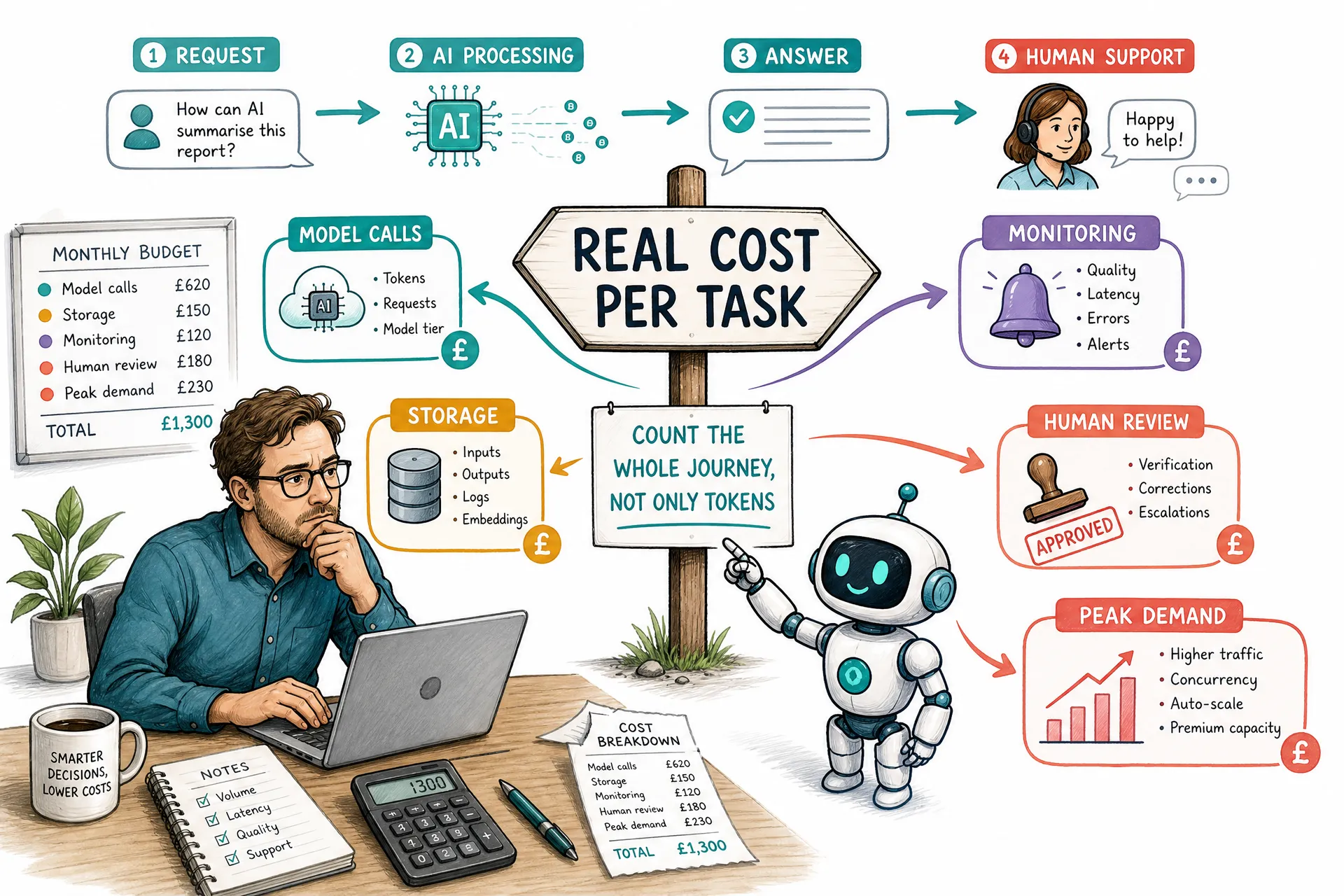
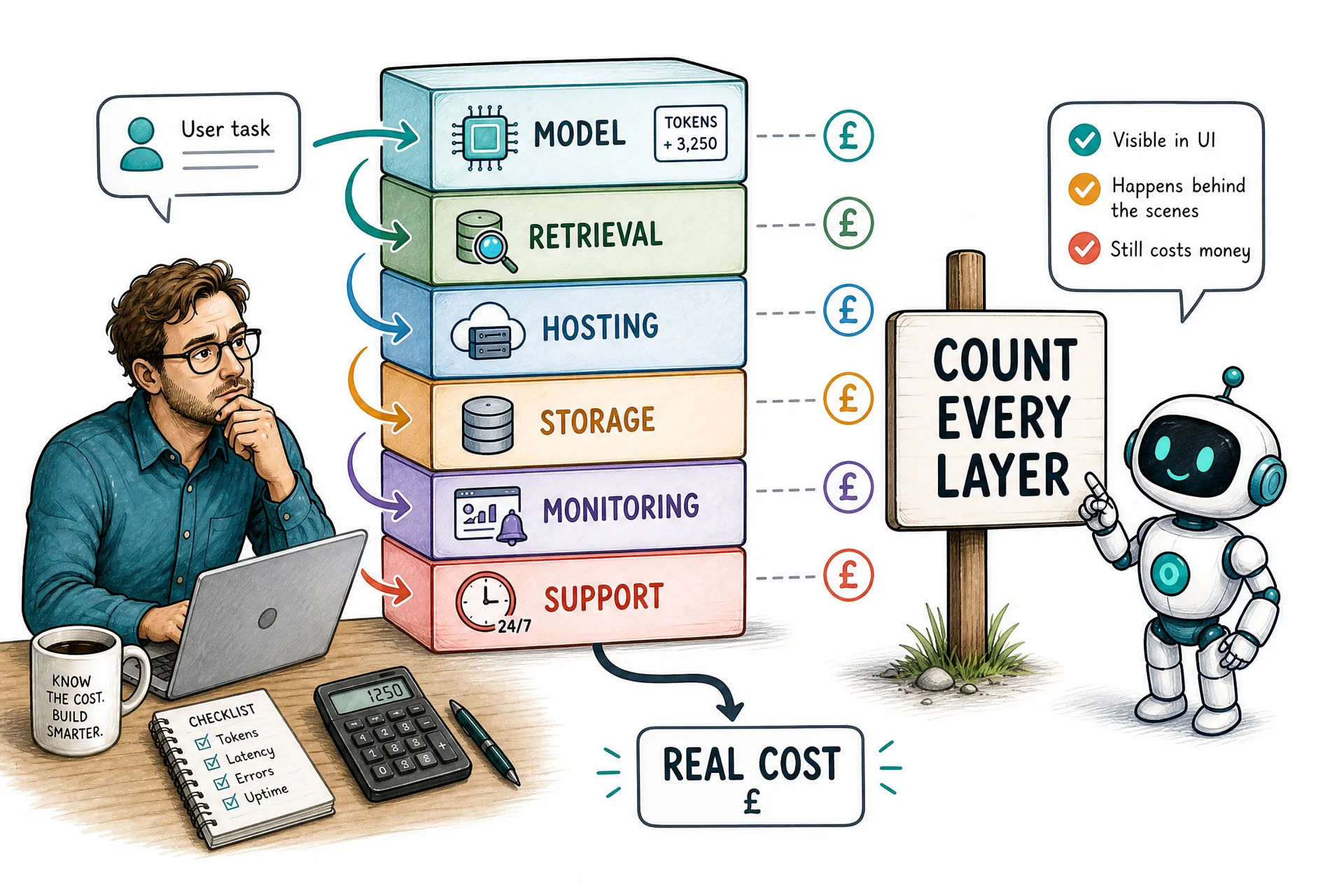
Define the user task before counting tokens
An AI feature is easier to price when its unit of work is explicit. A support assistant might answer one customer question. A document tool might classify one uploaded file. A writing feature might produce one approved draft. Call that unit a completed task.
Write down what starts the task, what the model must receive, what it returns, and what happens afterwards. If a document answer requires retrieval from a search index, include the search request. If an employee must approve the answer, include review time. If the system retries a failed call, include the additional attempt instead of hiding it inside an average.
The task definition also prevents false comparisons. “One user” is not a useful unit if one user submits two short questions and another uploads a 100-page document. A task should describe a reasonably consistent journey, even when the inputs vary.
Separate five kinds of production cost
A useful first pass divides the estimate into five groups. Variable costs rise with usage, such as input tokens, output tokens, image processing, retrieval calls, and transaction fees. Fixed costs continue when demand is quiet, such as a reserved endpoint, a database, a monitoring plan, or a minimum platform commitment.
Shared costs support several features. Examples include an identity service, a queue, a vector index, a common API gateway, and an operations dashboard. Allocate these costs carefully instead of assigning the entire bill to the newest experiment. One-off costs cover integration, data preparation, evaluation, prompt design, security review, and launch work. Risk-reserve costs cover unexpected retries, traffic spikes, model changes, incident response, and extra human review.
The FinOps Foundation recommends modelling the deployment pattern and using capacity planning and benchmarking instead of relying on a single estimate. [1] This distinction matters because a hosted API, a self-managed open model, and a reserved serving platform have different cost shapes.
Build a cost-per-task formula
Start with a simple formula:
> Cost per completed task = model cost + retrieval cost + infrastructure allocation + storage allocation + monitoring allocation + human-work cost + risk allowance.
For a token-priced service, model cost can be estimated as follows:
> Model cost = (input tokens × input rate) + (output tokens × output rate).
Use the pricing unit supplied by the provider. If a provider quotes a rate per million tokens, divide the rate by 1,000,000 before multiplying. Keep input and output counts separate because they may have different prices. A feature that produces long answers can cost more even when the user’s prompt is short.
Do not present the formula as a promise. It is a planning model. Actual charges can vary with cached prompts, batch processing, discounts, minimum commitments, failed requests, region, model version, and billing rules.
Count the calls around the main model
Many features make several requests for one visible answer. A retrieval-augmented assistant may create an embedding, query a vector store, fetch source documents, call a language model, and run a safety or formatting check. A document workflow may call an OCR service before it asks a model to extract fields.
Create a call map for the task. Record the service, number of calls, average input size, average output size, and failure behaviour. A small table makes hidden work visible.
| Production step | Questions to answer | Cost evidence to collect |
|---|---|---|
| Input handling | Is text extracted, resized, transcribed, or scanned? | Requests, pages, images, minutes, or files processed. |
| Retrieval | Does the feature search a database or knowledge base? | Queries, stored vectors, retrieved records, and transfer. |
| Generation | Which model receives which context? | Input tokens, output tokens, model rate, and retries. |
| Validation | Is the result checked by a second service or person? | Validation calls, rejection rate, and review minutes. |
| Delivery | Does the answer create a record or notification? | Storage writes, e-mails, messages, and retention. |
A request that looks like one model call in the interface may therefore be a small chain of billable actions.
Estimate demand with low, expected, and peak cases
Avoid choosing one monthly volume because it feels tidy. Create at least three cases. The low case describes a cautious launch. The expected case reflects the adoption you are budgeting for. The peak case tests the service during a campaign, deadline, seasonal event, or sudden support demand.
For each case, state tasks per day, active days per month, average tokens, retry rate, and the share of tasks requiring human review. Include a concurrency assumption when the system uses dedicated infrastructure. Ten thousand tasks spread across a month may need less capacity than the same number arriving during one afternoon.
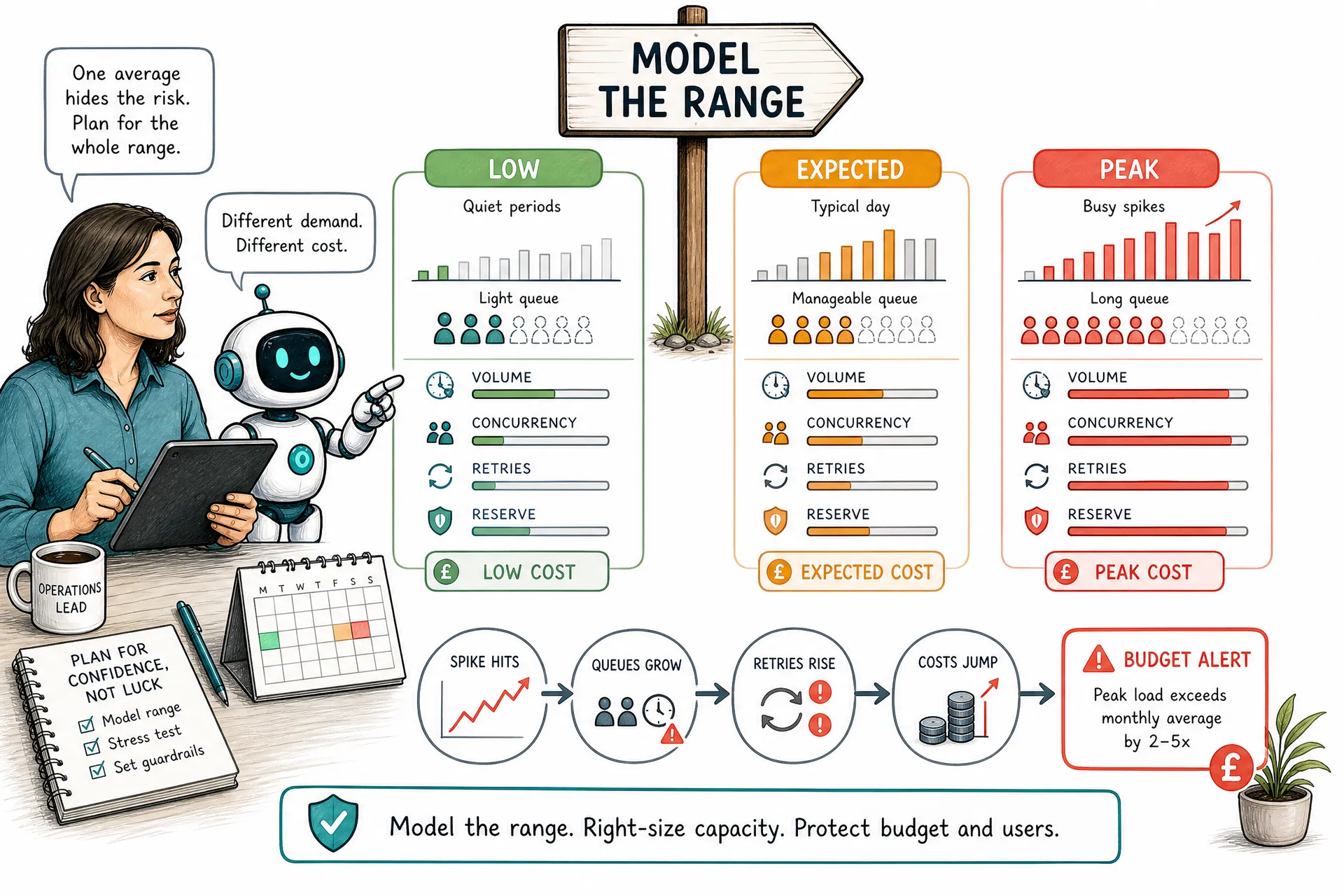
Google Cloud’s AI and ML cost guidance recommends tracking unit costs alongside business outcomes, assigning ownership, and using pilots, labels, dashboards, alerts, and feedback loops to manage costs over time. [2] That approach is more useful than setting a budget once and forgetting it.
Price infrastructure that the model invoice hides
Hosted model calls do not remove the rest of the application. Include API hosting, queues, databases, object storage, search indexes, caches, network transfer, backups, secrets management, authentication, and alerting. If the feature uses a GPU or CPU server that stays available, estimate idle time as well as active processing.
Do not assume that storage is negligible. Source files, extracted text, embeddings, conversation histories, audit records, evaluation sets, and logs accumulate. Retention rules can turn a small launch into a larger recurring bill. Data transfer can also matter when prompts, documents, or results cross regions or services.
If infrastructure is shared, choose an allocation rule. You might assign cost by requests, tokens, stored records, compute minutes, or a fixed percentage reviewed each quarter. Document the rule so finance and engineering can reproduce the estimate.
Include people, maintenance, and reliability work
A production feature needs more than code. Someone monitors errors, reviews quality samples, handles user reports, updates prompts, tests a model change, manages access, and investigates an unusual bill. Those hours are part of the feature’s cost even when they do not appear on the provider invoice.
Estimate the time required for launch and steady state separately. Launch work may include evaluation design, data cleaning, security review, integration, documentation, and staff training. Steady-state work may include weekly sampling, incident response, content updates, model comparison, and monthly cost reconciliation.
Reliability creates another layer. A retry can recover a temporary failure, but it can also create a second billable call. A fallback model can preserve service but change quality and price. A queue can smooth demand but add storage and delay. Write these paths down and assign a probability or scenario instead of pretending they do not exist.
Use a worked example with visible assumptions
Suppose a team expects 12,000 completed document-summary tasks each month. Each task averages 3,000 input tokens and 700 output tokens. The feature also makes one retrieval request, stores the source and result, and sends 4% of outputs to a human reviewer. The team uses an illustrative model rate, a small application service, shared search, logging, and a review rate per minute.
The estimate should show each assumption and its result. First calculate monthly input tokens: 12,000 × 3,000 = 36 million. Then calculate output tokens: 12,000 × 700 = 8.4 million. Apply the chosen rates separately. Add retrieval, storage, application hosting, observability, support, and the expected cost of the 4% review path. Add a reserve for retries and peak traffic.
The important result is not a single impressive total. It is a cost per completed task that another person can inspect. If review time doubles, if output length rises, or if a new model changes the rate, the owner can update the relevant line instead of rebuilding the whole budget.
Compare estimated cost with measured cost
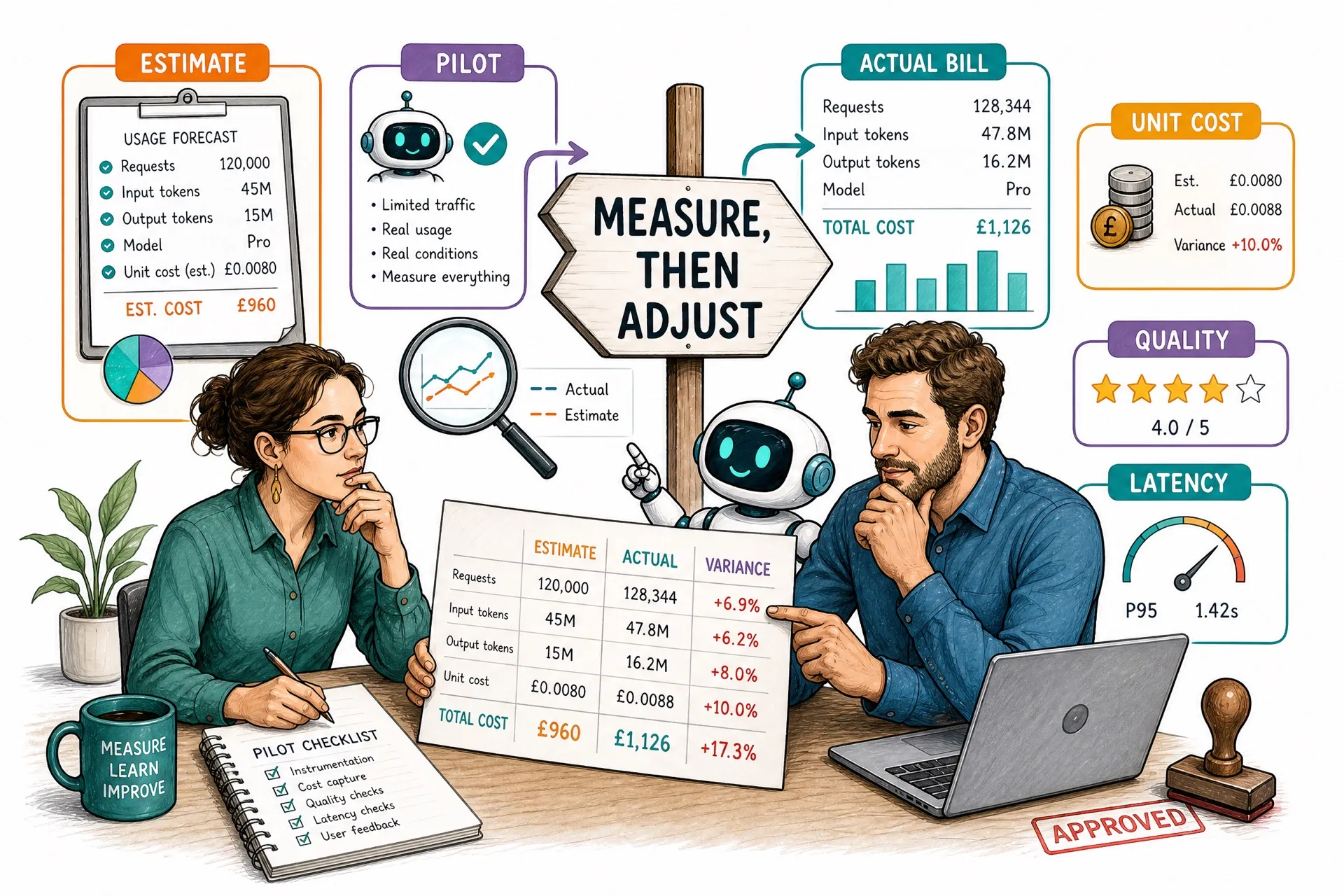
Before a full rollout, run a pilot using representative traffic. Include short and long inputs, normal and difficult documents, concurrent users, rejected requests, retries, and human corrections. Capture provider usage, infrastructure consumption, storage growth, latency, error rate, and business outcome.
Microsoft’s cost-management guidance recommends forecasting before release, exercising the system with realistic traffic, sorting observed billing by service and charge type, and comparing the results with the forecast. [3] Use that discipline even when your application is small.
Create a variance table after the pilot. If the model cost is higher than expected, check input length, output length, retries, and model selection. If infrastructure is higher, check idle capacity, logs, data transfer, or an overlooked service. If human-work cost is higher, investigate answer quality and workflow design instead of merely reducing the review rate.
Set unit-economics and safety gates
A feature can be affordable per task and still be a poor product investment. Compare cost with a meaningful outcome, such as a completed case, a saved staff minute, a qualified lead, a correctly extracted field, or a resolved support issue. Do not count every generated answer as value if people regularly discard it.
Set a maximum acceptable cost per successful task, a quality floor, a latency limit, and a monthly budget alert. Define what happens when one threshold is missed. The response may be a smaller model, shorter context, lower output limit, delayed batch processing, a manual route, or a pause while the team investigates.
Cost controls must not encourage unsafe shortcuts. Removing validation, privacy protections, monitoring, or human review may lower the invoice while increasing operational and legal exposure. Treat those controls as requirements in the estimate, not optional decoration.
Make the estimate a living operating record
Google Cloud recommends continuous measurement of costs, resource use, and business value, while Microsoft notes that AI-service charges are only part of the wider solution cost. [2] [3] Review the estimate after launch, after a model change, after a material traffic shift, and after an incident.
Keep the assumptions beside the code or service configuration. Record the model version, rates, token distributions, request volume, retry policy, infrastructure size, retention period, allocation method, and review process. Add the date of the last reconciliation and the person responsible for the next review.
A useful estimate is not a prediction that will remain correct forever. It is a transparent set of assumptions that helps a team notice when reality has moved. That makes the production decision clearer and gives engineers a practical route to lower cost without guessing.
| KEY TAKEAWAY: Estimate AI production cost per completed task, not per attractive demo. Count model calls, retrieval, hosting, storage, monitoring, retries, human work, peak capacity, and a risk reserve, then compare the estimate with measured usage during a representative pilot. |
|---|
| SAFETY CHECK: Do not cut validation, access controls, privacy safeguards, logging, monitoring, or accountable human review merely to reduce cost. Use approved services, protect sensitive data, reconcile bills with usage records, test failure paths, and define a human decision point before the feature affects people or important records. |
|---|