
An AI vendor can demonstrate a polished assistant in fifteen minutes. The demo may summarise a document, answer a customer, or turn a meeting into tasks. It may also avoid the questions that matter after adoption: where your data travels, who can reach it, how the model changes, and what happens when the service fails.
That gap makes AI vendor due diligence for small businesses a practical skill instead of an enterprise-only exercise. A small firm does not need a sixty-page tender pack for every writing assistant. It does need a repeatable way to match the tool with the work, expose material risks, record supplier answers, and stop a convenient trial becoming an uncontrolled dependency.
NIST presents its AI Risk Management Framework as a voluntary approach for considering trustworthy practice throughout an AI system’s lifecycle. Its four functions, Govern, Map, Measure, and Manage, give a small buying team a practical organising frame. [1] NIST’s Generative AI Profile also treats acquisition, cloud services, lifecycle changes, and third-party components as relevant parts of the risk picture. [2]
The UK National Cyber Security Centre advises small and medium-sized organisations to prepare response and recovery arrangements before a cyber incident. That principle belongs in AI procurement too. A supplier should explain how the customer can detect, contain, recover from, and learn from a serious failure. [3]
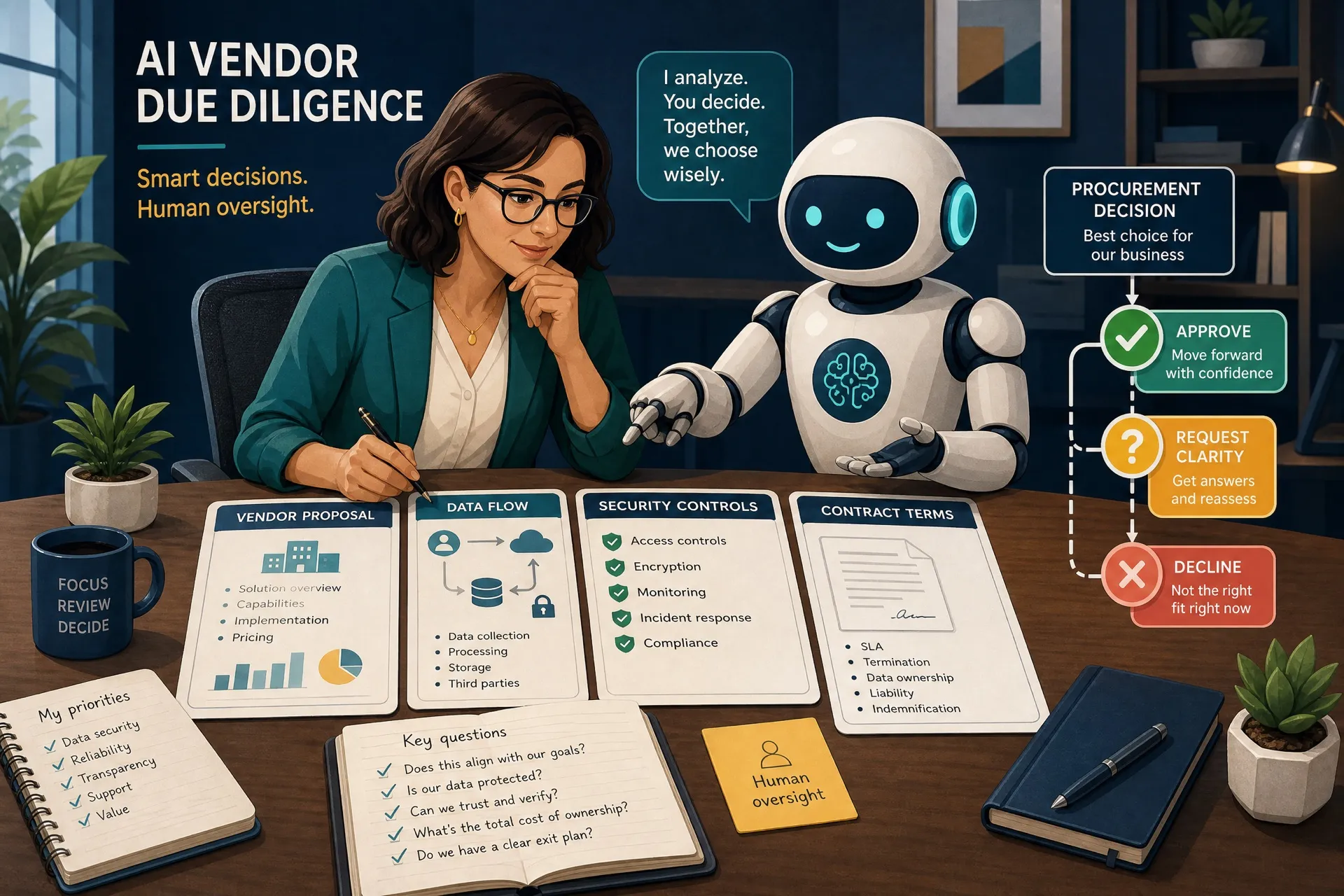
Start with the work, not the product catalogue
Write down the job before looking at vendor features. State who will use the system, what information it needs, what output it should create, and which actions remain with a person. “Help the support team draft replies from approved policies” gives a supplier review a boundary. “Buy an AI assistant” does not.
List the outcomes that would make the use unacceptable. The assistant must not expose one customer’s details to another, invent a refund promise, send an external message without approval, or retain confidential material beyond the agreed purpose. These examples help a team judge safeguards by consequence instead of by attractive interface elements.
Decide whether the tool produces information, recommends a decision, or performs an external action. A meeting summariser and a system that changes payroll records may both use a language model, but their procurement thresholds should differ. Match review effort to the harm that a mistake could cause.
Map the data before the demonstration
Create a short data map for the proposed workflow. List the information entered by staff, uploaded from files, retrieved from other systems, generated by the model, and sent to connected services. Mark personal data, confidential business material, regulated records, credentials, and commercially sensitive information.
Ask where each category is processed, stored, encrypted, backed up, and deleted. The answer should distinguish the vendor’s service from its subprocessors, analytics systems, support tools, and model-training pipeline. If the supplier uses several hosting regions or changes them by plan, record the condition that applies to your account.
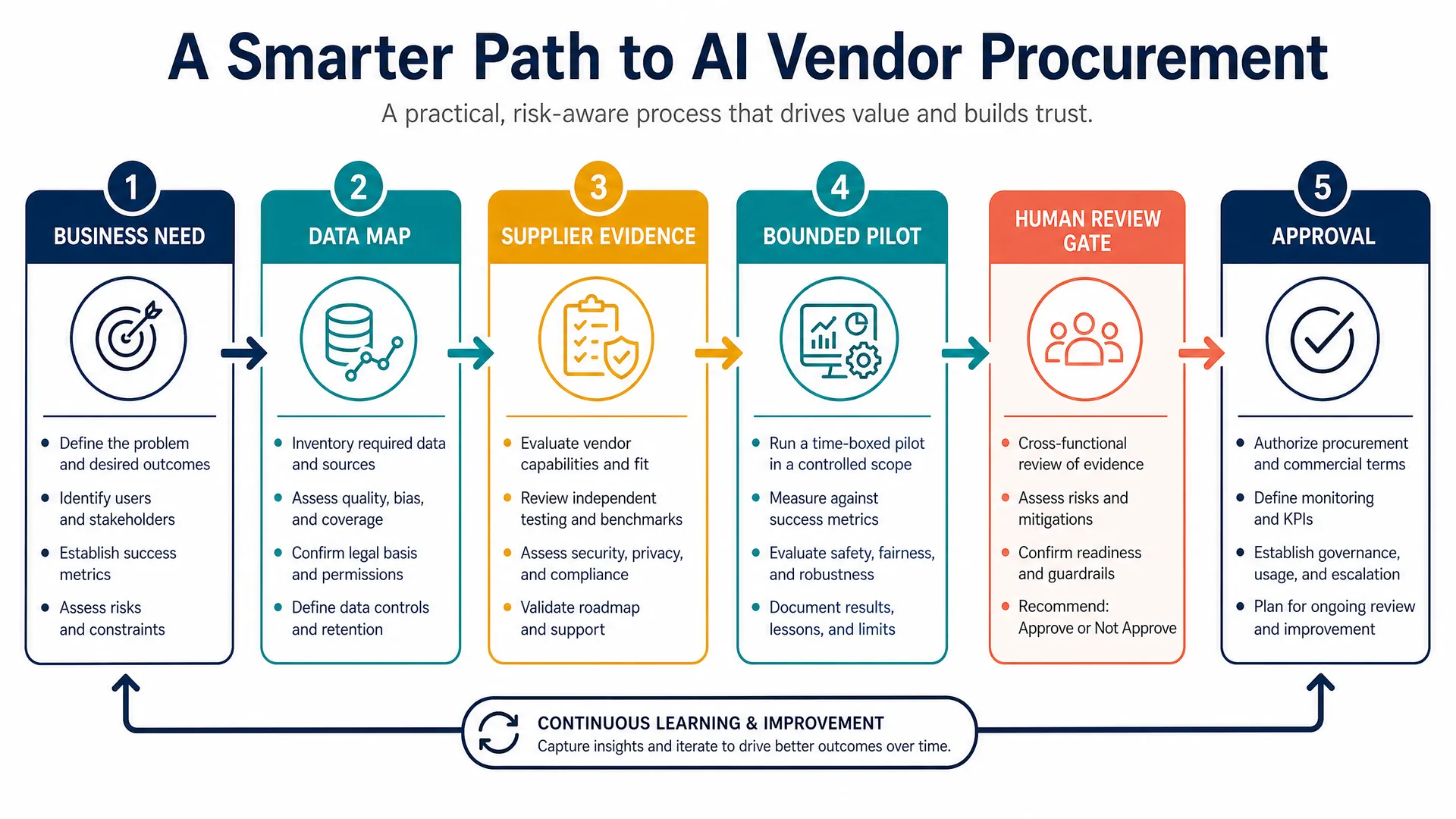
A vendor’s claim that it does not train on customer content may answer one question, but it does not describe every form of processing. Support access, abuse monitoring, retention of prompts, diagnostic logs, human review, and backup copies still require clarification. Request the policy page and the contract clause that support the answer.
Ask questions that produce evidence
A procurement conversation becomes useful when each answer can be checked. Ask the supplier to identify the policy, contract term, technical document, or report behind a claim. A sales statement can start the enquiry, but it should not close it.
A useful answer should also have a date and scope. “Encryption is available” leaves open the questions of which product tier, which data stores, and which traffic paths. Ask whether the statement covers the trial account, the paid plan, the connected integrations, and the support channel. Record exclusions beside the claim so a future user cannot mistake a narrow promise for a complete control.
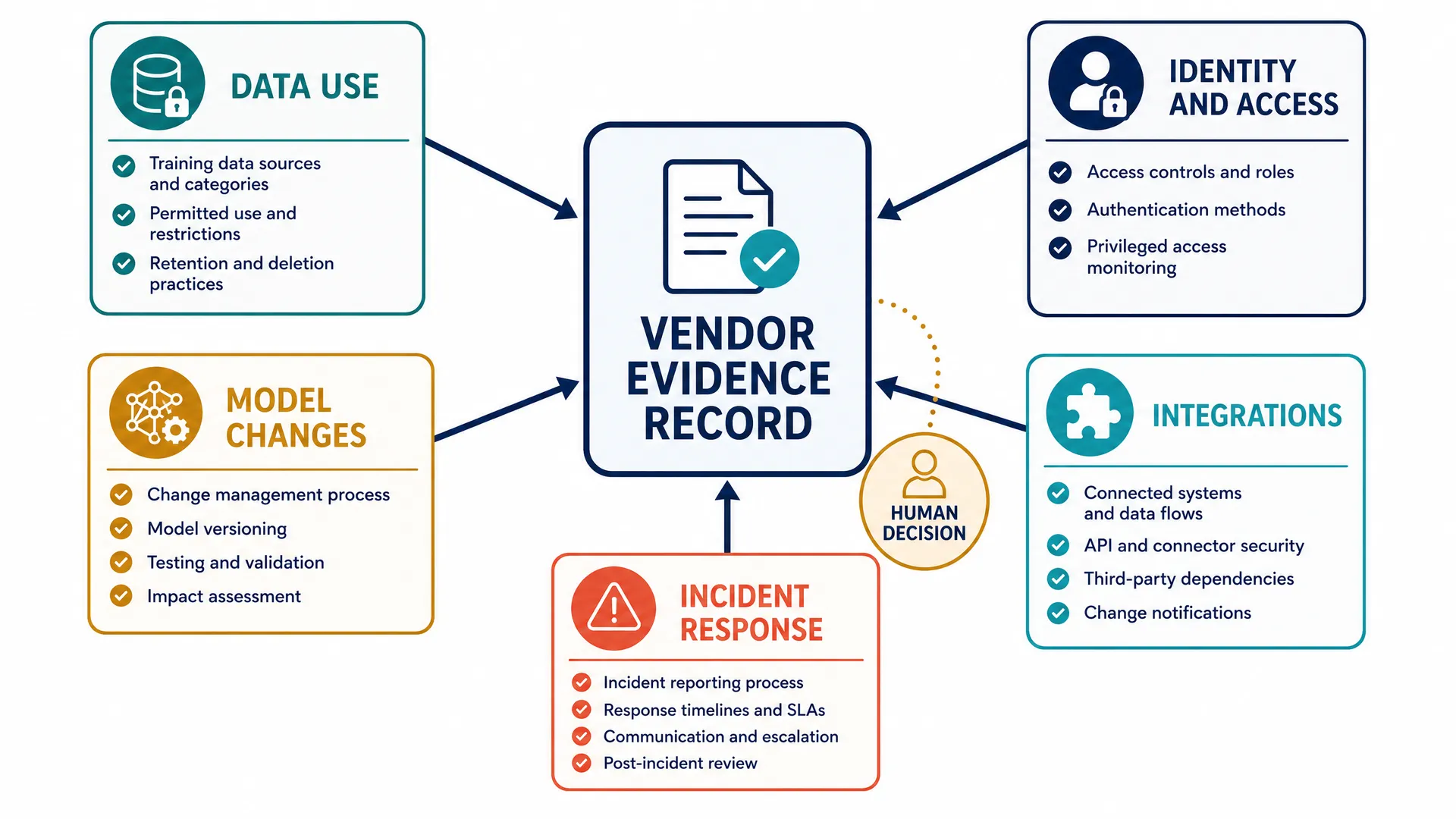
Use a question sheet with an owner and status. Record “answered in security addendum, section 4” instead of “vendor says secure”. Note what remains unknown and whether the uncertainty blocks the pilot, requires a contract change, or can be accepted for a low-risk use.
| Review area | Question to ask | Evidence to request |
|---|---|---|
| Data use | Is customer content used for training, evaluation, support, or abuse monitoring? | Current privacy policy and contract wording |
| Retention | How long are prompts, outputs, files, and diagnostic records kept? | Retention schedule and deletion process |
| Access | Which supplier roles can reach customer material, and under what approval? | Access-control description and audit evidence |
| Change | How are model, feature, region, and subprocessor changes announced? | Change-notice terms and release documentation |
| Recovery | How are incidents reported, contained, and investigated? | Incident process, contact route, and service commitments |
| Exit | Can the customer export, delete, and verify its information? | Export format, deletion method, and exit terms |
Examine identity and access controls
Check whether the service supports the identity controls your team already uses. Single sign-on, multi-factor authentication, role separation, administrator approval, session management, and audit records can matter more than a long list of model features.
Ask how a new employee receives access and how a departing employee loses it. Confirm whether a workspace administrator can view prompts, files, conversation history, usage records, or billing details. Find out whether users can create private workspaces that bypass the organisation’s review.
Integrations deserve a separate question. A tool connected to a help-desk, cloud drive, email account, or finance platform may inherit broad permissions. Request a list of scopes, default permissions, token controls, and approval steps. Start the pilot with the smallest dataset and narrowest connection that can prove the intended value.
Find out how the service changes
AI products can change without a new installation on your computer. The provider may replace a model, alter retrieval behaviour, add a feature, revise a safety filter, change a subprocessor, or move a capability into a new plan. Those changes can affect accuracy, cost, privacy, and the work a reviewer must perform.
Ask how much notice the supplier gives, what information the notice contains, and whether a customer can delay or reject a material change. Find out whether model identifiers, release notes, evaluation results, or API versions are exposed. If the provider offers a stable version, check its support period and price.
Keep a small baseline test set for the intended workflow. Include ordinary cases, incomplete information, sensitive content, a request that should be refused, and a case involving a connected tool. Run the set before the pilot and after material changes. A vendor’s benchmark cannot replace a test based on your own work.
Review reliability and human control
Ask what happens when the model is unavailable, slow, over capacity, or wrong. Does the application fail closed, fall back to another model, queue the request, or continue with an unreviewed action? The answer affects business continuity and the safety of the workflow.
Define the human checkpoint before signing up. A person should approve customer-facing claims, financial actions, access changes, employment decisions, and other consequential outcomes unless the team has documented a stronger control. The interface should make uncertainty, sources, missing information, and proposed actions visible.
Request service-level information that matches the intended use. Uptime alone may not describe delayed jobs, rate limits, response time, regional outages, or degraded model quality. Record the practical workaround: manual processing, a downloaded template, a second approved service, or a temporary pause.
Inspect contract, privacy, and exit terms
A free trial can hide the commercial conditions that govern a paid workspace. Read the privacy notice, data-processing terms, acceptable-use rules, security addendum, service terms, and support commitments that apply to the plan under consideration. Save copies with the procurement record because web pages can change.
Look for language covering ownership, licence to process content, training, subprocessors, international transfers, confidentiality, breach notification, audit rights, deletion, backups, and liability. A small business may not negotiate every term, but it can identify a clause that conflicts with the proposed use and seek a written clarification.
Plan the exit before adoption. Decide how the team will export prompts, files, configuration, logs, evaluation results, and user records. Establish who will confirm deletion, how long backups remain, and how connected tokens will be revoked. An exit test can be a small exercise instead of a theoretical paragraph.
Use a scored decision sheet, not a single security badge
A certification, questionnaire, or reassuring logo can provide evidence, but none should decide the purchase alone. Score the tool against the work it will perform. Use a simple scale such as green, amber, and red, with a written reason for every amber or red result.
A green result means the team has evidence and the control fits the use. Amber means a limitation needs a compensating control, restricted pilot, contract clarification, or named acceptance. Red means the proposed use should stop until the supplier or internal design changes.
| Decision factor | Green condition | Amber condition | Red condition |
|---|---|---|---|
| Data boundary | Processing and retention match the approved use | Some detail awaits written confirmation | Supplier cannot explain data handling |
| Access | Least-privilege roles and strong sign-in are available | Manual reviews cover a control gap | Broad access cannot be restricted |
| Change visibility | Material changes are announced and testable | Notices are incomplete | The customer cannot identify material changes |
| Human control | Consequential actions require approval | A narrow exception has monitoring | The tool can act without a workable stop |
| Exit | Data and configuration can be exported and deleted | Export needs a manual process | No credible exit or deletion route exists |
Run a bounded pilot before wider adoption
A pilot should test the actual job, not provide a free period for enthusiastic experimentation. Choose a limited user group, approved data, a defined duration, a baseline test set, and a named owner. Keep production credentials and high-risk integrations outside the first trial unless the review specifically covers them.
Measure useful outcomes: time saved, correction rate, missed refusals, source accuracy, user adoption, support effort, cost per task, and incidents or near misses. Ask users to record examples where the tool created extra work. A pilot that produces fewer minutes but more checking may not improve the process.
Set a decision gate before the pilot starts. Continue when the intended value appears with manageable risk. Narrow the use when evidence is mixed. Stop when the supplier cannot answer a material question, the workflow behaves unsafely, or the team cannot supervise the output.
Keep the review alive after purchase
Vendor due diligence is not a one-time form. Review the supplier when the model, data source, integration, plan, contract, ownership, or business use changes. Revisit the baseline tests after a material release and after any incident.
Keep one evidence record containing the approved use, data map, supplier answers, contract version, pilot results, decision, owner, review date, and exit plan.
Give the record a review trigger. A new model, altered retention policy, added connector, material price change, security incident, or change of business purpose should reopen the assessment. The trigger can sit in a calendar, ticketing system, or shared register. Its value comes from linking a real event to a named person and a defined question.
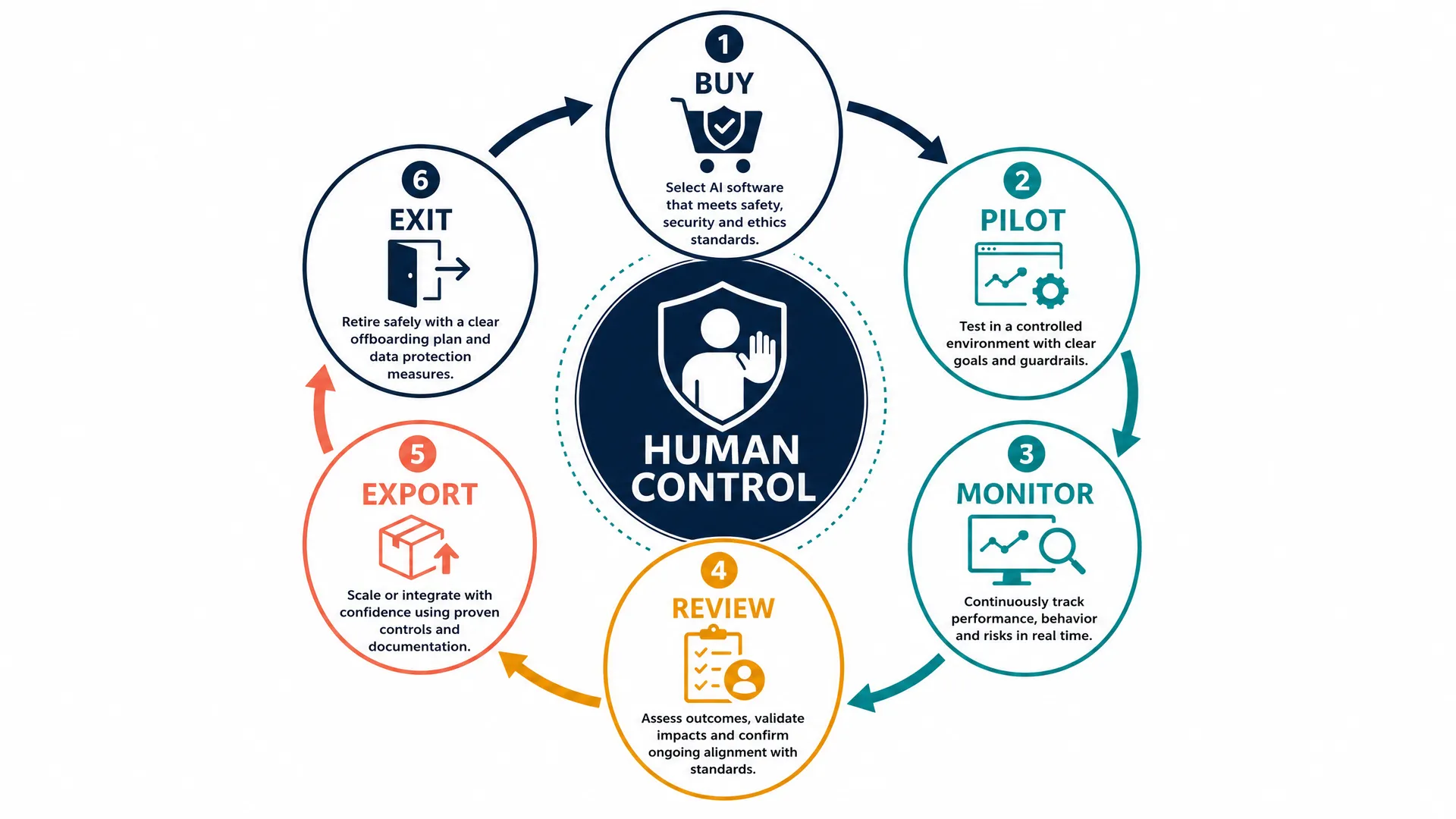
Store the evidence record where another colleague can find it. This record turns a purchase into a governed business decision instead of a forgotten trial.
Assign responsibilities before the contract is signed
A supplier review can fail because everyone assumes someone else owns the unanswered question. Name the person who approves the use case, the person who checks data protection, the person who tests the workflow, and the person who can suspend access. One individual may hold several roles in a small firm, but the responsibilities should remain visible.
Give users a route for reporting a wrong answer, unexpected disclosure, suspicious output, missing feature, or supplier change. A report should capture the account, workflow, time, input category, output, action taken, and immediate containment without asking staff to copy unnecessary personal data. Review reports at an agreed interval and escalate patterns instead of treating each event as an isolated annoyance.
Ask the supplier what cooperation is available during an investigation. Can the team obtain relevant timestamps, request identifiers, access records, or a technical explanation? Is there a named support route for a suspected compromise? A small business may not receive every internal detail, yet it should know what information can be requested and how quickly the request is handled. Put that route in the supplier record, including the account owner, support portal, emergency contact, and the evidence the team should preserve before changing settings. This preparation reduces delay when a quiet configuration problem becomes a customer-facing incident.
The strongest small-business AI procurement process is selective. It spends little time on low-risk drafting and more time on data movement, permissions, external actions, model changes, evidence, recovery, and exit. That balance lets a team adopt useful technology without pretending that a vendor demo answers every operational question.
| KEY TAKEAWAY: Before buying an AI tool, define its job and unacceptable outcomes, map the data, demand evidence for supplier claims, inspect identity and integration controls, test model changes, agree human checkpoints, plan recovery and exit, and run a bounded pilot before wider use. |
|---|
| SAFETY CHECK: Do not upload personal, confidential, regulated, or credential data to an AI service until the intended processing, retention, access, training use, contractual terms, and deletion route have been reviewed and approved. Treat vendor marketing as a starting point for evidence, not as proof. |
|---|