
AI governance is often pictured as an enterprise programme, complete with lawyers, risk panels, and shelves of policy binders. A small team needs a leaner arrangement. Its purpose is to make consequential choices visible before an AI feature touches customers, staff, or private information. Routine prompts need not become committee business.
A useful governance framework gives the team six working answers. It records the system’s purpose, permitted data, accountable owner, human review point, evidence of acceptable behaviour, and response to change or failure. NIST’s AI Risk Management Framework connects governance with mapping, measurement, and management when teams seek trustworthy AI practices. [1]
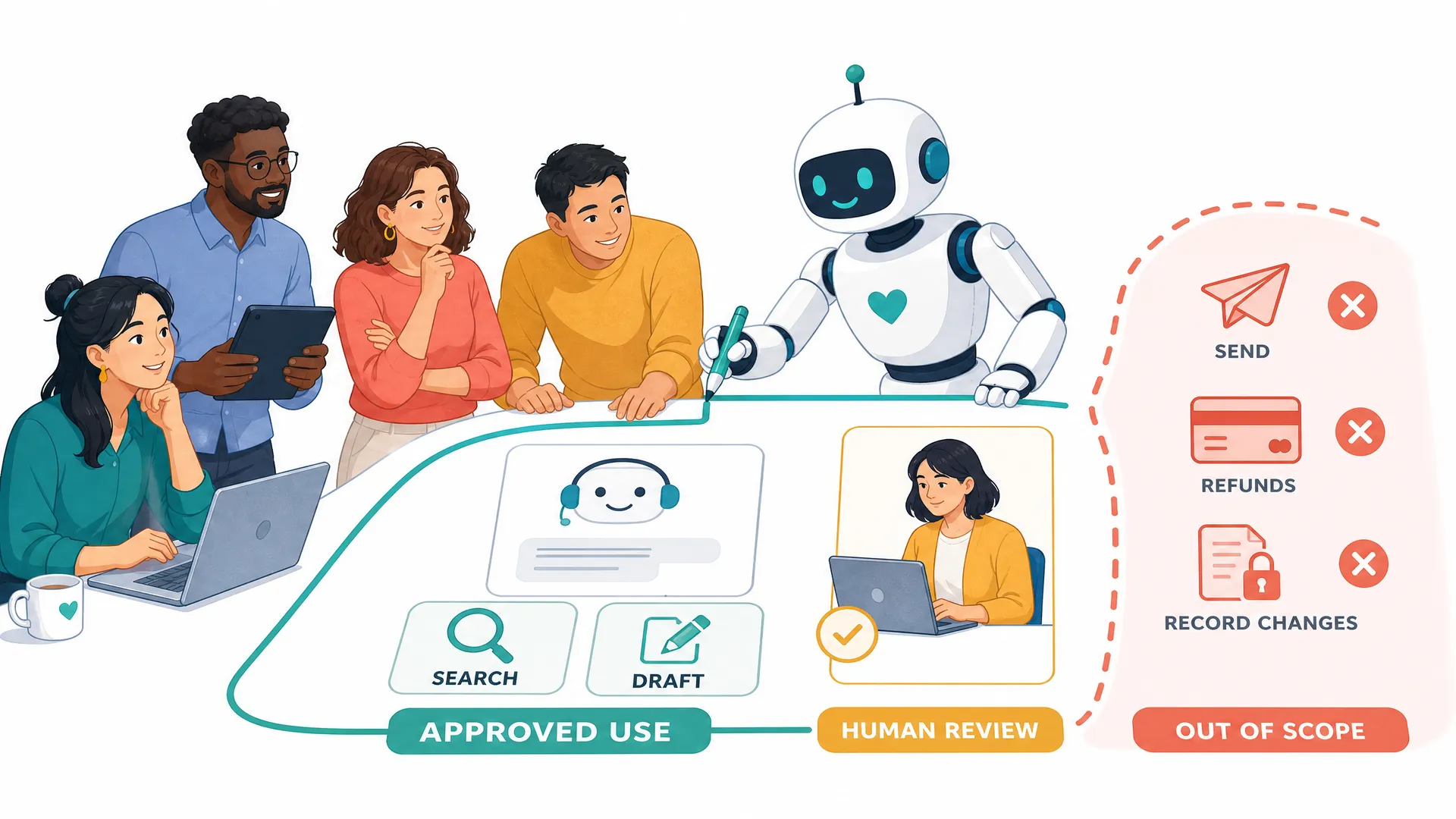
The examples below follow a small team building a customer-support assistant. It searches a controlled help library and prepares replies for a trained adviser. It cannot issue refunds, edit account records, or send messages on its own. A boundary like this converts an abstract policy discussion into decisions the team can test.
Start with one approved use case
A governance policy becomes difficult when it begins with a slogan such as “Use AI responsibly.” People need a decision they can apply during a busy afternoon. Write one approved use case in plain language. Name the user, the task, the permitted inputs, the expected output, and the action that remains under human control.
For the support assistant, the statement might read: “A support adviser may use the approved assistant to find information in the published help centre and prepare a draft response. The adviser must check the draft before sending it. The assistant must not make promises about compensation, change a customer record, or infer a sensitive personal characteristic.”
This compact rule is more useful than a broad promise. It describes the permitted route and gives the team a reference point for later requests. If a colleague wants to paste an entire customer history into a public chatbot, the answer is not hidden inside a long policy. The proposed action sits outside the approved use.
Keep the first register small. Record the use case, owner, data classification, model or vendor, human decision point, known risks, test set, review date, and retirement condition. A spreadsheet can work if the team can find it and keep it current. The register is not a trophy. It is a shared memory for decisions that would otherwise live in private conversations.
Assign ownership without creating a committee
A small organisation may have many people interested in an AI feature, but interest does not identify the person who can stop it. Name one lead for the use case. The lead coordinates evidence, signs off routine changes, and raises anything that crosses the agreed risk limit. Other colleagues can contribute without carrying unclear accountability.
Add colleagues to the working group only when their knowledge changes a decision. A product lead can describe the desired result. An engineer can check integrations and permissions. A subject specialist can assess the answers. A privacy or security adviser can examine information handling. In a small organisation, one colleague may cover several duties, provided the record names the duty performed each time.
Set a route for difficult decisions instead of arranging a meeting for every question. A routine prompt edit may need the use-case owner and a regression test. A new data source may need privacy review. A feature that ranks applicants, recommends medical action, approves credit, or sends external communications needs a more formal decision. The rule should explain the trigger, required evidence, and approver.
Create a data boundary people can remember
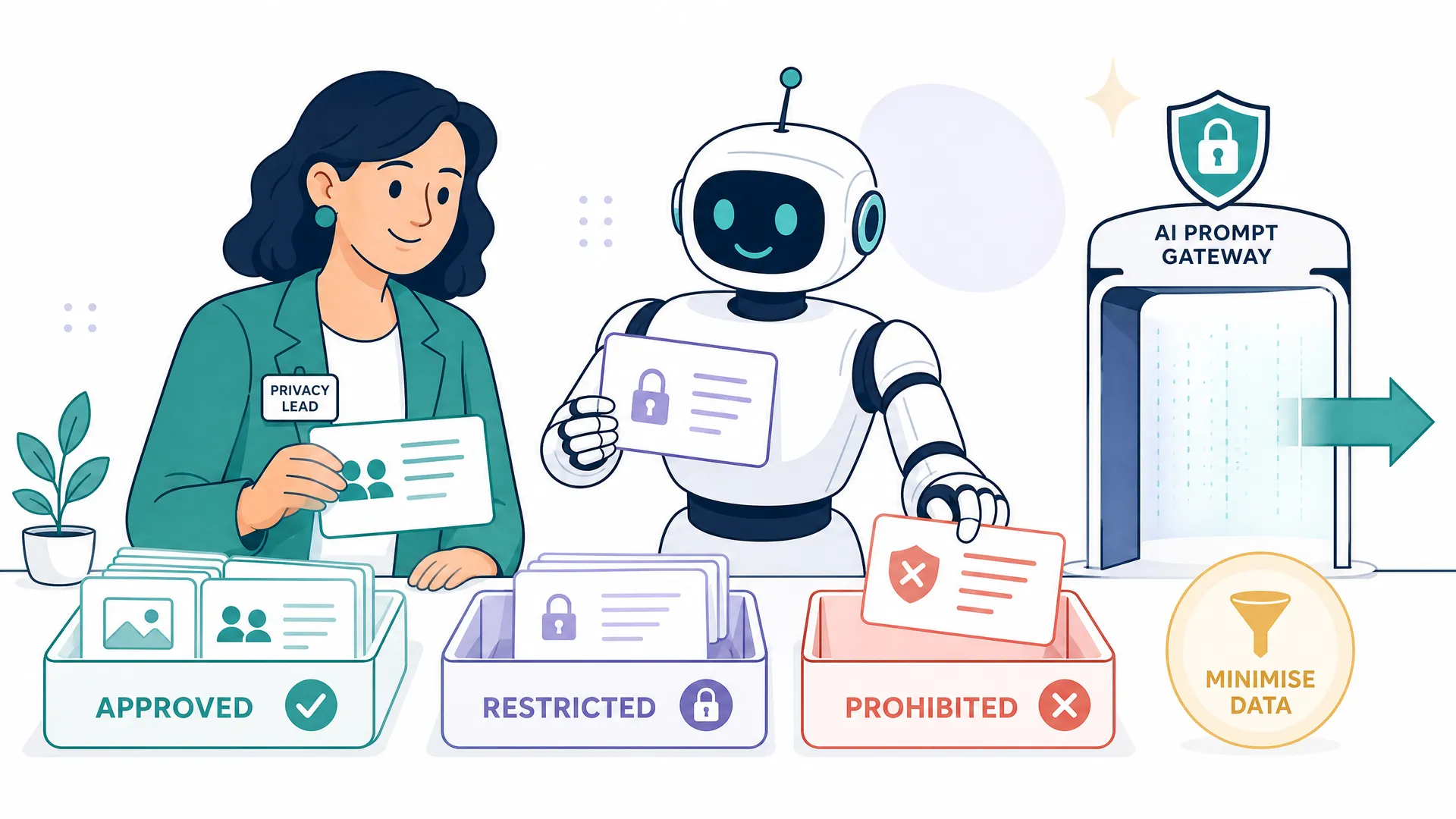
AI governance fails quickly when employees cannot tell what information may enter a tool. “Do not share confidential information” is too broad to guide behaviour. Classify practical examples before staff begin using the tool. Approved public content might include published help pages and product documentation. Restricted content might include internal procedures, unreleased pricing, and staff contact details. Highly sensitive material might include credentials, identity documents, health information, payment details, and private customer conversations.
The assistant’s data rule should match its design. If the system only needs published help articles, block customer case notes from its retrieval index. If a support draft needs a case identifier, provide a controlled reference instead of the customer’s entire history. Remove unnecessary fields before a prompt is created. The ICO’s guidance highlights accountability, transparency, fairness, security, and data minimisation across the AI lifecycle. [2]
A data boundary also covers the vendor relationship. Record whether prompts are retained, whether submitted data is used for provider training, where processing occurs, which sub-processors are involved, and how deletion works. Do not turn uncertain vendor language into a confident internal promise. Mark unanswered questions and assign an owner to resolve them.
Separate assistance from authority
An AI system can suggest an action without being allowed to take it. This distinction should appear in the product design, the written rule, and the test plan. A drafting assistant may propose wording. A person decides whether the wording is accurate, appropriate, and authorised.
List actions in four groups: inform, recommend, prepare, and execute. Informing can include summarising an approved document. Recommending can include proposing a category for a support case. Preparing can include drafting a reply. Executing can include sending the reply, changing a record, issuing money, or disabling access. The last group needs stronger controls because an incorrect suggestion becomes an external consequence.
Require confirmation at the point where harm becomes possible. The reviewer should see the source material, the proposed action, and any uncertainty that matters. A hidden approval box is not meaningful oversight if the person cannot inspect what the system used. The OECD AI Principles emphasise human-centred values, transparency and explainability, robustness, security and safety, and accountability. [3]
Write rules for acceptable uncertainty
A fluent answer can still be wrong. Governance should define what the assistant must do when evidence is missing, sources disagree, or confidence is low. For the support example, the safe response may be to say that the available articles do not answer the question and route the case to a specialist.
Turn uncertainty into observable behaviour. Require citations or source links for factual drafts. Instruct the assistant to distinguish an article’s wording from its own inference. Add a refusal route when the request asks for restricted information. Make the interface show whether a result came from an approved source, a general model response, or a human edit.
Do not use a numerical confidence score as a substitute for judgement. A score can look precise while hiding a weak dataset or a narrow test. Define the conditions that require human investigation: an unsupported claim, a missing source, a request involving a vulnerable person, a policy exception, or a proposed action outside the assistant’s authority.
Use a small but serious test set
Governance needs evidence, not only intentions. Build a test set from realistic examples and include cases that should fail. A support assistant should face a normal product question, an outdated article, and conflicting instructions. Add an attempt to obtain another customer’s information, an ambiguous request, a prompt injection inside a document, and a question with no approved answer.
Record the expected behaviour for each case. The expected result may be a sourced draft, a clarification question, a refusal, or a hand-off. Ask a domain reviewer to judge accuracy, tone, completeness, privacy, and escalation. Run the same set after a model change, retrieval change, prompt change, vendor change, or access-control change.
| Governance area | Small-team control | Evidence to retain |
|---|---|---|
| Purpose | One approved use-case statement | Owner and scope record |
| Data | Classification and input boundary | Data map and vendor answers |
| Authority | Human approval for consequential actions | Screen flow and access test |
| Quality | Fixed examples, including failure cases | Test results and reviewer notes |
| Security | Least privilege, secret controls, audit trail | Configuration review and logs |
| Change | Trigger-based review after material changes | Change record and approval |
| Incident | Pause, investigate, notify, and learn | Incident note and corrective action |
Protect the workflow, not only the model
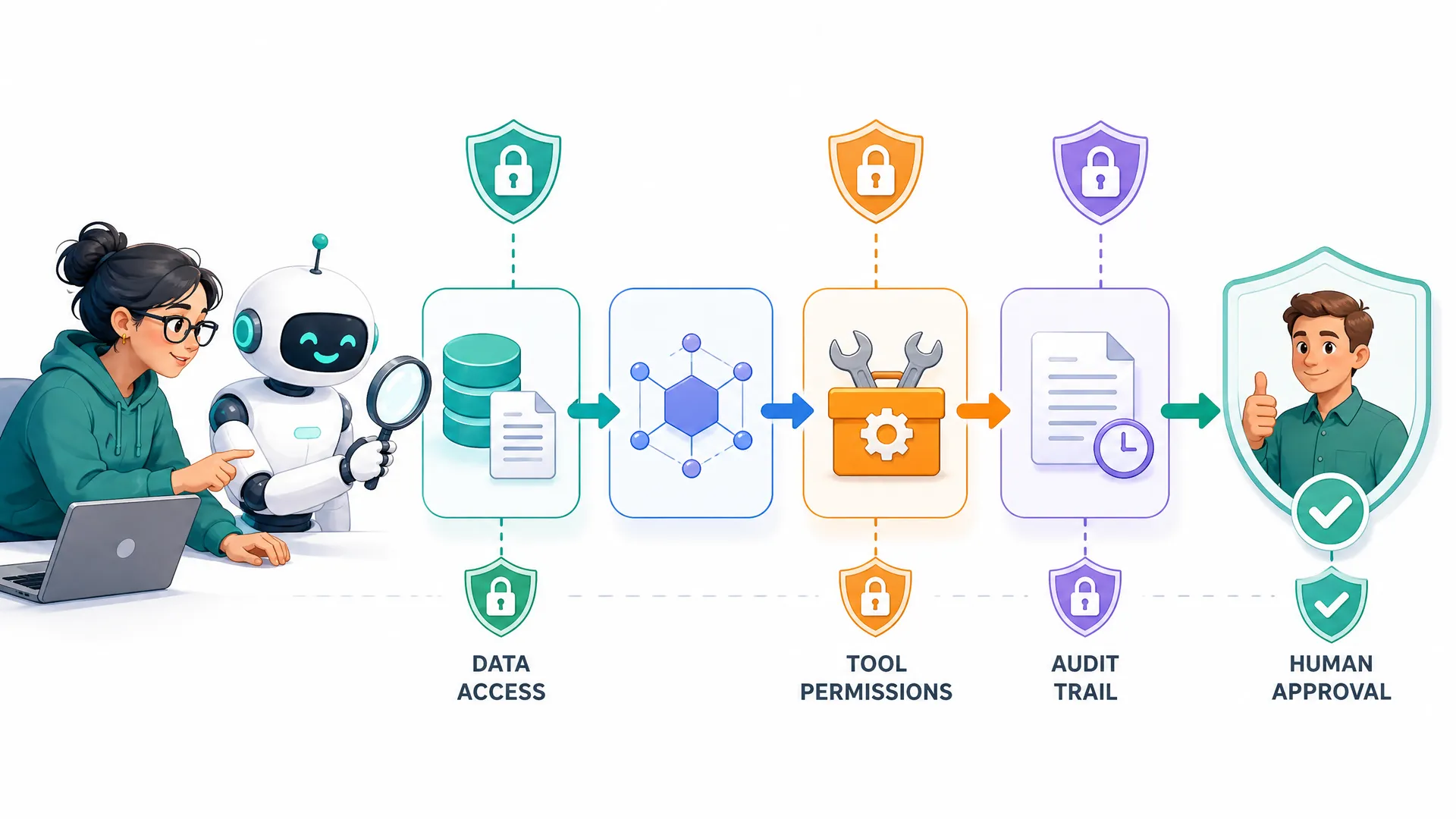
A team can choose a reputable model and still create an unsafe application. The surrounding workflow controls what enters the system, who can use it, where outputs travel, and what gets recorded. Review identity and access, prompt construction, retrieval filters, tool permissions, logging, retention, and export routes.
Apply least privilege to service accounts. A drafting assistant rarely needs permission to alter a customer database. Keep secrets out of prompts, source files, screenshots, and debugging transcripts. Restrict the retrieval index by user role. Test whether a normal adviser can retrieve another customer’s record by changing an identifier or asking an indirect question.
Logging needs a deliberate balance between evidence and exposure. Retain enough information to investigate a failure, but do not create a second uncontrolled copy of sensitive material. Store event identifiers, policy decisions, model version, source identifiers, and reviewer outcomes where full text is not needed. Define who may access logs and when they are deleted.
Make change management proportionate
Not every edit deserves the same review. A spelling correction in a private prompt is different from a new model, a new retrieval collection, or a connector that can send messages. Define change levels before the team is under delivery pressure.
A low-impact change might require the owner, a focused test, and a short record. A material change might require data review, security checks, regression testing, and approval from a domain expert. A high-impact change might require a formal impact assessment, a staged release, monitoring, and a named rollback decision.
The trigger list should include model replacement, provider terms, new personal data, new user groups, and new jurisdictions. Add new external actions, altered retention, a material quality drop, a serious incident, or a changed business decision. This approach keeps review effort connected to risk instead of the number of lines changed.
Give people a route to challenge the result
An affected person may need more than a generic support address. If AI contributes to a recommendation, classification, or customer response, staff should know how to flag an error and obtain human review. The route can be modest: a visible escalation button, a case label, and an owner who receives the report.
Record the issue without blaming the user. Capture what the system produced, which source it used, what the reviewer expected, who was affected, and whether the output was sent or acted upon. Triage incidents by potential harm. A minor tone problem may need a prompt adjustment. A privacy disclosure, discriminatory recommendation, or unauthorised transaction requires immediate containment and senior review.
A pause mechanism matters. The owner should know how to disable the feature, remove a bad source, revoke a connector, or return to a manual process. A governance plan that cannot stop its own system is an aspiration, not a control.
Review governance on a useful rhythm
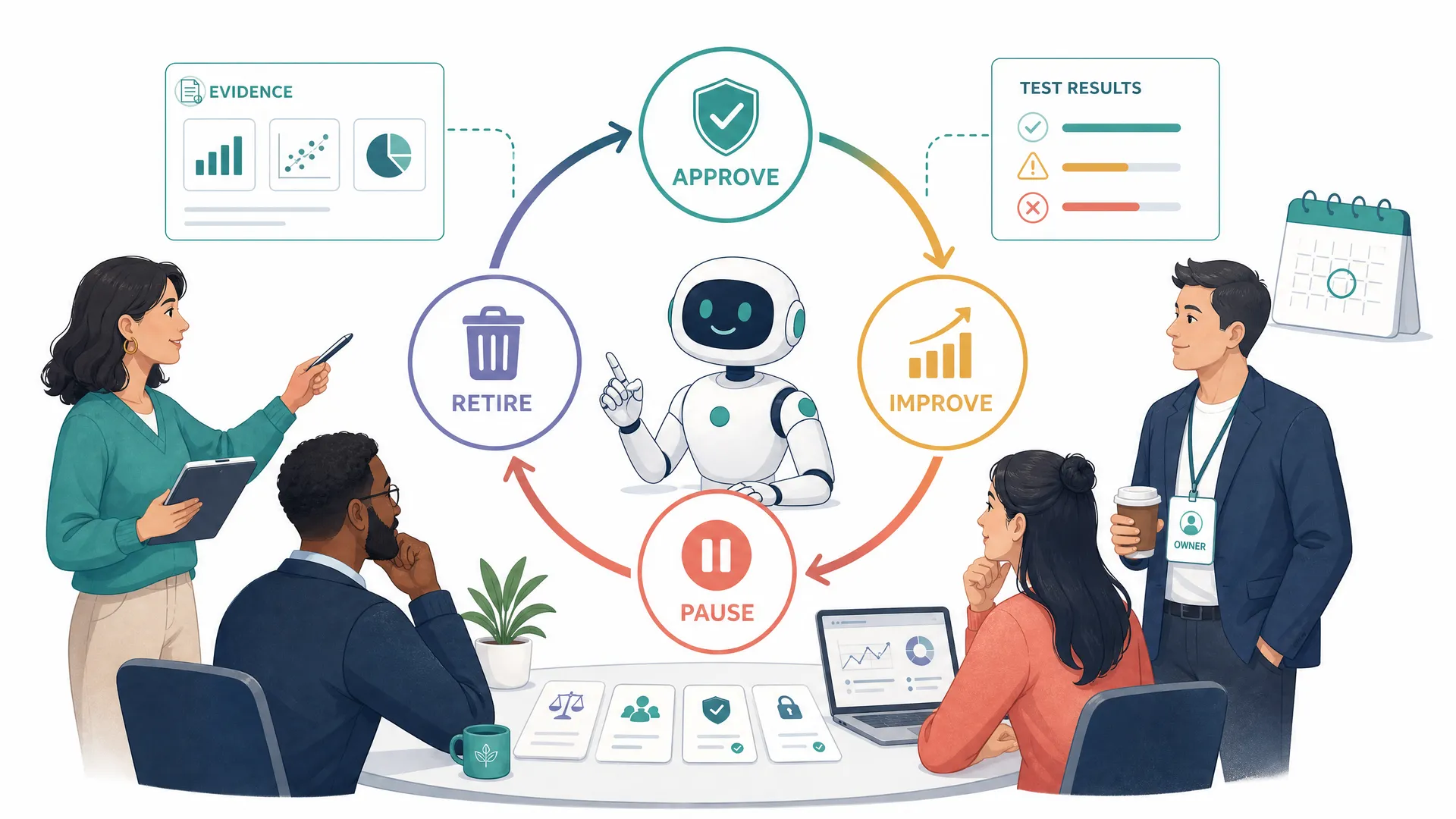
Set a review date and event-based triggers. A quarterly review may suit a stable internal assistant. A fast-changing product may need a monthly check. Review after an incident, supplier change, new data source, major model update, or significant shift in users.
Use the review to ask practical questions. Did the system stay within its approved purpose? Did people bypass the data boundary? Which failure cases appeared in live use? Did the model or provider change? Are the logs sufficient? Does the human approval step still work under pressure? Should the use case expand, remain bounded, pause, or retire?
Keep a decision record with the current owner, approved scope, test results, open risks, changes since the last review, and next actions. Short records are more valuable than abandoned policy documents. The OECD presents its principles as adaptable guidance for public authorities and organisations. That supports proportionate controls instead of a fixed bureaucracy. [3]
A lightweight governance sequence
First, write the approved use case and name its owner. Next, classify the data and define the actions the system cannot take. Then identify the human decision point, create a test set, and protect the workflow with suitable access controls.
Before launch, record the vendor questions, run normal and adversarial examples, and decide what evidence the team will retain. Release to a limited group. Monitor errors, escalations, data-boundary breaches, and attempts to use the assistant outside its purpose.
After launch, review on a fixed rhythm and after material events. Keep the rule set close to the product documentation. When the system changes, repeat the checks that match the change. When evidence no longer supports safe operation, pause the feature while the owner investigates.
| KEY TAKEAWAY: Small-team AI governance works when it turns broad principles into visible decisions: one approved purpose, one accountable owner, a remembered data boundary, human authority over consequential actions, evidence from realistic tests, and a reliable pause route. |
|---|
| SAFETY CHECK: Do not place credentials, private customer records, health information, payment details, or unrelated confidential material into an AI tool. Use approved services, restrict access, verify vendor terms, test failure cases, require human review for consequential actions, and pause the workflow when evidence no longer supports safe use. |
|---|