
An AI assistant can become part of a team’s daily rhythm before anyone notices how much work depends on it. A support adviser asks for a draft, a retrieval service supplies the context, and a model prepares the reply. Then the provider times out, the search index fails, or a usage limit blocks the request.
The immediate problem is not only the outage. It is the absence of a prepared alternative. If colleagues do not know what to do next, they may copy sensitive information into an unapproved tool, promise a response the system cannot support, or leave urgent work unowned.
An AI fallback plan defines the safe route when an AI workflow cannot perform its normal job. The route might be a human process, a smaller local function, a controlled queue, a cached set of approved material, or a temporary pause. It should not attempt to reproduce every feature during a failure.
The NIST framework offers a voluntary reference for deciding whether trust-related concerns have been considered as an AI service is planned, operated, and reviewed. [1] Google Cloud’s reliability guidance explains graceful degradation as continued service with reduced performance or accuracy instead of total failure. It recommends throttling, early rejection of excess requests, handling partial errors, testing overload, and watching traffic spikes. [2]
The running example is a service desk helper that consults an authorised knowledge library before preparing a reply for a staff member. The principles also apply to internal search, document classification, meeting summaries, and other small-team AI workflows.
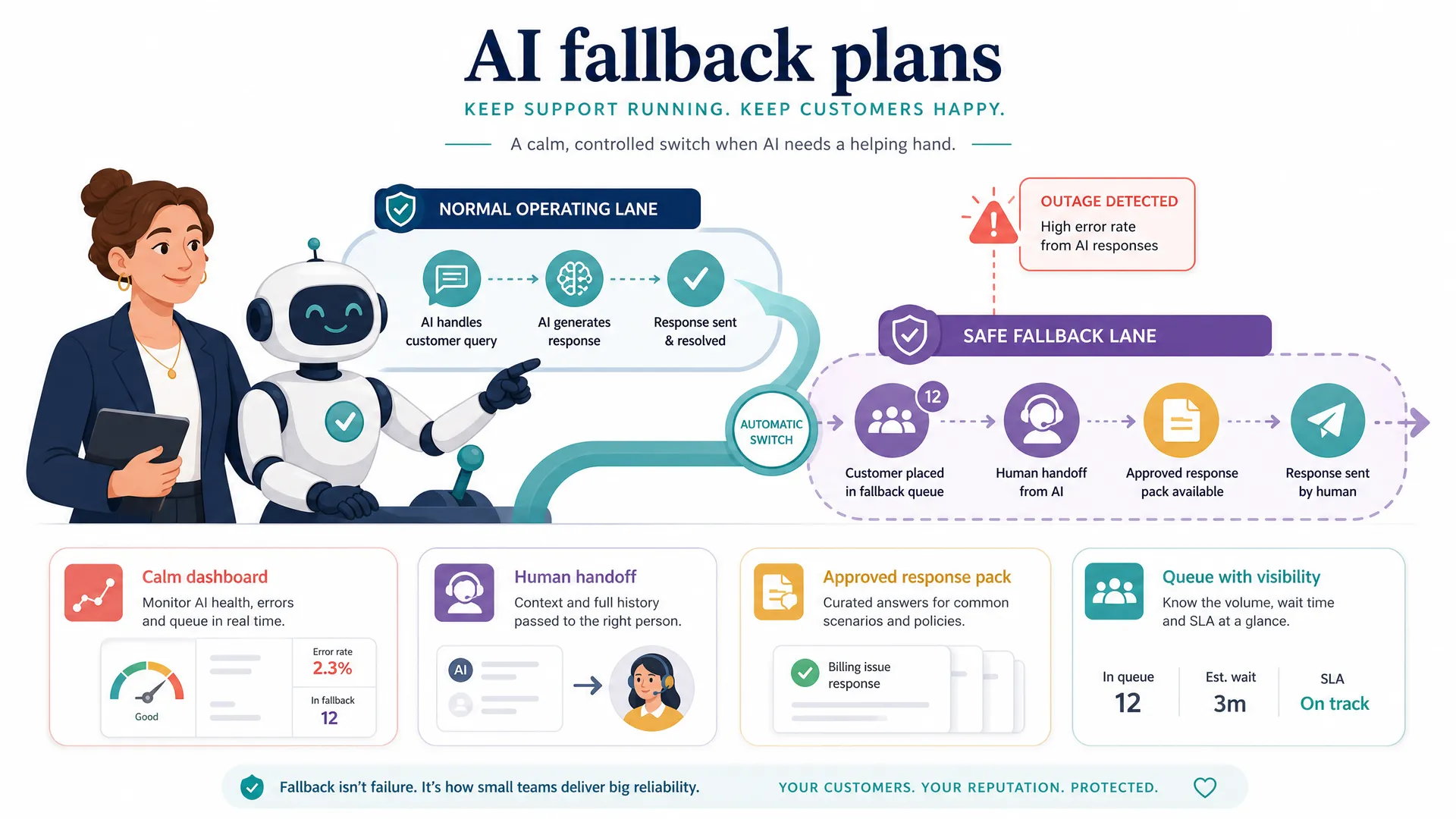
Decide what must continue
Begin with the business outcome instead of the model. A support service may need to acknowledge urgent cases, protect customer information, preserve a queue position, and provide an accurate answer for common questions. The AI draft is one way to help. It is not the outcome itself.
List the tasks that must continue during an outage. A team may need to receive new requests, identify priority, send a holding message, answer a small group of known questions, and record work for later completion. Other activities, such as generating a long explanation or summarising a low-priority conversation, can wait.
Classify each task by harm, urgency, and reversibility. A delayed product-description draft has a different consequence from an incorrect medical instruction, an unauthorised account change, or a missed safety complaint. The higher the potential harm, the stronger the human route and the narrower the automated fallback should be.
Write the degraded service in one sentence. For example: “When the drafting assistant is unavailable, advisers use the approved response pack and record unresolved cases. Restricted topics go to a specialist.” This gives the team a shared operating rule.
Map every dependency
An AI feature rarely fails in one place. Its route may include identity management, a user interface, an API gateway, a model provider, a retrieval index, a document store, an attachment parser, a queue, a logging service, and a notification channel. A fallback that covers only the model can fail when the surrounding components are unavailable.
Draw the normal path in plain language. State what enters the system, where it is transformed, which service makes a decision, where evidence comes from, and what leaves the workflow. Mark each dependency as required, optional, or replaceable during degraded operation.
Record the failure signal for each dependency. A timeout is different from an authentication error. A partial search result is different from an empty index. A provider response may arrive after the user interface has stopped waiting. These distinctions affect whether the team retries, queues, switches route, or stops.
Assign an owner to each dependency and to the fallback decision. Small teams should avoid a long committee structure. One person can coordinate the response, while named colleagues own the provider, source library, support queue, security check, or customer message.
Design a human route that can work under pressure
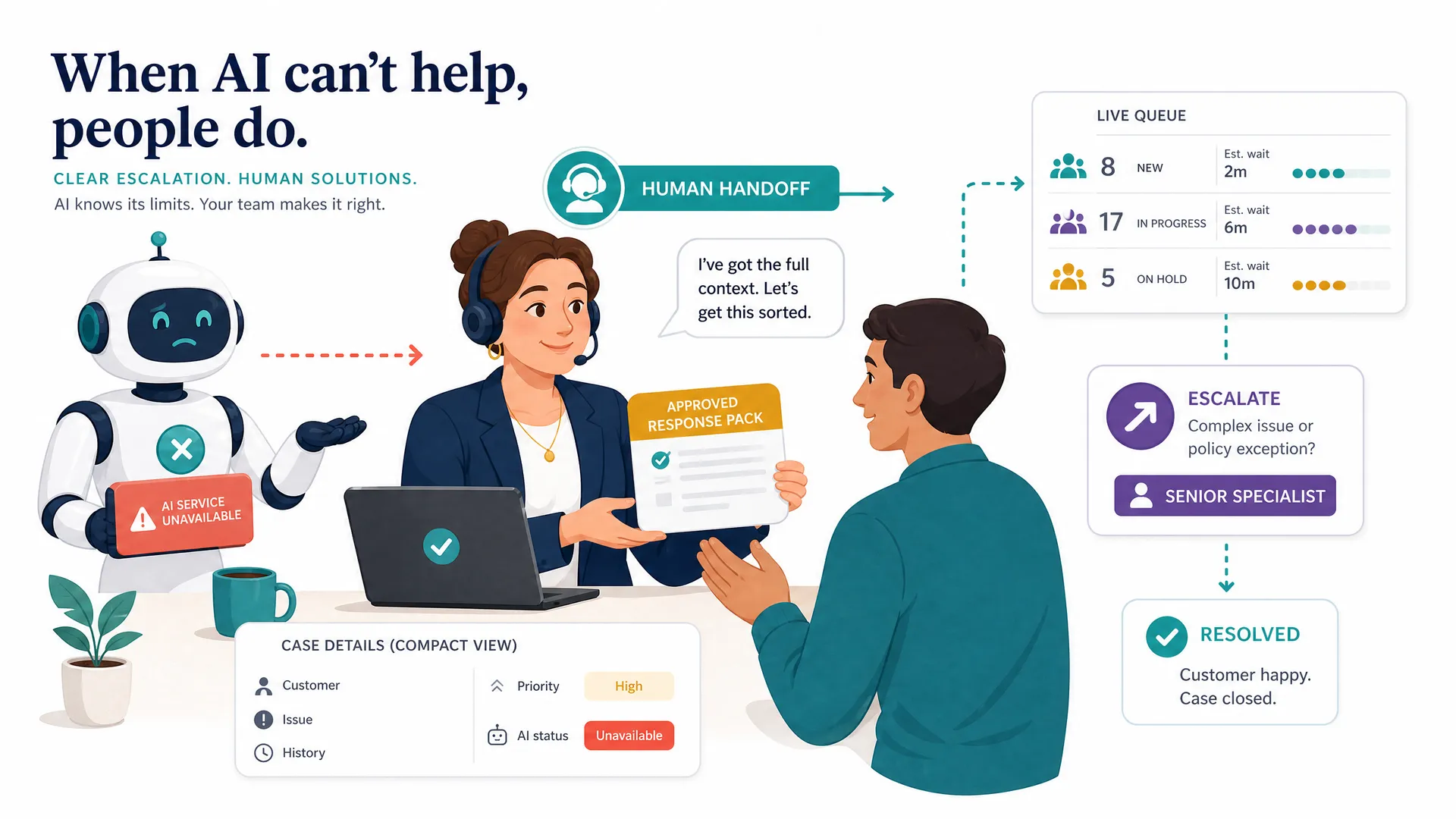
A manual fallback is not a vague instruction to “handle it by hand”. Give advisers the information and authority needed to complete the reduced service. Provide a short response pack, escalation contacts, source links, case fields, and a rule for requests that cannot be answered safely.
Keep approved material available without depending on the failed path. A controlled document pack can cover common questions, service-status messages, opening hours, refund boundaries, and escalation instructions. Give each item an owner, review date, and version so an old answer does not quietly become the emergency standard.
Make the manual form small. Capture the request identifier, customer contact route, priority, selected response, unresolved question, next owner, and promised follow-up. Do not ask colleagues to reproduce the full AI telemetry when the AI system is unavailable.
Prepare a holding message. It should explain that the response may take longer, state what the team can do now, and avoid claiming that a case has been solved. If the request involves personal data or a consequential decision, route it to the approved human process.
Use cached capability with strict boundaries
A cached response or local model can reduce disruption, but it introduces its own risks. A stored answer may refer to a superseded policy. A small model may lack the capability of the normal provider. A local copy may not enforce the same access controls or deletion process.
Define what the cached route may answer. Limit it to stable, low-risk material with a known owner and a clear expiry date. Block topics that require current account information, personal judgement, regulated advice, or a live system check.
Show the operating mode to the user and adviser. A visible “reduced service” label prevents people from assuming that the normal checks still apply. Add the source version, response date, and a reminder that the draft needs human approval.
Do not silently switch providers with customer data. A backup vendor may process information in another location, retain prompts under different terms, or use a different security model. The fallback decision must include data classification, approved providers, access controls, and the fields that may travel.
Queue work instead of losing it
When the AI route is unavailable but the business can wait, place requests into a durable queue. Give every item an identifier, received time, priority, customer channel, and next action. The queue should remain useful if the original interface or model service cannot be restored quickly.
Set an honest expectation for the backlog. A holding message can provide a service window without inventing an exact recovery time. Prioritise safety concerns, deadlines, vulnerable customers, and cases that block another business process.
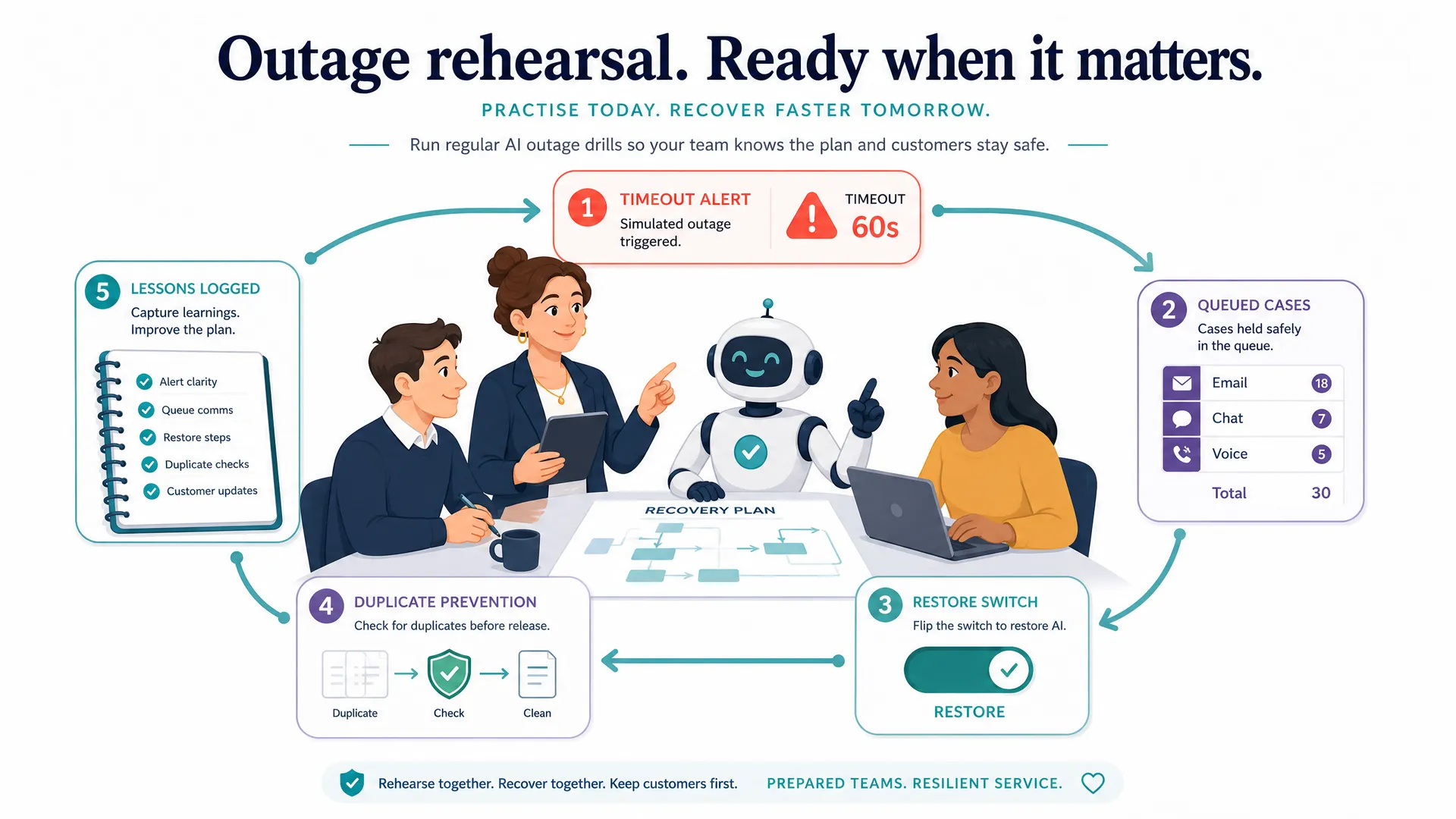
Prevent duplicate work when the system recovers. A request may have been accepted before a timeout appeared. Store an idempotency key or another safe reference, and check the queue before sending a second response. A retry that creates two customer actions can cause more harm than a short delay.
Decide who drains the queue. The original adviser may not have capacity after recovery. Assign a rota or temporary owner, and record when the backlog has returned to normal.
Control retries, throttling, and overload
A failed dependency often attracts more requests because users and automated clients repeat their attempts. That extra load can turn a short incident into a wider failure. Add a retry limit, increasing delay between attempts, and a clear stop condition.
Use throttling to protect the remaining service. During a provider slowdown, the team may reduce concurrency, disable optional summarisation, or accept only urgent requests. During a queue surge, the front end may reject excess requests with an informative message instead of allowing every request to reach a failing backend.
Separate partial failure from total failure. If retrieval is unavailable, the system should not present an unsupported model answer as if it were grounded. If notifications fail after a case is saved, show the adviser that delivery remains pending. If the model responds but the reviewer service fails, hold the draft instead of sending it automatically.
Google Cloud recommends testing overload conditions and monitoring traffic spikes as part of graceful degradation. [2] Adapt the idea to the AI workflow by rehearsing provider timeouts, search failure, queue growth, delayed callbacks, and incomplete responses.
| Failure condition | Safe degraded mode | Avoid |
|---|---|---|
| Model timeout | Queue the case and use approved holding text | Repeated unlimited retries |
| Retrieval outage | Use a restricted response pack or human review | Uncited model answers |
| Provider limit | Throttle requests and prioritise urgent work | Switching to an unapproved vendor |
| Queue growth | Show honest delay information and assign extra reviewers | Losing priority order |
| Notification failure | Keep the case pending and display delivery status | Assuming the message was sent |
| Data-store outage | Pause intake or use an approved temporary record | Copying customer data into personal notes |
Protect the fallback from unsafe shortcuts
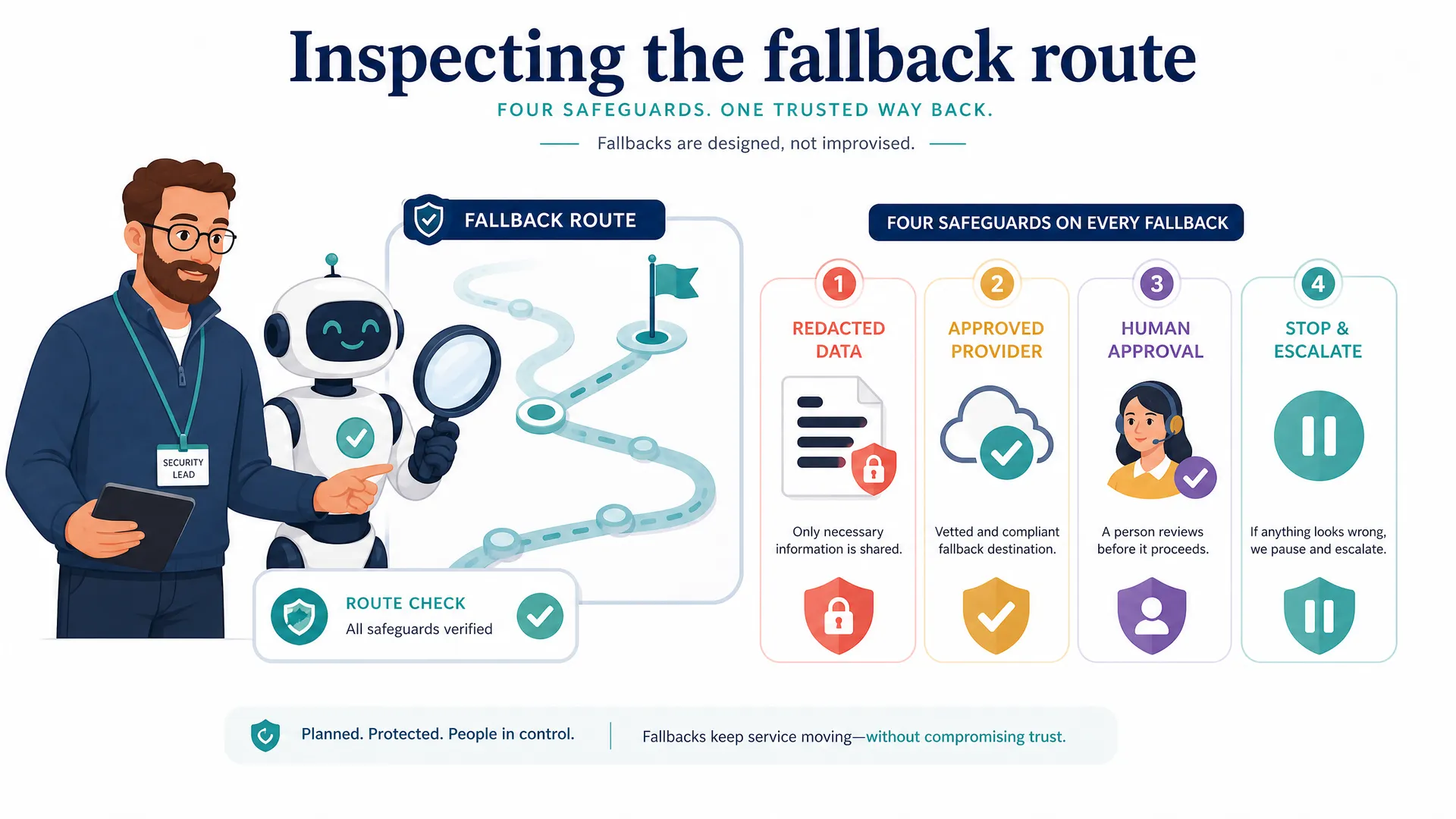
Pressure can encourage unsafe shortcuts. Colleagues may paste a whole customer history into a public chatbot, share a password to restore access, or remove a review step because the queue is growing. Put these risks into the fallback design instead of relying on reminders during the incident.
State which information may enter the alternative route. Use redacted identifiers where possible. Keep secrets outside prompts, forms, local files, and emergency notes. Restrict access to the response pack and queue according to the work each person performs.
Keep consequential actions behind approval. A degraded mode should not let an adviser alter an account, approve credit, issue a refund, change a safety setting, or send a legal commitment without the required authority. Reduced automation is not reduced accountability.
Include a stop rule. If the human route lacks current evidence, if identity cannot be confirmed, or if the request exceeds the team’s authority, pause the action and escalate. A safe “not yet” is better than an irreversible guess.
Tell users what changed
A degraded service message should be short, accurate, and useful. Say that the AI-assisted route is temporarily limited, explain what remains available, and provide the next step. Avoid technical details that confuse customers, but do not hide a material change in how their request is handled.
Give internal users a separate message. Advisers may need to know which tools are paused, which response pack is approved, how to record cases, and when to escalate. A shared status page or team channel can reduce conflicting instructions.
Update the message when the mode changes. The service may move from full operation to queued work, then to manual review, and finally back to normal. Each transition should have an owner and a check that prevents premature reopening.
Record any customer impact. A fallback plan should help the team identify delayed responses, duplicate actions, unsupported advice, access problems, and privacy concerns. Those records support correction after recovery.
Test recovery, not only failure
A fallback that works during an outage can still fail when normal service returns. Test how queued cases re-enter the workflow, whether duplicate responses are prevented, whether cached material is retired, and whether temporary permissions are removed.
Run a small exercise before a real incident. Simulate a model timeout during a busy period. Ask the team to switch mode, send the holding message, record a case, escalate a restricted request, and restore the normal path. Measure how long each step takes and note where staff improvise.
Test the boundaries with a request containing missing identity information, a stale policy, a delayed provider response, a full queue, a duplicate submission, and a customer asking for an action beyond the team’s authority. The exercise should end with a written decision record, not only a discussion.
Review the plan after provider changes, source updates, interface releases, staffing changes, and incidents. NIST treats AI risk work as a continuing activity across planning, operation, and review. That supports treating fallback as a lifecycle control instead of a document written once. [1]
Write the one-page fallback runbook
The runbook should name the normal workflow, failure signals, service owner, decision authority, approved degraded modes, user messages, data limits, queue fields, escalation contacts, retry rules, rollback steps, and recovery checks. Keep it near the operational tool instead of in an archive nobody opens.
Use a simple status decision. Continue normally when the system meets its checks. Switch to reduced service when an optional dependency fails or an agreed threshold is crossed. Pause the affected action when evidence, identity, permissions, or source freshness cannot be trusted.
Review the runbook with the people who will use it. An engineer may understand the timeout, while an adviser understands the customer consequence. A security lead may identify a data shortcut that others missed. The best fallback is written in language each role can follow.
An AI workflow is not resilient because it has a second model. It is resilient when people can continue essential work without losing control of evidence, privacy, priority, and accountability. Start with one important journey, build the smallest safe alternative, and test the handoff before the next outage makes the decision for you.
| KEY TAKEAWAY: A practical AI fallback plan defines what must continue, maps dependencies, provides an approved human route, protects sensitive information, controls retries, preserves queued work, explains degraded service, and tests recovery before a real failure. |
|---|
| SAFETY CHECK: Never use an outage as permission to paste private data into an unapproved tool, bypass identity checks, remove human approval, share credentials, or send an unsupported answer. Pause and escalate when the fallback lacks current evidence or authority. |
|---|