
An AI support assistant can perform well during a pilot and struggle a few months later. Customers may begin asking about a new product, the help centre may gain different terminology, or staff may change the way they phrase requests. The model has not necessarily been altered. The world around it has moved.
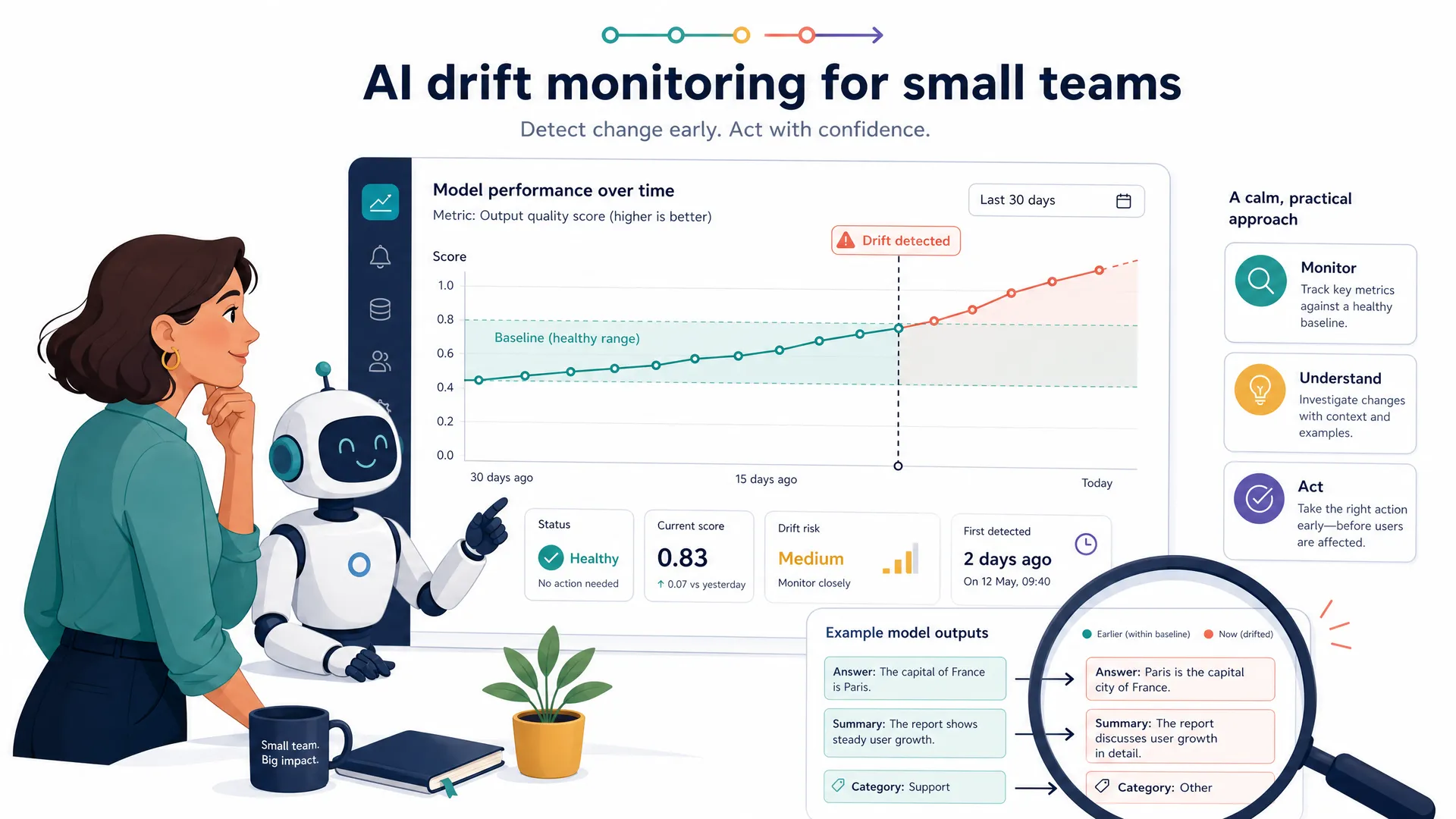
This gradual change is known as AI drift. It can appear as unfamiliar inputs, different output patterns, weaker retrieval, rising correction work, or a gap between what the system was designed to do and what people now need. A stable dashboard cannot guarantee stable behaviour. A useful monitoring plan must connect technical signals with the business result.
NIST’s AI RMF Measure guidance says deployed AI functionality and behaviour should be monitored. It also calls for regular evaluation, documented risk tracking, feedback from users, and attention to performance improvements or declines in context. [1] Google Cloud distinguishes skew between training and serving data from drift in serving data over time, showing why teams need a baseline and a comparison period. [2]
Small teams do not need a large monitoring department. They need a small set of meaningful measures, a person who reviews them, and a response plan for signals that deserve investigation. This guide uses a customer-support assistant that searches approved articles and drafts replies for an adviser.
Know the three useful kinds of drift
Data drift occurs when the inputs reaching a system change. A support assistant may receive longer messages, more messages in another language, new product names, or a larger share of urgent complaints. The input distribution has shifted, even if the software remains unchanged.
Model drift describes a decline in performance as the system meets conditions that differ from its earlier experience. A classifier may misroute more cases after customer language changes. A retrieval assistant may select weaker passages because new documents use unfamiliar terms. A generative model may produce a different style after a provider update.
Concept drift happens when the relationship between an input and the desired result changes. A policy may change the correct answer to a question. A complaint that once belonged to one department may now require another route. The old answer can remain grammatically sound while becoming wrong for the current business rule.
These categories can overlap. New inputs may cause weaker predictions, while a policy change may make yesterday’s labelled examples unsuitable today.
Define the outcome before choosing a metric
A drift dashboard should begin with the job the system performs. For the support assistant, the outcome might be a response that contains the correct policy, avoids unsupported promises, reaches the right adviser, and needs no major rewrite before sending.
Translate that outcome into observable measures. Track source-supported answer rate, adviser correction rate, escalation rate, response delay, unanswered-question rate, and the proportion of drafts rejected. Keep safety and privacy incidents separate from ordinary quality measures because a low error count cannot offset one serious exposure.
Avoid a single score that hides useful detail. An average quality rating may stay steady while performance falls for one language, product line, customer group, or request type. Break results down by meaningful segments, but do not create so many groups that random variation becomes an alarm.
Write the decision attached to each measure. If the correction rate rises, who examines examples? If an unauthorised source appears, who pauses retrieval? If response delay increases, who checks the provider, queue, or search service? A measure without an owner becomes decoration.
Build a baseline that reflects real work
A baseline is a description of acceptable behaviour during a defined period. It should come from real traffic or a representative test set, not from a perfect demonstration prepared by the development team. Record the workflow version, model, prompt, retrieval settings, source collection, user groups, and relevant seasonal conditions.
Save both aggregate measures and examples. A median response time, correction rate, and source-coverage figure can show movement. A small reviewed sample can reveal that the movement comes from one repeated failure pattern. Keep the examples redacted when they contain personal or confidential information.
Allow the baseline to settle. A new tool may produce unusual results while staff learn how to use it. A short launch period may also contain unusually enthusiastic testers. Choose a comparison window that covers ordinary use and any known weekly or seasonal rhythm.
Do not freeze the baseline forever. When the business changes and the new behaviour is approved, create a new reference period. Record why the baseline moved, who approved the change, and which tests demonstrated that the new state was acceptable.
Watch inputs without collecting unnecessary content
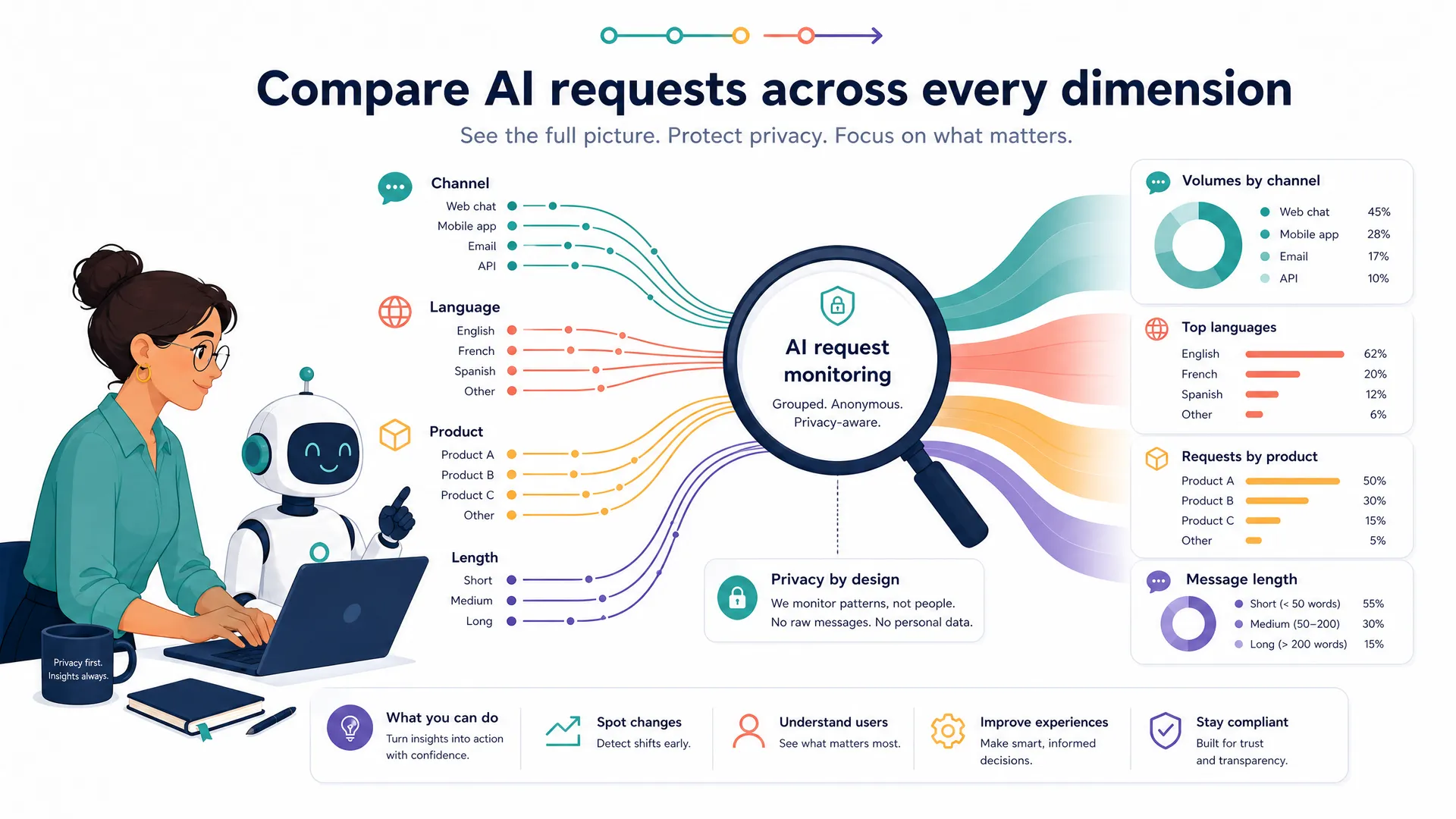
Input monitoring can avoid storing every customer message. Count request volume, message length bands, language or channel categories, product labels, attachment types, retrieval-query patterns, and the rate of unknown terms. Use grouped or redacted values when the exact text is not needed.
Look for changes that can affect the workflow. A new product name may not match the old search vocabulary. A surge in screenshots may expose a parser limitation. A new channel may deliver fragmented conversations. A rise in multilingual requests may require different evaluation coverage.
Set minimum sample sizes before raising distribution alerts. Ten unusual requests can be important as an incident, but they may not support a general conclusion about drift. Combine automated signals with a reviewer’s judgement and label alerts as leads for investigation, not verdicts.
Measure outputs and human correction
For generative systems, output drift is often easier to notice through review work than through a model-confidence value. Measure how often advisers change a draft, remove an unsupported claim, add a missing condition, reject a citation, or escalate the case. Record the reason using a small set of categories.
Sample outputs on a schedule. Reviewers can assess factual support, completeness, tone, refusal behaviour, privacy, and routing. Rotate the sample across routine and difficult requests, unusual wording, and cases where the correct response is to ask a question or decline.
Keep automated checks modest and targeted. A rule can detect a missing source identifier, a forbidden promise, an empty answer, or an unexpected output format. These checks are useful guards, but they cannot judge every business nuance.
Compare current results with the baseline by segment and task. A rise in corrections among experienced advisers may indicate changing policy or weak source material. A rise among new staff may indicate training or interface friction. The same top-line signal can have different causes.
Separate drift from ordinary variation
Every system moves a little. Traffic changes, reviewers disagree, and some weeks contain unusual requests. An alert threshold should account for expected variation instead of reacting to every fluctuation.
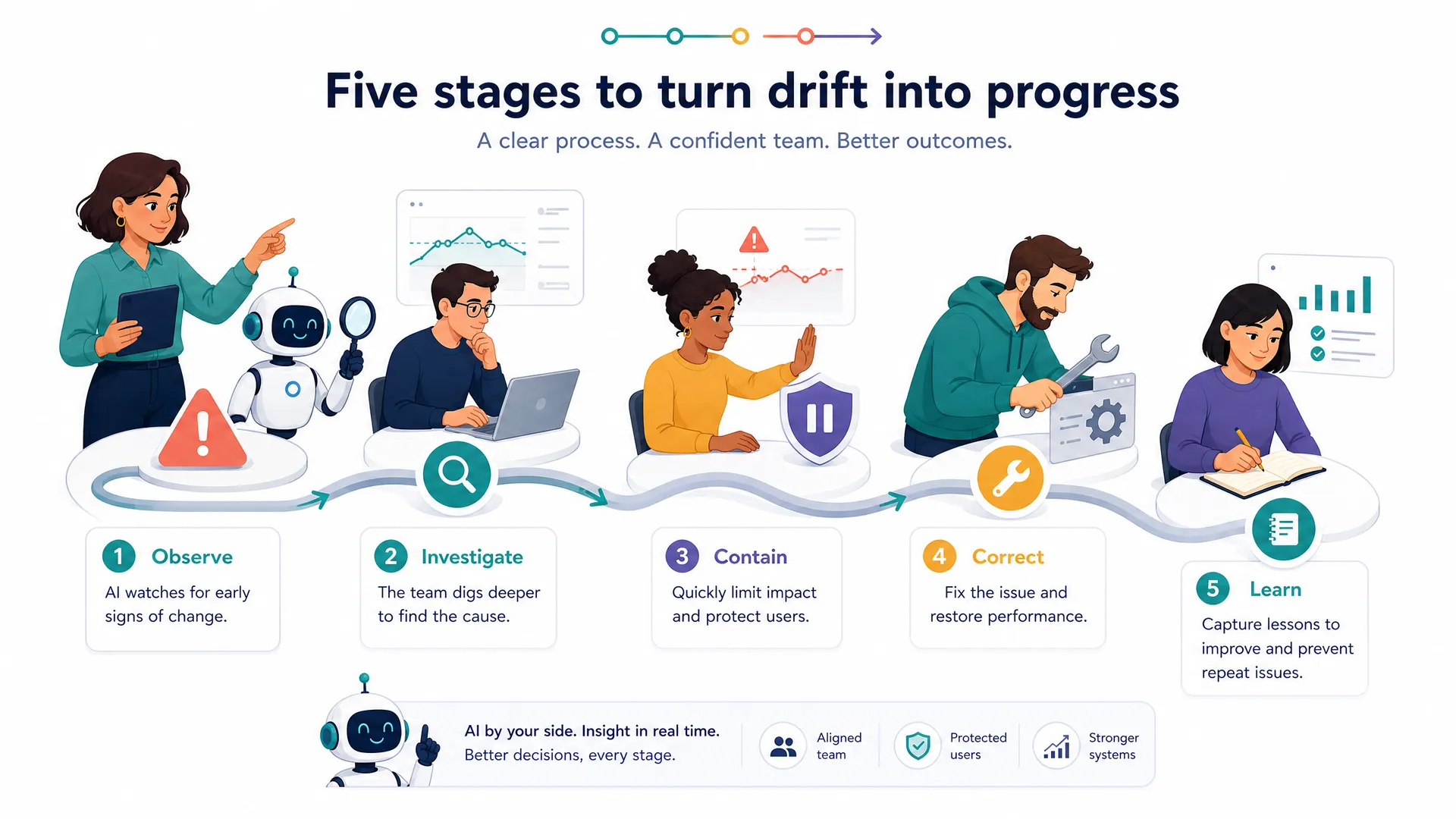
Set three alert levels. An observation level records a movement for the next review. An investigation level asks the owner to inspect examples, recent changes, and affected groups. A critical level triggers containment, such as pausing a route, requiring additional human review, or reverting to an approved version.
Do not set thresholds only from vendor documentation. A provider can report latency or service availability, but the team still needs to decide what an unacceptable customer answer looks like. Combine technical thresholds with outcome thresholds and define who can change them.
A useful alert contains context. It should state the measure, baseline period, current period, affected segment, sample size, recent changes, owner, and first action. “Quality down” is a weak alert. “Source-supported drafts fell in the returns category after the policy index update” gives an investigator somewhere to start.
Investigate the whole path
When a drift signal appears, inspect more than the model. Check the source collection, document revisions, parser, chunking method, embedding version, retrieval filters, prompt template, model identifier, tool permissions, user interface, and review process.
Ask whether the input changed, the desired answer changed, or the system changed. A rise in unsupported replies after a policy update may point to an index that missed the new document. A fall in routing accuracy after a form redesign may begin at the input boundary. A provider model update may affect style, refusal behaviour, or tool use.
Use a fixed investigation record. Capture the alert, examples, affected population, first suspected cause, evidence checked, temporary control, final correction, and follow-up test. Record uncertainty when the evidence cannot support a firm conclusion.
Do not retrain or replace a model as the first response. Repair the earliest broken link that explains the observed failure, then test the complete workflow.
| Signal | Questions to ask | First response |
|---|---|---|
| New input pattern | Which channel, language, product, or message type changed? | Sample and classify the new inputs. |
| Lower source coverage | Did a revision, parser, filter, or index change? | Verify the evidence path for affected cases. |
| Higher correction rate | What are reviewers adding, removing, or disputing? | Group corrections by reason and task. |
| Slower responses | Did volume, queue depth, provider latency, or retrieval time move? | Check each stage before changing the model. |
| More escalations | Is the business rule harder, or is routing weaker? | Compare current cases with the approved route. |
| Safety or privacy alert | What information or action crossed the boundary? | Contain the route and start the incident process. |
Test drift with a living evaluation set
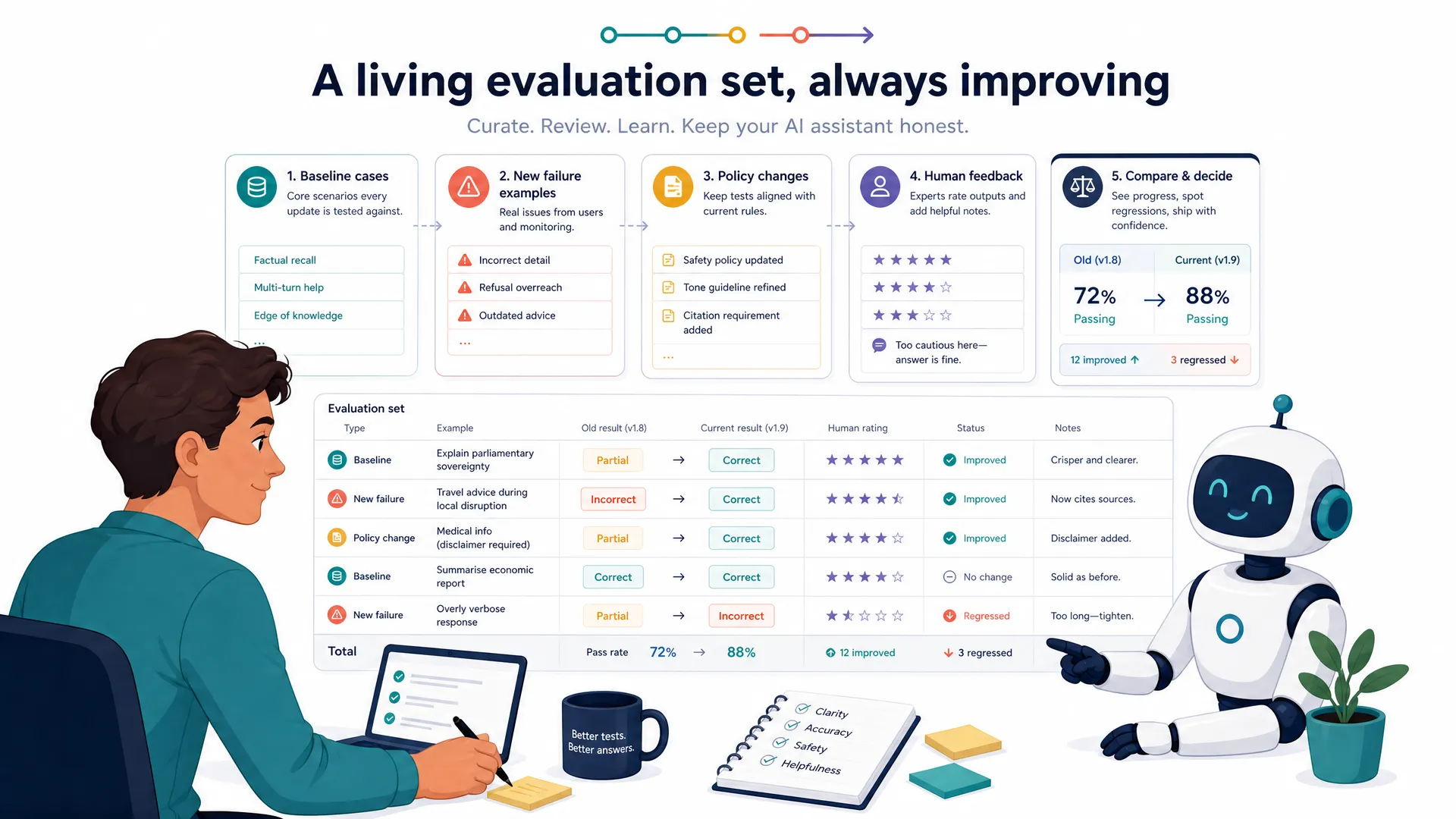
A fixed test set gives the team a stable comparison. A living evaluation set adds cases from real failures, new products, revised policies, and newly observed language. Keep the original cases so a change cannot improve recent examples while damaging earlier safeguards.
Label each case with its task, expected evidence, acceptable output, risk level, and last review date. A domain expert should confirm labels when the underlying business rule changes. Retire a case only when the reason is documented.
Run the evaluation after model changes, prompt changes, retrieval updates, source revisions, provider changes, interface redesigns, and meaningful shifts in users. Compare quality, safety, latency, and correction work together. A faster answer that requires more repair may not represent progress.
Invite feedback from the people who use and receive the system. NIST’s Measure guidance connects feedback processes with evaluation and asks teams to identify changes in performance across deployment contexts. [1] A visible correction route can reveal drift before a statistical signal becomes strong.
Create a small response playbook
The playbook should state who receives alerts, what evidence they inspect, which controls they may apply, and when a decision needs wider approval. For a low-level movement, the owner may schedule a sample review. For a serious safety issue, the team may pause automated drafting and require manual handling.
Define rollback options before they are needed. Keep the previous prompt, retrieval configuration, source index, model setting, and release record available for an approved return path. Test the rollback in a non-production environment so the team knows what it changes and what it leaves behind.
Communicate changes to users. Advisers need to know when a workflow is paused, when an extra check is required, and where to report a new failure.
Close each incident with a learning action. Add a regression case, update the baseline if the new state was approved, revise the alert rule, or improve the source process. A resolved alert should leave the monitoring system stronger than before.
Keep monitoring proportionate
A small internal assistant may need a weekly reviewed sample and a monthly trend discussion. A customer-facing workflow with sensitive information may need shorter review intervals, stronger access controls, and faster escalation. Monitoring effort should reflect the harm caused by an undetected change.
Automate collection before automating decisions. A scheduled report can gather measures, group cases, and show movement. A person should decide whether a signal represents expected variation, a correctable defect, a business change, or a risk that requires containment.
Review the monitoring plan itself. Are the measures still tied to the system’s purpose? Do they cover new users and products? Can the team investigate an alert without exposing private data? Does the rollback path work? Has anyone removed a check because it became inconvenient?
NIST’s guidance treats measurement as part of an AI system’s lifecycle, not a one-off launch activity [1]. For a small team, that means keeping a short record, reviewing meaningful evidence, and changing the system when the evidence supports the decision.
A practical drift-monitoring routine
At launch, write the intended outcome, baseline period, segments, measures, thresholds, owners, and response levels. During operation, collect grouped inputs, output measures, reviewer feedback, incidents, and technical timings. At each review, inspect changes, sample affected cases, and record a decision.
After a material change, compare the new state with the previous reference. Confirm that expected improvements arrived and that old protections still work. If the system is paused or retired, record the final state and the handling of its logs, test data, prompts, indexes, and backups.
AI drift is not proof that a model has failed. It is a signal that the relationship between the system and its operating context may have changed. Manage it with a grounded baseline, business-focused measures, human feedback, and a tested response route.
| KEY TAKEAWAY: Monitor the result your AI system is meant to deliver, not only its technical dashboard. Establish a realistic baseline, track input and output changes, sample human corrections, investigate the full workflow, and connect every alert to an owner and a tested response. |
|---|
| SAFETY CHECK: Do not use drift monitoring as permission to collect unlimited customer content or to remove human review. Minimise and protect data, restrict access to logs, test for privacy and safety failures, contain serious signals, and obtain appropriate approval before changing a high-impact workflow. |
|---|