
An AI prediction begins with a question, a source of information, and a chain of decisions about what the information means. A retailer might want to estimate which products need replenishing. A support team might want to route incoming cases. A manufacturer might want to identify an unusual sensor pattern. In each example, the model is only one part of the system.
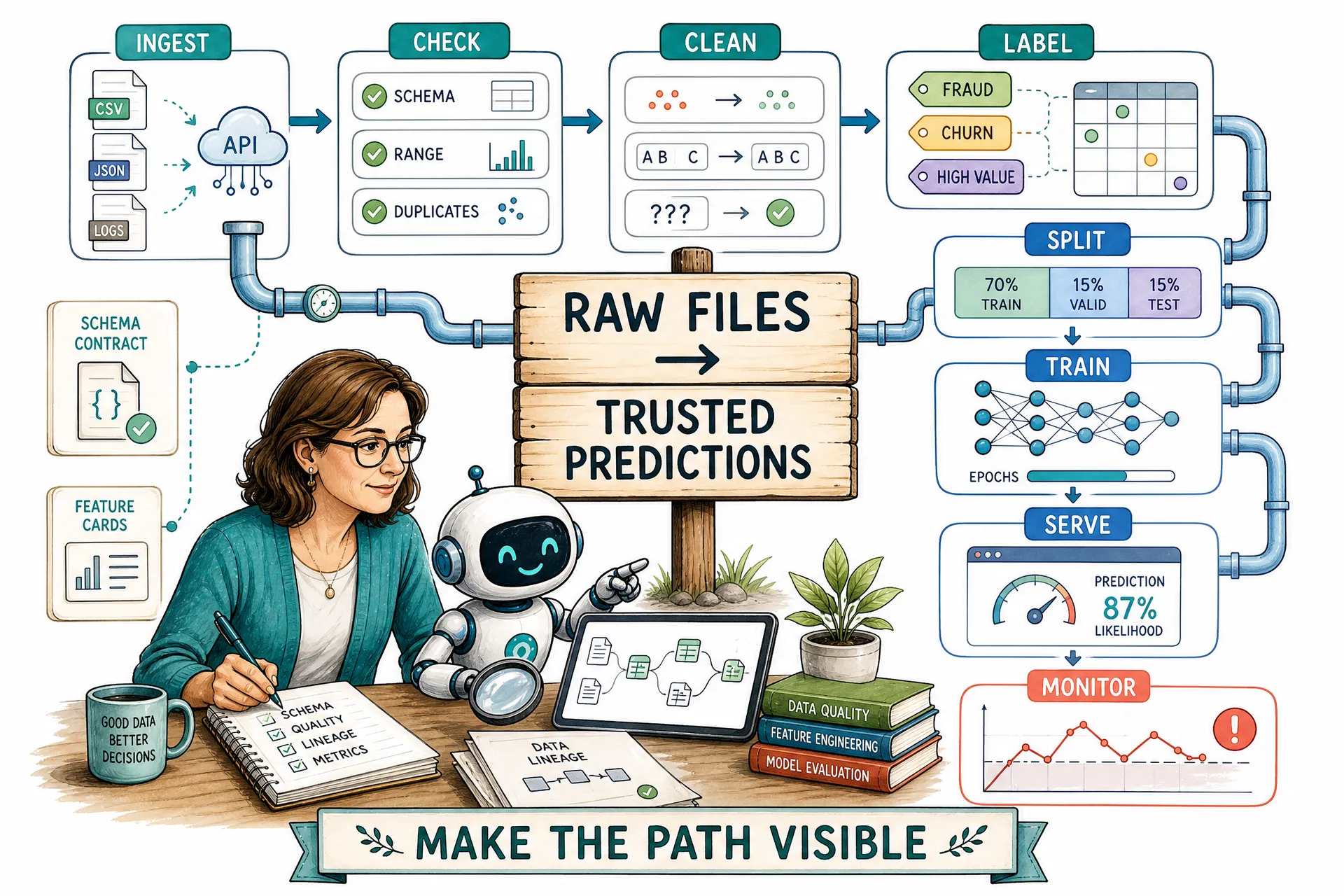
An AI data pipeline is the repeatable path that moves data through collection, preparation, validation, model development, and delivery. It can be a small scheduled script, a managed cloud workflow, or a collection of services connected by queues and storage. The important property is not its size. It is that another person can understand what entered, what changed, what was produced, and which checks allowed the result to move forward.
Google’s machine-learning guidance separates data, training, validation, and serving pipelines, and explains that production models need updating as the world and its data change. [1] This guide turns that lifecycle into a beginner-friendly example: a fictional shop that wants to predict next week’s demand from sales and stock files.
Tie the pipeline to a real decision before arranging data
Name the operational choice that the forecast is meant to inform. A broad ambition such as “apply AI to retail” cannot define useful inputs or a fair test. A more workable question asks whether a particular item is likely to need another delivery during the following trading week. Record the person who will use the result, the deadline for producing it, the action it could trigger, and the safe response when confidence is low.
Choose the prediction unit before organising rows. It could be one item at one branch for one trading week. That choice shapes the table design, labels, and evaluation method. Agree the success measure in advance. A retailer may value fewer empty shelves, more dependable purchase orders, or less spoilage; an impressive accuracy percentage alone may not represent those outcomes.
This step prevents a common failure: building a technically elegant pipeline that answers a question nobody needs answered.
1. Find and catalogue the raw sources
List every source that could contribute to the decision. The shop may have sales exports, product details, stock counts, promotions, opening hours, and delivery records. Each source needs an owner, a format, an update pattern, and a reason for inclusion.
Keep an untouched copy of each received file when the rules and storage controls allow it. Store the arrival time, source name, file version, and checksum or other identifier. A raw copy helps a team investigate a change without wondering whether a later cleaning step altered the evidence.
Do not collect everything merely because it exists. Data minimisation reduces exposure, storage, and confusion. If a customer name cannot improve a stock estimate, leave it out.
2. Ingest data with a clear contract
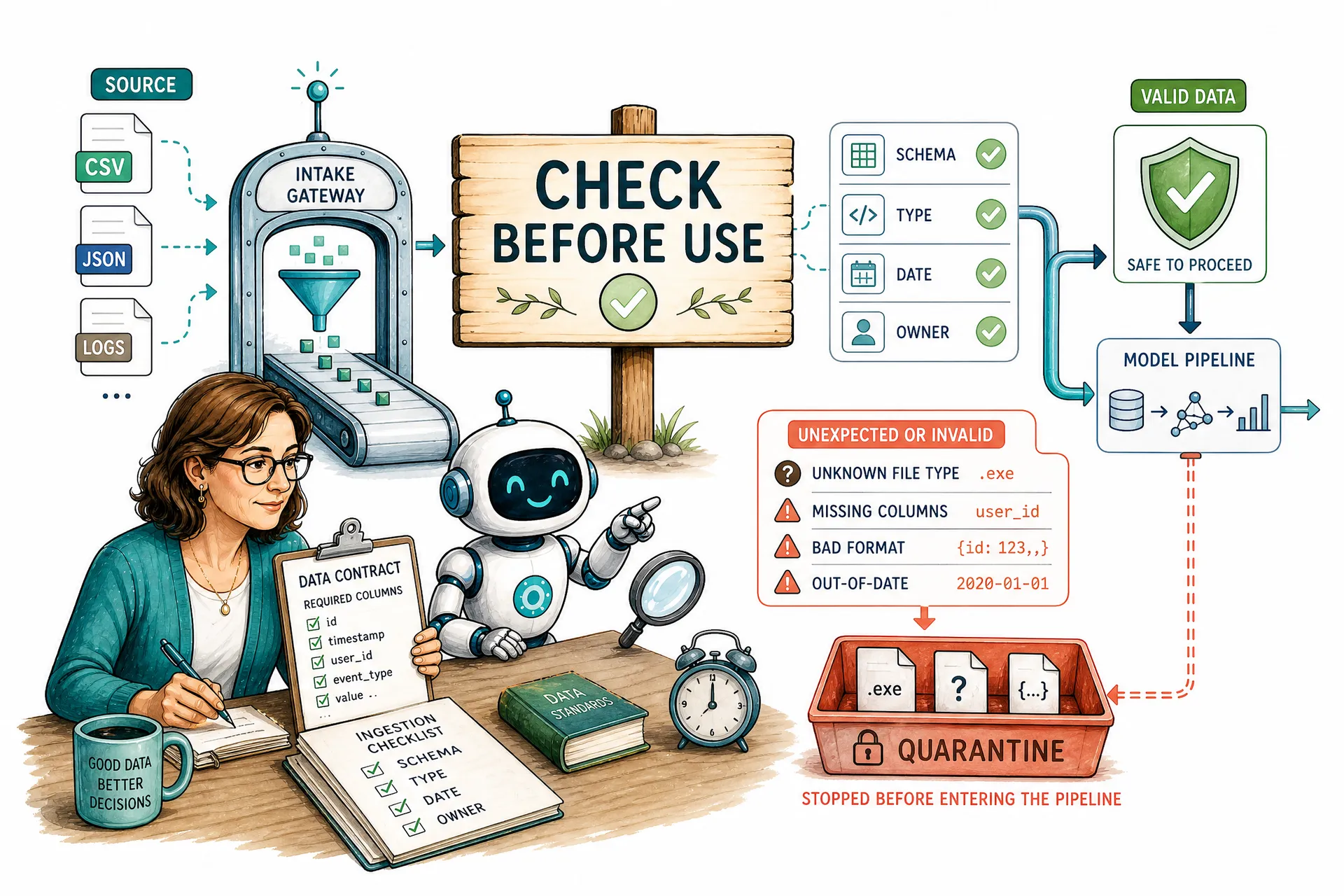
Ingestion is the controlled act of bringing source data into the pipeline. A file may arrive in a shared folder, through an API, as a database extract, or in a message from another system. The pipeline should record whether it received the expected source and whether the file can be read.
Create a simple data contract. State the required columns, types, time zone, identifier format, allowed missingness, and maximum acceptable age. For example, `sale_date` might need a date and time in one agreed time zone, `product_id` might be a non-empty identifier, and `units_sold` might be a non-negative number.
Reject or quarantine a file that breaks the contract. Do not silently convert every unexpected value into zero. A visible failure is easier to correct than a clean-looking dataset containing invented assumptions.
3. Inspect quality before cleaning
Quality inspection describes what the data contains before anyone tries to improve it. Count rows, columns, null values, duplicate identifiers, unusual ranges, missing dates, and unexpected categories. Compare the current file with a recent known-good file. Look for abrupt changes that may reflect a source-system alteration instead of a real-world event.
The word “clean” can hide a judgement. A missing stock count might mean zero stock, a delayed update, or a broken export. Those meanings require different treatment. Ask the source owner before choosing a replacement.
Create a quality report that records checks, thresholds, results, and the action taken. Keep failed samples where access controls permit it. A short example often helps an engineer reproduce a problem faster than a percentage alone.
4. Transform without losing meaning
Transformation changes data into a form that the next stage can use. Dates may be standardised, product identifiers joined, units converted, and text normalised. The pipeline may calculate recent sales, days since the last delivery, or the number of promotional days in a week.
Every transformation should have a reason and a test. If a join changes the number of rows, investigate why. If a currency conversion is applied, record the rate and date. If a missing value is filled, state the rule and distinguish an imputed value from an observed one.
Avoid a giant cleaning script that nobody can inspect. Separate stages by purpose and name their inputs and outputs. A small pipeline with explicit steps is easier to repair than a clever pipeline whose side effects remain hidden.
5. Create labels and features carefully
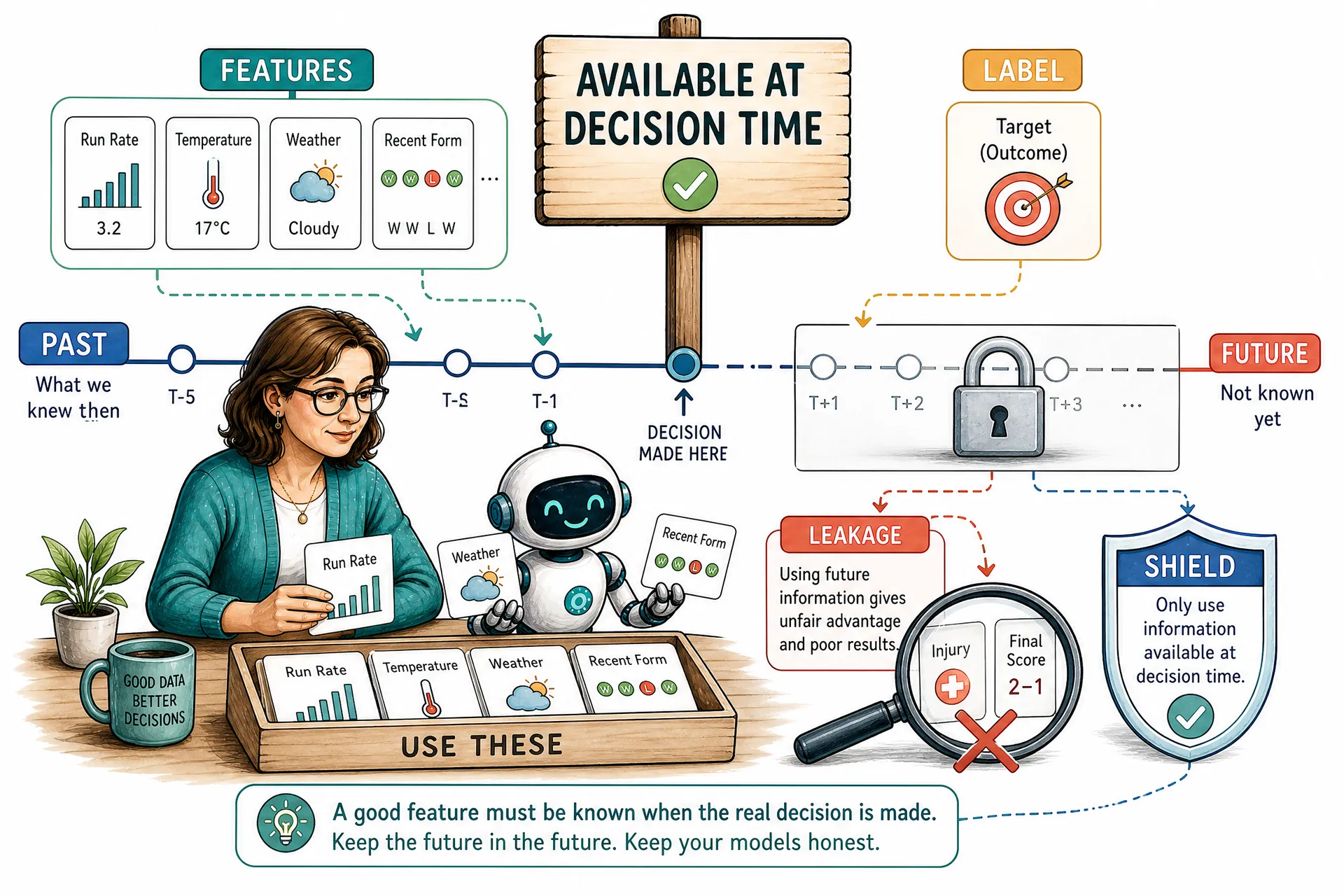
A supervised model needs a target or label. For the shop example, the label could be whether a product required replenishment in the following week. The label must refer to a future outcome, not information that was only known after the decision date.
Features are the signals the model may use. Recent sales, current stock, price, promotion status, and delivery lead time may be plausible features. A field created after the order was placed would leak future information into the past. The model could appear excellent in testing while failing in real use.
Write down the point in time at which each feature would have been available. This simple timestamp question catches many forms of leakage.
6. Split data to imitate reality
A test set should represent how the model will encounter future cases. Randomly mixing old and new records can make a time-based problem look easier than it is. If the shop predicts next week from earlier weeks, use an earlier period for training and a later period for validation or testing.
Keep related records together when separation would leak information. Several rows from one product, customer, device, or document may share clues that should not cross the boundary. Record the split rule, date ranges, and row counts.
Do not adjust the test set every time the result disappoints you. A protected test set gives the team a more honest final comparison. Use a separate development set for experiments.
7. Train and validate the first model
Training is the stage where an algorithm learns patterns from the prepared training data. Beginners do not need to start with the most complicated model. A transparent baseline, such as a simple historical average or straightforward classification method, gives the team something to beat.
Validate the candidate against the baseline using measures connected to the decision. For stock replenishment, examine missed high-demand items as well as overall accuracy. Review false positives, false negatives, performance across product groups, and behaviour when input data is missing.
The validation stage should produce evidence, not only a model file. Save the dataset version, code version, configuration, metrics, evaluation date, and decision about whether the candidate may proceed. Keep a short run log that explains which checks passed and which assumptions still depend on a human owner.
8. Serve predictions through a controlled path
A serving pipeline receives new data, applies the same approved transformations, asks the model for a result, and delivers that result to an application or person. It may run online for a quick response or offline on a schedule for a weekly report.
Keep training transformations and serving transformations aligned. A difference in column names, units, time zones, or missing-value rules can make a model behave differently after deployment. Package the approved feature logic or test it at the boundary.
Decide what the application should do when the model is unavailable or uncertain. A manual review, a known baseline, or a safe default may be preferable to a confident-looking guess.
9. Monitor the pipeline and the outcome
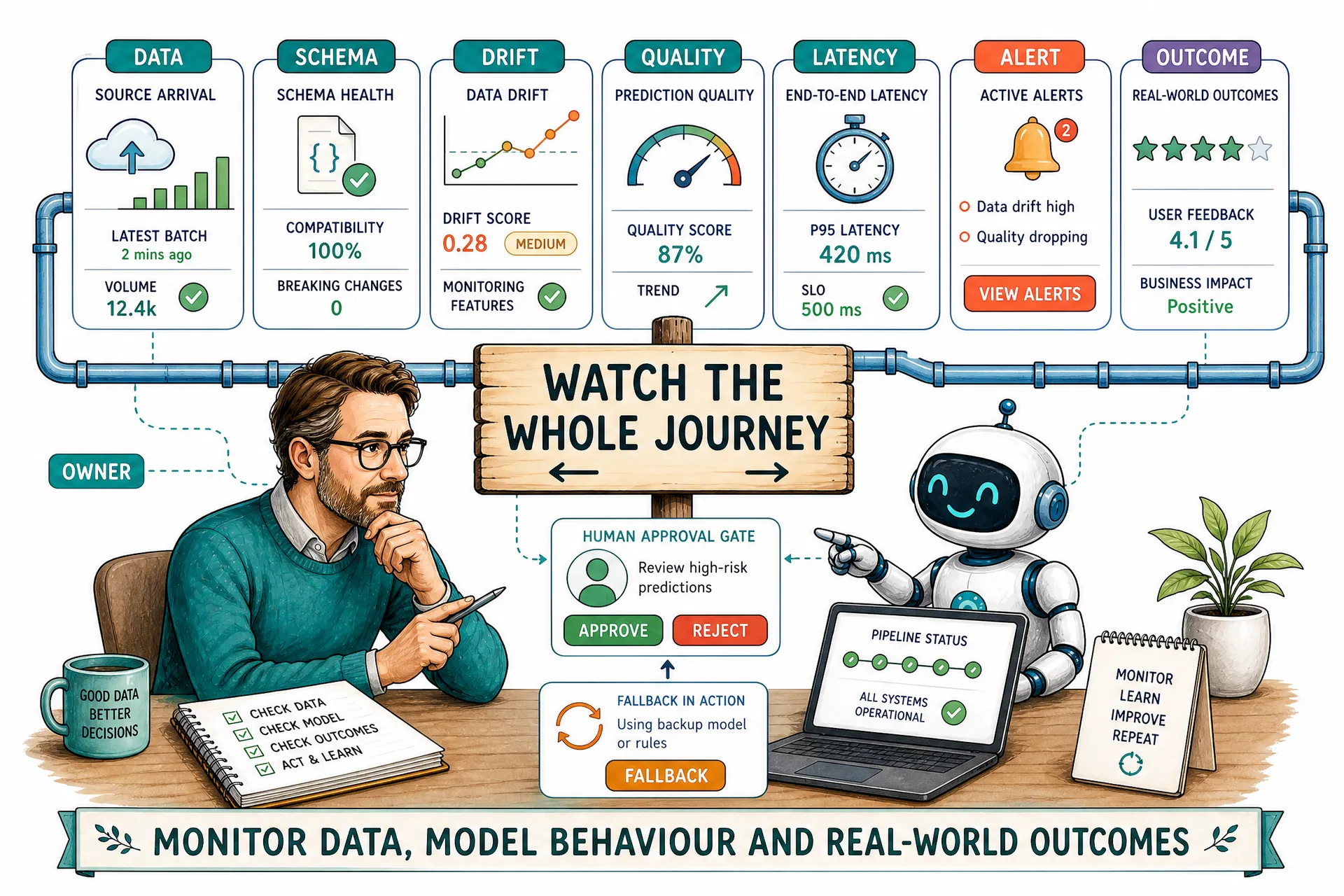
Deployment is not the finish line. Monitor whether files arrive, schemas remain compatible, rows pass quality checks, features stay within expected ranges, predictions are produced, and the application receives them. Also monitor the outcome that motivated the project.
Google notes that models can become stale as data and real-world behaviour change, and recommends a process for refreshing and validating them. [1] A rise in delivery delays, a new product range, or a change in customer behaviour may weaken the old relationship between inputs and outcomes.
Set thresholds that lead to action. An alert should identify an owner, a run or data version, the failed check, and the next investigation step. Define a response window and an escalation route before the first alert arrives. Otherwise, a warning can sit unnoticed while the application continues producing results. A dashboard that nobody reviews is decoration instead of monitoring.
10. Record lineage and make changes reproducible
Lineage answers where a value came from and which transformations touched it. Record source files, table versions, code revisions, model versions, configuration, approvals, and output destinations. The level of detail should match the risk and complexity of the use case.
Version datasets and predictions where practical. Google’s guidance points to repositories and metadata as useful aids when machine-learning work must be reproduced or debugged. [1] If someone challenges a result, the owner should trace its model version, input record, and review checks without rebuilding the entire history from memory.
Document ownership as well. Someone should know who maintains the ingestion contract, who approves model changes, who responds to pipeline failures, and who decides whether a prediction may influence a person or important record.
What belongs in a beginner-friendly pipeline
The table below separates the stages so a small team can choose an appropriate first version.
| Stage | Main question | Evidence to retain |
|---|---|---|
| Decision | What action will the prediction support? | User, timing, outcome, and success measure. |
| Ingestion | Did the expected source arrive in the expected form? | File version, arrival time, schema and contract result. |
| Preparation | Were values transformed without changing their meaning? | Rules, tests, row counts, and rejected samples. |
| Dataset | Is the training and test split honest? | Date ranges, identifiers, and leakage checks. |
| Training | Did the candidate learn from approved data? | Code, data version, configuration, and run record. |
| Validation | Does it meet the quality and safety threshold? | Metrics, error analysis, baseline comparison, decision. |
| Serving | Can the application receive a timely result? | Request, response, latency, fallback and error logs. |
| Monitoring | Is the system and outcome still behaving acceptably? | Alerts, drift checks, quality review and owner. |
Keep the first implementation small
A beginner can start without a platform packed with every available feature. Start with one source, one defined decision, one baseline, one evaluation set, and one monitored output. Use a scheduled job and versioned files if that is sufficient for the first honest experiment. Add streaming, feature stores, orchestration services, or automated retraining only when the workload justifies them.
AWS describes MLOps as practices that automate and simplify machine-learning workflows and deployments, including changes to code and data. [2] Automation is valuable when it makes a repeatable process safer. It is not valuable when it hides a fragile process behind more buttons. Before automating, write the manual version once: name the input, the check, the output, the owner, and the recovery action. That outline becomes a practical specification for later tools.
A small pipeline should still protect sensitive data. Limit access, remove unnecessary personal fields, encrypt approved storage, and keep secrets out of files and prompts. If the prediction affects employment, finance, health, safety, or access to a service, add domain review and a clear route for challenging an error. This safeguard keeps a small experiment accountable from its first run.
For a first implementation, define one repeatable run from start to finish. Give it a run identifier, save the input and output locations, and make failure visible to its owner. A beginner can then rerun the same period, compare two versions, and explain why a result changed. This discipline matters more than selecting an elaborate orchestration product at the outset.
| KEY TAKEAWAY: An AI data pipeline is a traceable route from a defined decision through raw inputs, contracts, quality checks, transformations, labels, honest splits, training, validation, serving, and monitoring. Build the smallest route that produces useful evidence, then expand it when the workload and risk require more automation. |
|---|
| SAFETY CHECK: Do not treat a clean file or accurate test score as proof that a prediction is safe. Protect personal data, test for leakage and bias, preserve a fallback, monitor drift and failures, record lineage, and obtain accountable human approval before predictions influence people, money, access, or important records. |
|---|