
A support adviser opens an AI-generated reply and sees a confident explanation of a product rule. The wording sounds useful, yet the answer leaves the supplying document unclear. The adviser cannot tell whether the source is current, whether a hidden transformation changed its meaning, or whether the model invented the conclusion.
That gap is an AI data lineage problem. Lineage records how information travels from an origin to an output. An AI search or retrieval workflow can pass through several stages. These may include a source file, an approved revision, extracted text, a document chunk, an embedding, a search result, a prompt, a model version, an answer, and a human edit.
A small team can begin without an enormous catalogue. Start with an evidence trail that answers one practical question: What did this system use, change, and produce? NIST’s Generative AI Profile names content provenance as a primary consideration. It also describes actions for governing, mapping, measuring, and managing generative-AI risks. [1]
This guide shows how to build that trail without turning a modest AI project into a data-warehouse programme. The working example follows a support assistant that consults a controlled help library and prepares a response for a trained adviser.
Understand what lineage records
A source citation answers, “Which document supports this statement?” Lineage asks a wider set of questions. Which revision was available? The record should identify its approver and the method used to convert the file. Which passage entered retrieval? Which prompt assembled the context? Which model produced the draft? What did the reviewer change before the answer reached a customer?
These questions matter because an AI result is rarely produced from one untouched file. A PDF may be converted into text. A parser may remove a table heading. A chunking rule may split a warning from the instruction it qualifies. An embedding service may index an older revision. A retrieval filter may exclude the best passage. The final model then works with a context that can differ from the source a colleague remembers approving.
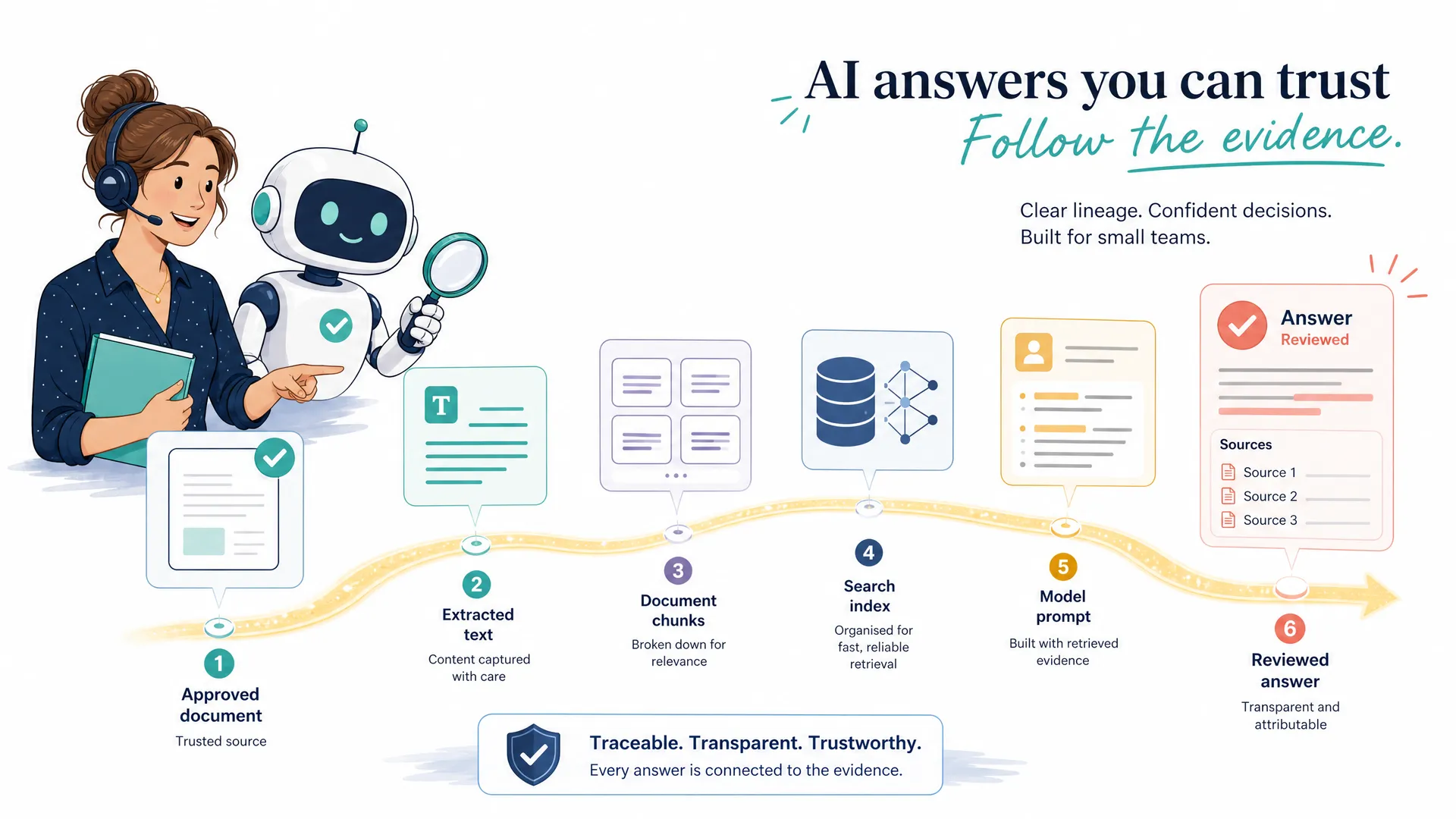
Use the smallest useful definition: lineage is the record of origin, transformation, selection, generation, and disposition. Origin identifies where material came from. Transformation records meaningful processing. Selection shows what entered a particular run. Generation identifies the model and prompt path. Disposition records whether a result was sent, edited, rejected, or deleted.
This definition prevents two common mistakes. A folder of source documents cannot establish which file influenced an answer, so it is not a lineage system. A model log is incomplete when it records the prompt but omits the document revision or retrieval result that shaped the prompt.
Start with one answer type
Do not map every data flow in the organisation before testing the method. Choose one answer type with a known business owner. A support assistant that drafts replies is a useful starting point because the team can compare the output with published guidance and retain a human approval step.
Write the path in plain language. A help article enters the approved library. The ingestion job extracts text and assigns a revision identifier. The chunker creates passages with stable identifiers. An embedding process makes those passages searchable. A user question retrieves selected passages. A prompt builder combines the question, rules, and passages. The model drafts a reply. An adviser checks, edits, sends, or rejects it.
For each stage, name the input, output, owner, timestamp, and identifier. Do not begin with a specialised platform. A spreadsheet, database table, or structured JSON record can prove the concept. The record becomes valuable when another person can reconstruct the route without relying on a developer’s memory.
Give every source a stable identity
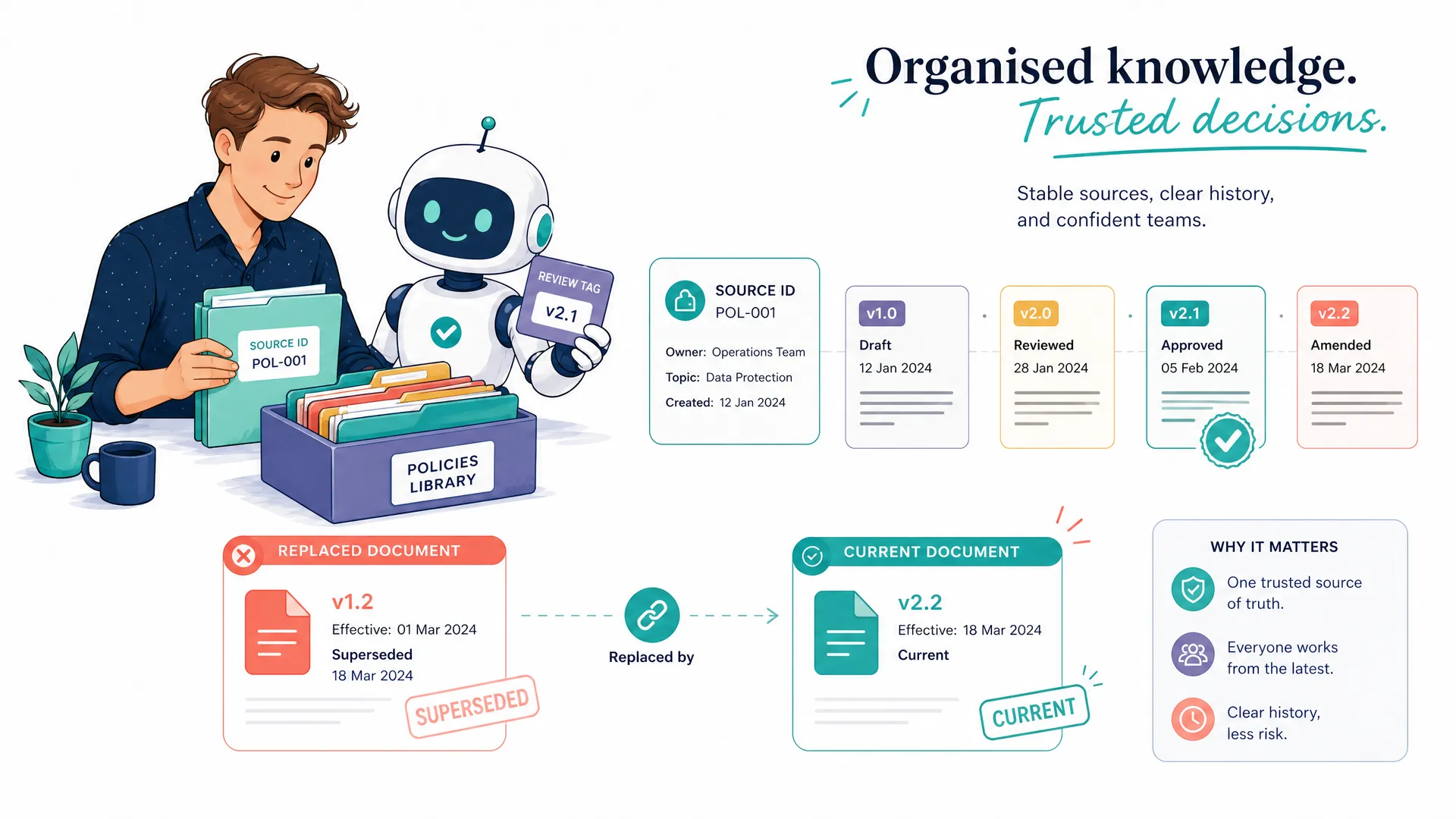
File names are weak identifiers. A document called `returns-policy-final.pdf` can be replaced while retaining the same name. Use a source identifier and revision identifier instead. Store the title, owner, approval status, effective date, expiry date, location, checksum where appropriate, and the reason for the revision.
Keep publication status separate from ingestion status. A file may be approved by the policy owner but not yet processed by the retrieval system. Another file may be indexed successfully but withdrawn from use. These are different facts and should not share one vague status field.
Record when one revision supersedes another. When a new policy replaces an old one, link the two revisions and state when the older version should stop influencing new answers. Preserve enough history to investigate an earlier response. Do not keep every copy without a retention rule; lineage must support accountability without creating uncontrolled data hoards.
Record transformations that can alter meaning
Lineage does not require a record of every harmless technical operation. It does require the steps that can change interpretation or retrieval. Capture file conversion, OCR, language translation, redaction, table extraction, normalisation, chunking, filtering, and metadata enrichment when those steps affect what the model can see.
For a chunk, store the source identifier, revision, page or section reference, character range where available, chunking method, overlap setting, and content hash. A content hash can help detect whether a passage changed even when a file keeps the same title.
Treat extraction warnings as evidence. If OCR reports a low-confidence region, mark the affected passage for review. If a parser drops an image containing a safety warning, the downstream search index should not appear complete. An ingestion status of “finished” says that a job ended; it does not prove that the resulting text preserved the source’s meaning.
Keep transformation code versioned. A change from one chunking method to another can alter retrieval even when the source library remains unchanged. Record the code or configuration version beside the generated artefacts. This gives the team a way to compare two indexes without guessing which settings produced them.
Connect retrieval to the final prompt
A source may exist in the index without affecting a particular answer. The lineage record for an inference should identify the passages returned, their ranking or retrieval score if used, the filters applied, and the final context passed to the model. Store identifiers when full text is unnecessary or sensitive.
Record the prompt template version and model identifier. If the workflow adds an instruction that changes how evidence is interpreted, that instruction is part of the lineage. So are tool calls, search rewrites, conversation history, and user-provided attachments.
Do not treat a citation added after generation as proof of source use. A system might produce a draft first and attach a plausible link later. Source attribution should come from the retrieval event or a verified evidence-matching step. If the system cannot establish a source, label the answer as unsupported and route it for review.
A useful answer record might contain the request identifier, user role, source revision IDs, chunk IDs, retrieval configuration, prompt version, model version, output identifier, reviewer decision, and dispatch status. Apply data minimisation to the record. A support investigation may need source identifiers and a redacted excerpt, not a permanent copy of a customer’s entire conversation.
Use lineage to test quality
Lineage makes quality testing more specific. Instead of asking whether the assistant “appears accurate”, compare the expected source with the source returned. Test whether a new policy revision is found, whether an expired document is excluded, and whether a qualifying exception remains attached to the rule it modifies.
Build cases around known failure modes. Include a one-source question and a question requiring two documents. Add a conflict between revisions, a request with no approved answer, a misleading heading, a scanned page, and a prompt injection hidden inside a source document. For each case, record the expected evidence path and the acceptable response.
Measure more than answer similarity. Track source coverage, unsupported-claim rate, stale-source rate, retrieval failure rate, reviewer correction rate, and time needed to investigate an output. These measures do not prove that a system is safe, but they show where the evidence chain breaks.
Run the test set after changes to the source library, parser, chunker, embedding model, retrieval settings, prompt template, model, permissions, or retention policy. A lineage record makes the comparison possible because the team can see which component changed.
| Lineage stage | Minimum record | Failure it helps investigate |
|---|---|---|
| Source | Identifier, revision, owner, status, dates | Obsolete or unauthorised material |
| Ingestion | Job ID, timestamp, parser version, warnings | Missing or damaged text |
| Chunking | Chunk IDs, method, source ranges | Lost context or broken exceptions |
| Indexing | Embedding version, index ID, access group | Wrong or stale search results |
| Retrieval | Query ID, returned IDs, filters, ranking | Relevant evidence excluded |
| Generation | Prompt version, model, tool events | Unsupported or inconsistent wording |
| Review | Editor, decision, changes, dispatch status | Unsafe output sent externally |
Keep access controls inside the lineage design
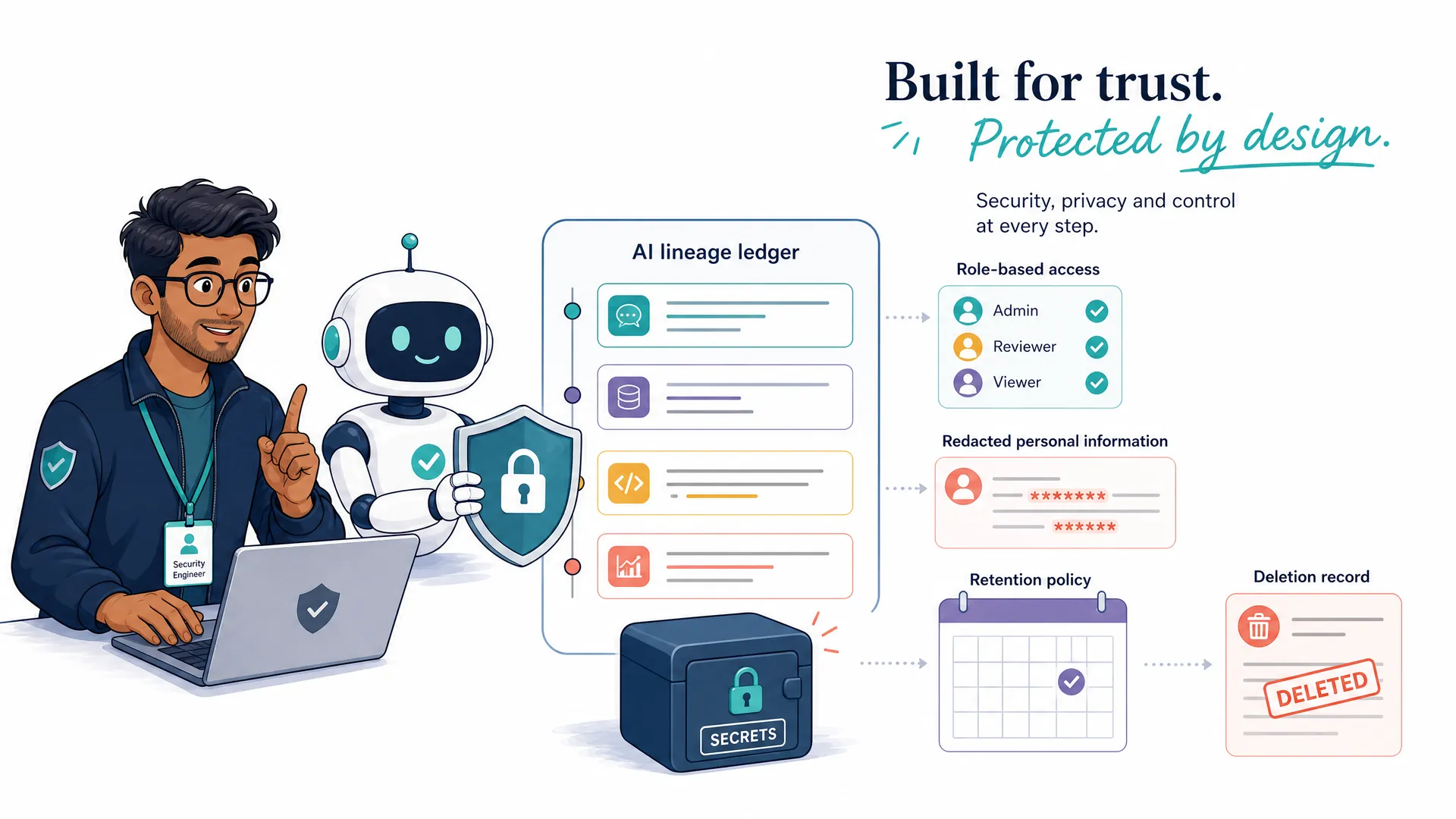
Traceability can expose sensitive information if records are copied without restraint. Limit access by role. A support adviser may need the source title and passage link. An engineer investigating retrieval may need technical identifiers. A privacy lead may need to inspect retention and deletion behaviour. These needs do not require identical access.
Separate evidence from secrets. Never place API keys, passwords, session tokens, or private credentials in a lineage record. Mask personal data when the identity is not relevant to the investigation. Define how long prompts, outputs, source excerpts, and audit events remain available.
Test permissions as part of lineage testing. Ask whether a user can retrieve an identifier belonging to another customer, view a restricted policy, or infer private content from a supposedly harmless citation. A visible source link does not make a source suitable for every reader.
The record should also show deletion events. If a source is withdrawn, the team needs to know whether it disappeared from the live index, remained in a cache, persisted in a backup, or continued to appear in evaluation data. Deletion without evidence can be as difficult to investigate as retention without limits.
Use lineage when an answer goes wrong
When a customer receives an incorrect reply, begin with the output identifier instead of searching the whole system. Follow its source revisions, retrieved passages, prompt version, model, reviewer action, and dispatch event. This narrows investigation and reduces the risk of changing an unrelated component.
Classify the fault before choosing a correction. The source may have been wrong. The correct revision may not have reached the index. The parser may have removed a qualification. Retrieval may have selected a weaker passage. The prompt may have hidden a contradiction. The model may have invented a bridge between two facts. A reviewer may have approved a draft without checking its evidence.
Record the finding as a chain, not a vague label such as “AI error”. State the first broken link, the impact, the containment action, and the permanent correction. If the response was sent, note whether a customer correction is required. If the fault involved restricted data, use the incident process and limit further distribution of the evidence.
A good lineage system supports learning. After correcting the source or workflow, add a regression case that would have caught the failure. Link the case to the relevant component and review it after future changes.
Build a small lineage system in stages
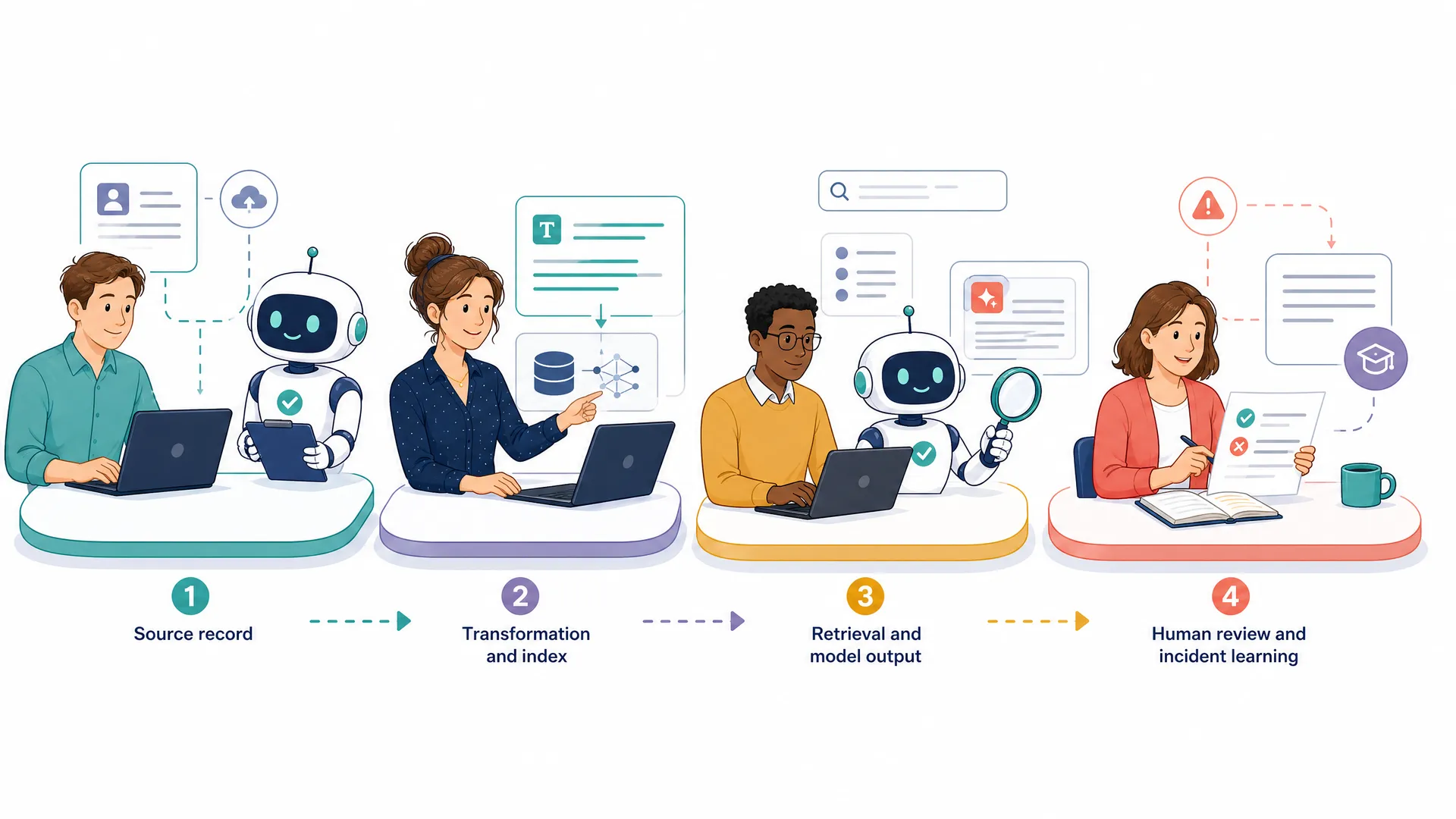
Stage one can cover source IDs, revisions, ingestion timestamps, and owner information. Stage two can add chunk identifiers, index versions, and retrieval records. Stage three can connect prompt and model versions to outputs. Stage four can add reviewer decisions, incident links, retention events, and dashboards.
Choose identifiers before choosing a dashboard. A polished chart cannot repair missing relationships. Start with one workflow and make the evidence record easy to inspect in code review or an internal support tool.
Give each field a purpose. If nobody can explain how a field helps answer an investigation question, leave it out of the first version. Review the schema after real incidents and remove records that create exposure without helping a decision.
A practical lineage checklist
Before launch, name the source owner, revision rule, ingestion process, transformation versions, index boundary, retrieval record, prompt template, model, reviewer, and retention period. Before a material change, capture the current lineage snapshot and define the tests that will be repeated.
After launch, sample outputs and verify that the evidence path is real. Review stale sources, missing identifiers, access failures, unsupported answers, and unexplained human edits. When the system is retired, record the final status and the fate of its indexes, caches, logs, backups, and evaluation material.
Lineage is not a promise that every answer is correct. It is a disciplined way to show what happened, expose uncertainty, and make correction possible. NIST’s guidance treats provenance and traceability as part of managing generative-AI risk across the lifecycle [1].
| KEY TAKEAWAY: AI data lineage connects a result to its source, revision, transformation, retrieval event, prompt, model, human decision, and final disposition. Start with one workflow, stable identifiers, and the smallest evidence record that another person can follow. |
|---|
| SAFETY CHECK: Do not place credentials, unnecessary personal data, private customer histories, or unrestricted source text into lineage logs. Restrict access, redact sensitive values, test withdrawn and unauthorised sources, define retention, record deletion, and use human review before consequential outputs are sent or acted upon. |
|---|